white dust from humidifier: White residue near an ultrasonic humidifier is often aerosolized tap-water minerals, not necessarily mold. EPA does not claim health effects of all emitted minerals/microorganisms are fully understood.
Quick Answer: White dust near an ultrasonic or impeller humidifier is often minerals carried into the air with the water mist. As droplets evaporate, mineral residue settles on nearby surfaces. EPA recommends distilled water to limit minerals and notes that demineralization cartridges vary in effectiveness; evaporative models generally do not generate the same visible mineral mist. Clean accumulated scale separately using your model manual.
As an Amazon Associate we earn from qualifying purchases.
By DIY Ideas 4 Home Editorial Team
White mineral residue by the Numbers
Each line below ties a real-world decision to a visible outcome and an explicit limit. Start with the first check that fits the symptom rather than treating the whole list as required repairs.
| Decision point | Owner action | Result to check | Stop or exception |
|---|---|---|---|
| Identify white residue at its source | Check whether an ultrasonic or impeller unit is spraying mineral-containing tap water near the dusty surfaces. | See whether dust appears again after misting. | Do not assume the color identifies mold or excludes microbial contamination. |
| Change water type before changing equipment | Try properly labeled distilled water as the EPA recommends for fewer dissolved minerals. | Compare residue after ordinary use and surface cleaning. | Not every spring or purified bottled water is demineralized. |
| Review any demineralization cartridge | Inspect cartridge compatibility, service condition and model instructions. | Continued white dust can mean insufficient mineral removal. | Do not claim a cartridge removes every mineral or microorganism. |
| Keep water-contact parts clean | Empty and clean the humidifier on the manual schedule and avoid allowing scale to accumulate. | Check for remaining deposits before refilling. | Dust reduction does not replace hygiene or address all uncertain aerosol risks. |
Why tap-water minerals become a powdery deposit
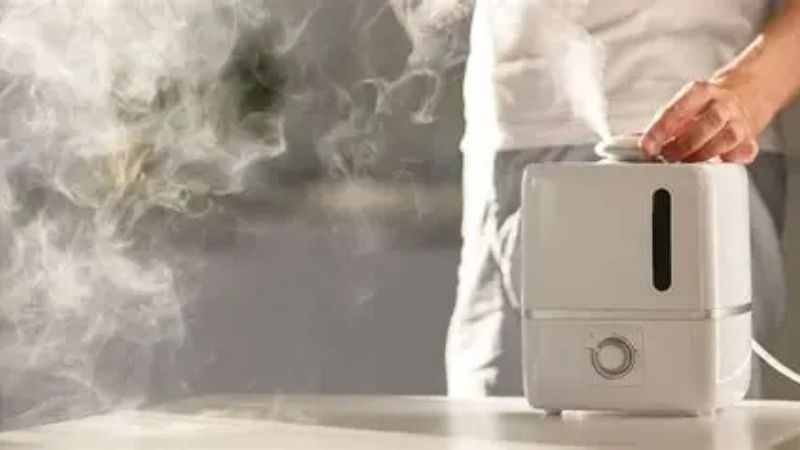
The U.S. EPA reports ultrasonic and impeller humidifiers can disperse minerals from water and create white dust in rooms.
White residue is best understood as a water-and-technology problem, not proof that ordinary household dust has suddenly increased. Ultrasonic and impeller models send small water droplets into the room; when those droplets contain dissolved minerals, a light-colored deposit can remain after the water evaporates. Check whether the marks are concentrated around the humidifier and whether they appear after using mineral-rich water. Dust elsewhere in the home may have other causes, so avoid assuming that every pale particle came from the appliance. This distinction helps readers change the water source before buying cleaning products or replacing an otherwise functioning unit.
Distinguish mineral dust from other deposits
The U.S. EPA explains that potential health effects of dispersing mineral/microbial materials via home humidifiers are not fully understood; do not promise zero risk.
The appearance of a powder does not provide a reliable health assessment. A visible deposit may contain minerals from the water, while aerosolized water can also be affected by the hygienic condition of the tank and reservoir. The EPA notes uncertainty around some potential effects of dispersed minerals and microorganisms, so a ‘harmless white dust’ promise goes beyond the evidence. Use good maintenance, control humidity, and avoid directing mist toward children, furniture, electronics, or a damp wall. If someone experiences symptoms, seek appropriate professional advice rather than trying to diagnose an exposure by inspecting a dusty tabletop.
Use distilled water for ultrasonic/impeller units
The U.S. EPA advises that labeled distilled bottled water typically contains far fewer minerals; distillation is its preferred mineral removal method for minimizing dust.
The water label matters more than the marketing word ‘pure.’ Distilled water is produced to remove most dissolved minerals and is the EPA’s preferred choice for reducing mineral dust in ultrasonic or impeller appliances. Ordinary filtered, bottled, spring, and some purified waters can still contain mineral content depending on the treatment. When switching water, first clean the existing residue from nearby surfaces and maintain the appliance according to its manual; otherwise old dust makes a before-and-after comparison unreliable. A change that reduces new deposits supports the mineral explanation, but it does not show that routine humidifier cleaning is no longer necessary.
How to Interpret the Evidence
Ultrasonic oscillation disperses microscopic water droplets which can transport dissolved solids; water evaporates, leaving mineral residue.
Evaporative wick methods evaporate water from a porous medium; mineral load often accumulates in the wick/reservoir instead of entering as visible water-droplet mist.
Adjust for Your Situation
Begin with observable conditions and proceed only through permitted user controls. A safety alarm, damaged part, live connection or inaccessible component ends the do-it-yourself path.
Step 1: identify white residue at its source
Check whether an ultrasonic or impeller unit is spraying mineral-containing tap water near the dusty surfaces. See whether dust appears again after misting.
Do not assume the color identifies mold or excludes microbial contamination.
Honeywell explains ultrasonic mist carries dissolved minerals which remain on surfaces after moisture evaporates; amount varies by hardness.
To check your own setup, note which room surfaces develop the powder, the humidifier type, and the kind of water being used. Change only the water source for a normal period of use and compare fresh deposits after surfaces have been cleaned. Keep the room’s relative humidity within appropriate limits, especially when windows begin to collect moisture. Do not add fragrance, oils, or unapproved chemicals to ‘bind’ minerals in the tank. Those additives may be prohibited by the manufacturer and can create a new airborne-exposure issue without solving the original dissolved-solids problem.
Step 2: change water type before changing equipment
Try properly labeled distilled water as the EPA recommends for fewer dissolved minerals. Compare residue after ordinary use and surface cleaning.
Not every spring or purified bottled water is demineralized.
EPA notes purified bottled water can use different processes, and spring/artesian/mineral bottled waters are not necessarily demineralized.
A demineralization cartridge may be helpful only within the limits the manufacturer states for that specific model and water quality. Check the fit, replacement instructions, and any indication that the cartridge is exhausted. A cartridge should not be described as proof that all minerals or microbes have been removed. If white dust continues despite compliant maintenance and lower-mineral water, review the machine’s technology and the location of the mist rather than layering on unsupported water treatments. An evaporative wick humidifier works differently and may avoid the same aerosolized mineral pattern, although it still needs safe wick handling and tank care.
Step 3: review any demineralization cartridge
Inspect cartridge compatibility, service condition and model instructions. Continued white dust can mean insufficient mineral removal.
Do not claim a cartridge removes every mineral or microorganism.
The U.S. EPA advises that demineralization cartridge/filter effectiveness and useful service life can vary; white dust indicates incomplete mineral removal.
Step 4: keep water-contact parts clean
Empty and clean the humidifier on the manual schedule and avoid allowing scale to accumulate. Check for remaining deposits before refilling.
Dust reduction does not replace hygiene or address all uncertain aerosol risks.
The U.S. EPA advises that mineral scale can build up in tanks and can support microbial growth; cleaning with correct maintenance remains necessary.
Products That Help
Useful supplies for the specific checks above can include Levoit Classic 300S humidifier and distilled water for humidifiers. Confirm the exact size, device compatibility and applicable maintenance instructions first. Equipment and tools do not remove the need to stop for a safety fault.
Frequently Asked Questions
The answers below separate normal operation, owner-accessible checks and conditions that require manufacturer support or professional service.
Is white dust from a humidifier harmful?
It is often mineral residue, but the EPA says potential effects of airborne mineral and microbial materials from humidifiers are not completely understood. Reduce emissions and maintain the unit.
Will filtered or purified water prevent white dust?
Not necessarily. Purified and spring waters may contain minerals; EPA identifies distilled water as a lower-mineral choice for limiting white dust.
Does an evaporative humidifier leave white dust?
Evaporative wick models generally emit invisible vapor rather than aerosolizing tap-water droplets in the same way, although they still require cleaning and wick care.
How often should I clean mineral buildup in my humidifier?
Follow the manufacturer and EPA maintenance schedule; EPA calls for cleaning a portable humidifier every third day and fresh water daily.
Final Thoughts
Check whether an ultrasonic or impeller unit is spraying mineral-containing tap water near the dusty surfaces. Dust reduction does not replace hygiene or address all uncertain aerosol risks.