Key takeaways
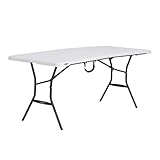
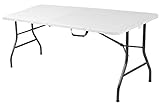
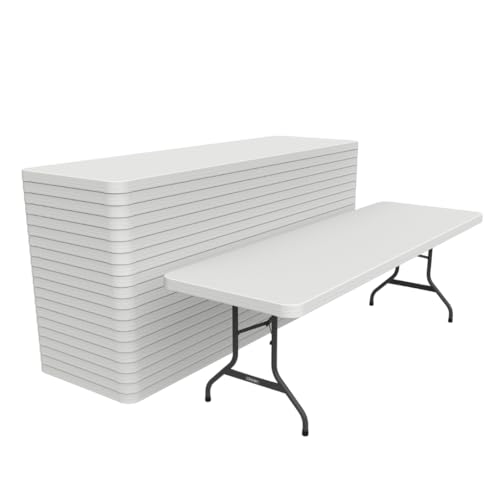
- Plastic blow-molded (e.g., Lifetime, Cosco style): 96″ L x 30″ W x 29″ H, folds in half to 48″ x 30″ x 3.5″
- Narrow 8-foot banquet table: 96″ L x 18″ W x 29″ H – designed to line walls for buffets, not for seating on both sides
- Plywood edge-folding: 96″ L x 30″ W x 29-30″ H, legs fold under but top does not fold in half, so it stores at full length
An 8 foot folding table seats 8 adults comfortably (4 per side) and can seat 10 if you add one person at each end, but you need at least 11.5 feet of room length and 7.5 feet of width to use it without crowding.
Our top picks

As an Amazon Associate we earn from qualifying purchases at no extra cost to you. Ratings are shown as listed on Amazon.
8 Foot Folding Table Dimensions Explained
The standard 8-foot folding table measures 96 inches long x 30 inches wide x 29 inches high. Most models are 29 inches high at the tabletop, which matches standard dining height (28 to 30 inches) and pairs with 18-inch seat-height folding chairs. Thickness of the top is typically 1.75 to 2 inches for blow-molded plastic tops and about 0.75 inches for plywood or MDF tops with edge banding.
There are small variations by type:
- Plastic blow-molded (e.g., Lifetime, Cosco style): 96″ L x 30″ W x 29″ H, folds in half to 48″ x 30″ x 3.5″
- Narrow 8-foot banquet table: 96″ L x 18″ W x 29″ H – designed to line walls for buffets, not for seating on both sides
- Plywood edge-folding: 96″ L x 30″ W x 29-30″ H, legs fold under but top does not fold in half, so it stores at full length
Boxed weight is usually 45 to 55 lbs for a single plastic folding table and 35 to 50 lbs for a plywood table. Folded-in-half models fit through any standard 30-inch interior doorway, while non-folding-top plywood tables need a 32-inch doorway and a clear 8-foot hallway to move without tilting.
How Many People Fit on an 8 Foot Table?
Seating capacity depends on chair width and how much elbow room you allow. A standard folding chair is 17 to 18 inches wide at the seat, but adults need 24 to 30 inches of table edge each to eat comfortably.
| Seating Layout | Placement | Space Per Person | Comfort Level |
|---|---|---|---|
| 6 people | 3 per side, ends empty | 32 inches | Very spacious, best for work, crafts, or large plates |
| 8 people | 4 per side, ends empty | 24 inches | Standard comfortable dining – the ideal setup |
| 8 people (ends used) | 3 per side + 1 at each end | 24 inches on sides, 30 inches on ends | Comfortable if ends have clearance from wall |
| 10 people | 4 per side + 1 at each end | 24 inches on sides, 30 inches on ends | Tight but workable with narrow 17-inch chairs |
For events with place settings, serving dishes, or laptops, stick to 6 to 8 people. For 10 people, use chairs without armrests and avoid bulky chair backs. If you plan to seat 10 regularly for family dinners, two 6-foot tables pushed end-to-end often feel less crowded because the seam creates a natural break and legs are less in the way.
How Much Clearance and Room Size Do You Need?
A table alone is not the full footprint. You need space for chairs to slide back and for people to walk behind seated guests.
- Chair slide-out: Allow 18 to 24 inches from table edge to wall or other furniture for a person to push back and stand
- Pass-through behind a seated person: Allow 36 to 48 inches if you need a walkway while others are seated
- Serving or standing space at the ends: Allow 24 inches minimum if no one sits at the ends
That means the total floor space needed for an 8-foot table with seating on both sides is:
Minimum footprint with 8 chairs: 96″ table length + 48″ (24″ clearance x 2 ends) = 144″ (12 ft) long x 30″ table width + 48″ (24″ x 2 sides) = 78″ (6.5 ft) wide. For a walkway on one side, expand width to 90″ (7.5 ft).
| Room Size | Fits 8 Foot Table? | Best Layout | Notes |
|---|---|---|---|
| 10 x 10 ft | No – too tight | Use 6 ft table instead | Only 12 inches of clearance per side, chairs hit walls |
| 10 x 12 ft | Tight, 6-8 people max | Table centered lengthwise, ends 12″ from walls | No walkway when seated, OK for dining only |
| 12 x 14 ft | Yes, 8 people comfortably | 24″ clearance all around | Allows chairs to slide and one pass-through aisle |
| 14 x 18 ft or larger | Yes, 10 people comfortably | 36″+ clearance on serving side | Enough for buffet line or walkway behind chairs |
If your room is under 12 feet long, measure door swing and baseboard heaters too. A common mistake is placing the 96-inch table against a 10-foot wall and forgetting that folded chairs stored behind it add another 12 to 15 inches.
When to Choose an 8 Foot Table vs. a 6 Foot Table
A 6-foot table is 72″ L x 30″ W x 29″ H and seats 6 comfortably (3 per side) or 8 squeezed (including ends). It fits in a 10 x 10 ft room and is lighter to carry at 30 to 40 lbs. Choose based on your situation, not just guest count.
| Your Situation | Choose 8 Foot If… | Choose 6 Foot If… |
|---|---|---|
| Small apartment or spare bedroom | You have a 12+ ft wall and storage for a 48″ folded table | Room is under 11 ft long, or you must store it in a closet |
| Hosting holidays 3+ times a year | You regularly host 8-10 and want one seamless surface | You host 4-6 and can add a card table for extra guests |
| Kids, crafts, and homework | You need a continuous 8 ft work surface for projects | You need to reconfigure often; 6 ft is easier for one person to set up |
| Renter who moves often | You have an SUV or truck; folded size is still 48″ long | You move via sedan or stairs; 6 ft folded is 36″ and 10 lbs lighter |
| Need buffet or display line | You want one long line against a wall | You want an L-shape; two 6 ft tables make a corner easier |
| Back pain or limited strength | You have help lifting 45+ lbs and bending to latch legs | You set up alone; lighter weight and lower leverage needed |
Rule of thumb: If you will use the table weekly for dining and your room is at least 12 feet long, the 8-foot is more versatile. If you use it monthly and store it in between, the 6-foot gets used more because it is easier to move and fits more spaces.
Material and Construction: What Holds Up Best?
Most 8-foot folding tables look similar but the top material changes weight capacity, feel, and how it ages.
| Material | Typical Weight Limit | Pros | Cons | Price Range in 2026 |
|---|---|---|---|---|
| Blow-molded HDPE plastic with steel frame | Usually 300-500 lbs distributed | Waterproof, won’t stain, indoor/outdoor use, light wipe clean | Hollow feel, can bow slightly under heavy center load, heat can warp if left in sun | Usually $80 – $180 |
| Plywood with vinyl edge | Usually 400-700 lbs distributed | Solid, flat for writing/crafts, can be refinished | Heavier, vulnerable to water rings and chipping, not for outdoor storage | Usually $120 – $250 |
| MDF with laminate | Usually 200-350 lbs distributed | Smooth, looks more like furniture | Swells if it gets wet, chips on edges, lowest durability | Usually $70 – $140 |
| Aluminum frame with plastic top | Usually 250-400 lbs distributed | Lightest to carry, rust-resistant | More flex, legs dent easily | Usually $100 – $200 |
Weight limits are for evenly distributed static load, not a person sitting or standing on the table. Sagging usually starts near the center hinge on fold-in-half models. If you plan to use it as a sewing or workshop table with a heavy machine in the middle, plywood with a center leg support is the sturdiest option.
Assembly, Moving, and What Wears Out First
Most blow-molded 8-foot tables arrive fully assembled – you just unfold the legs until they lock. Plywood tables may need you to bolt on the leg sliders, which takes about 10 minutes with a wrench.
Before buying, measure three things you might not expect: the folded thickness (3.5 to 4 inches) for closet storage, the stairwell width if you live upstairs, and whether your car can take 48 inches of folded length. A folded-in-half 8-foot table fits across the back seat of most sedans but not in a compact trunk.
What wears first is rarely the top. It is the leg lock mechanism and the hinge pins. To extend life, latch and unlatch legs on a flat floor rather than letting them snap, avoid dragging the table on its legs, and store it dry. Plastic tops clean with mild soap and water; abrasive cleaners dull the texture and make future stains harder to remove. For plywood, use coasters and wipe spills quickly to protect the edge seam.
Choosing the Right Setup For Your Space
Match table width to your use. The 30-inch width is best for dining because plates, glasses, and a center serving dish need that depth. The 18-inch narrow 8-foot is better as a wall buffet, entry table, or behind a sofa. If you are tight on space but need 8-foot seating occasionally, consider two 4-foot tables (48″ x 30″ each) that push together for 96 inches when needed and split into smaller tables otherwise. They cost more in total but are far easier to store and carry solo.