Key takeaways
- Leg locking rings and gravity locks: They get loose if tables are slammed open. Lift, don’t drop, the legs into place and they will hold for a decade.
- Edge seams on fold-in-half models: The center hinge is steel-reinforced, but crumbs and glue can collect in the seam. It’s not a structural weakness, but it can create a slight 1-2mm ridge in the middle.
- Feet and floor glides: Hard plastic feet will slide on smooth floors. Add stick-on felt pads if you use the table on hardwood or luxury vinyl.
- Powder coat on leg bottoms: Dragging the table across concrete chips the coating. Carry it — at 18 to 45 lbs, all Lifetime models can be carried by one adult.
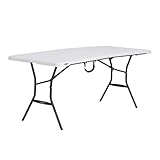
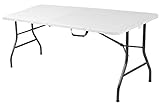
For most homes, the Lifetime 6-foot fold-in-half table is the best overall value because it seats 6 adults comfortably, supports up to 1,000 lbs distributed weight, and costs usually $70–$120, while the 4-foot model is better for tight spaces and the 8-foot model only makes sense if you regularly need to seat 8 to 10 people.
Our top picks


As an Amazon Associate we earn from qualifying purchases at no extra cost to you. Ratings are shown as listed on Amazon.
Lifetime Folding Tables Compared: Key Models at a Glance
Lifetime doesn’t make dozens of different folding tables — the core lineup is three sizes built on the same blow-molded high-density polyethylene (HDPE) top and powder-coated steel frame system. The differences are length, leg design, and whether the top folds in half for storage.
| Model Type | Top Size (L x W) | Height Settings | Folded Size | Weight | Weight Capacity (Evenly Distributed) | Typical Price Range |
|---|---|---|---|---|---|---|
| Lifetime 4-Foot Fold-in-Half Adjustable (4428) | 48″ x 24″ | 3 heights: 22″, 29″, 36″ (table, dining, counter) | 24″ x 24″ x 3.5″ | ~18 lbs | ~500 lbs | usually $55–$85 |
| Lifetime 6-Foot Fold-in-Half (80160 / 280094) | 72″ x 30″ | 1 height: 29″ | 36″ x 30″ x 3.5″ | ~33 lbs | ~1,000 lbs | usually $70–$120 |
| Lifetime 8-Foot Fold-in-Half (80425 / 44228) | 96″ x 30″ | 1 height: 29″ | 48″ x 30″ x 3.5″ | ~45 lbs | ~1,000 lbs | usually $100–$160 |
| Lifetime 6-Foot Non-Folding / Commercial | 72″ x 30″ | 1 height: 29″ | 72″ x 30″ x 2″ | ~26 lbs | ~1,500 lbs | usually $90–$140 |
All four use the same Lifetime 10-year limited warranty for residential use. Commercial or non-fold-in-half versions sometimes carry a separate commercial warranty period, but the residential warranty is the longest in this category — most competitors offer 1 to 5 years.
Frame and Tabletop Materials: What You Actually Get
The reason Lifetime tables last longer than cheap banquet tables is not the steel gauge alone, it’s the combination of a blow-molded HDPE top and a fully powder-coated frame. Here’s how that construction trades off against other common materials:
| Material / Construction | Pros | Cons | Best For |
|---|---|---|---|
| HDPE Blow-Molded Top (Lifetime standard) | Waterproof, stain-resistant, dent-resistant, UV-protected, never needs refinishing, light for its strength | Can warp if left in extreme heat (over 130°F in a closed shed/trailer), surface can feel like plastic, not repairable if deeply gouged | Crafting, kids’ activities, outdoor parties, garage use |
| Plywood with Laminate / Vinyl Edge | Looks more like real furniture, stiffer feel under elbows | Swells and delaminates if water gets under the edge banding, heavier, requires dry storage | Indoor-only meetings where appearance matters |
| MDF with Thermofoil | Very smooth surface, inexpensive | Weakest moisture resistance, sags under heavy load over time, short lifespan in humid spaces | Temporary or very light-use folding tables |
| Powder-Coated Steel Frame (Lifetime) | High load capacity, rust-resistant, legs lock securely with gravity locks | Heavier than aluminum, powder coat can chip if dragged on concrete | Regular setup / takedown, uneven floors |
| Bare Steel or Aluminum Frame | Aluminum is lightest to carry | Bare steel rusts quickly; aluminum dents and costs more for same capacity | Ultra-light transport where weight matters more than capacity |
Lifetime’s HDPE is textured to resist scratching and has a honeycomb-tacked interior that prevents the hollow “oil canning” flex you get on thin plastic tops. The steel tubing is 18 to 20 gauge with a cross-brace under the 6-foot and 8-foot models. That bracing is why the 6-foot and 8-foot tables rate to 1,000 lbs while the 4-foot adjustable model rates lower — the adjustable leg mechanism has more pivot points and less triangulation.
Durability Realities: What Wears First
Lifetime tables rarely fail at the tabletop. The first wear points after years of use are:
- Leg locking rings and gravity locks: They get loose if tables are slammed open. Lift, don’t drop, the legs into place and they will hold for a decade.
- Edge seams on fold-in-half models: The center hinge is steel-reinforced, but crumbs and glue can collect in the seam. It’s not a structural weakness, but it can create a slight 1-2mm ridge in the middle.
- Feet and floor glides: Hard plastic feet will slide on smooth floors. Add stick-on felt pads if you use the table on hardwood or luxury vinyl.
- Powder coat on leg bottoms: Dragging the table across concrete chips the coating. Carry it — at 18 to 45 lbs, all Lifetime models can be carried by one adult.
Heat is the only real killer for HDPE. Don’t store a folded table flat in a hot attic or closed metal shed in summer where surface temperatures can exceed 140°F. Standing it on edge against a wall allows heat to dissipate and prevents warping.
Size, Height and Room Fit: Real Measurements That Matter
Choosing by length without planning clearance is how a table ends up blocking doorways. Use these numbers before you buy:
- Seated clearance: Allow 18–24 inches for a chair to slide back. A 6-foot (72″) table with chairs on both long sides needs a room at least 78–84 inches wide (30″ table + 24″ per side).
- End clearance: Leave 36–42 inches at the ends if people need to walk behind seated guests. In a 10×12 ft (120″ x 144″) room, an 8-foot (96″) table leaves only 24″ on each end — too tight for traffic. A 6-foot table leaves 36″ per end in the same room, which works.
- Seating capacity by size: 4-foot = 2–4 people (2 comfortably with elbow room, 4 squeezed shoulder-to-shoulder), 6-foot = 4–6 people (6 is comfortable), 8-foot = 6–8 people (8 comfortable, 10 if you use the ends).
- Height check: Standard 29″ dining height fits 18″ seat-height folding chairs. The 4-foot adjustable model’s 36″ counter height pairs with 24–26″ stools for standing crafts or buffet serving. Its 22″ height is ideal for kids (pairs with 10–12″ seat height) or as a low activity table.
- Doorway and storage: A fold-in-half 6-foot table at 36″ x 30″ fits through any interior 28–30″ doorway while folded. A non-folding 6-foot or 8-foot one-piece top will not turn easily in tight hallways or small apartment closets. If your storage closet is less than 48″ deep, choose fold-in-half.
Box weight and moving are also practical: The 4-foot model ships at about 20 lbs boxed and is easy for one person to carry up stairs. The 8-foot model ships at 50+ lbs boxed and is awkward for one person despite handles — plan for two people to move it if stairs are involved.
Decision Matrix: Which Lifetime Table Should You Buy?
Match your situation to the right size, not just the biggest table your budget allows:
| Your Situation | Best Pick | Why |
|---|---|---|
| Small apartment, craft room, or home office (under 100 sq ft) | 4-Foot Adjustable | Smallest footprint, three heights replace a separate kid table and counter, stores as 24″ square |
| Family with kids and pets, indoor/outdoor use | 6-Foot Fold-in-Half | Waterproof top wipes clean, handles spills and paint, 33 lbs is light enough to move outside |
| Hosting holidays or large gatherings (8+ regularly) | 8-Foot Fold-in-Half | Seats 8 without adding a second table, but only if your room is at least 10×12 ft |
| Renter who moves often or has limited closet storage | 4-Foot or 6-Foot Fold-in-Half | Folds to half-length to fit in closets and car trunks; non-folding models don’t |
| Garage workshop, vending, or heavy-duty use (tools, coolers, sewing machines) | 6-Foot Non-Folding Commercial | Higher 1,500 lb capacity and no center seam means a perfectly flat work surface |
| Need a buffet / serving station for parties | 4-Foot Adjustable at 36″ height | Counter height lets guests serve without bending; pair with a 6-foot dining table |
Value Compared: Where the Money Goes
Price differences between Lifetime models are driven almost entirely by steel and size, not quality tier — the HDPE and powder coat are the same across the line. That makes the value calculation simple:
- Best dollar-per-seat: The 6-foot fold-in-half, usually $70–$120 for 6 seats = $12–$20 per seat. The 8-foot costs more per seat if you don’t fill it.
- Best for versatility-per-dollar: The 4-foot adjustable, usually $55–$85, because it replaces three separate tables (kids, dining, counter). If you would otherwise buy a small kids table plus a folding table, this single purchase saves space and money.
- Best for absolute stability: The non-folding commercial 6-foot, usually $90–$140. You pay slightly more and lose compact storage, but you gain the highest capacity and a seamless top with no center line for puzzles, cutting, or projects.
If you only buy one Lifetime table for general home use and have at least 6 feet of wall or floor space to use it, the 6-foot fold-in-half remains the safe choice. Buy the 4-foot adjustable as a second table if you need a kids table, plant table, or buffet — they pair well together in an L-shape. Only choose the 8-foot if you have measured your room and confirmed 36 inches of walk-around space at the ends; otherwise two 6-foot tables pushed together are more flexible than one 8-foot table.
Care and Setup Tips That Extend Life
No assembly is required beyond unfolding — legs lock automatically. Wipe the HDPE with mild soap and water; avoid abrasive cleaners that dull the texture. For outdoor use, the tables are rated for UV exposure, but storing them out of direct sun when not in use keeps the color from fading over several years. If the center seam on a fold-in-half model feels sticky after a messy craft project, a soft brush along the hinge clears debris that prevents a flush close.
Frequently Asked Questions
Can Lifetime folding tables be left outside year-round? They are weather-resistant and will not rust or delaminate like wood, but prolonged standing water in the leg tubes and extreme heat can shorten their life. Store folded on edge under a cover when not in use for weeks.
Do Lifetime tables wobble on uneven floors? The steel frames have independent leg braces, but no built-in levelers. On uneven patios or garage floors, a single shim under one foot solves wobble. All four feet should contact the floor before loading.
Is the center seam on fold-in-half models noticeable when eating or working? You can feel a faint line with your hand, but plates, laptops, and paper stay flat across it. For jobs that need a perfectly flat surface like fabric cutting or puzzles, choose the non-folding commercial version.