Key takeaways
- Solid wood: Made from single boards or edge-glued planks of species like acacia, rubberwood, teak, or pine. Grain runs continuously, joints are glued and often reinforced with dowels or mortise and tenon. Usually finished with lacquer, oil, or hardwax.
- Plywood: Made from 7-13 thin veneer layers cross-laminated and pressed with adhesive, then faced with a hardwood veneer (oak, walnut, ash) and sealed. Edges are often banded with solid wood or veneer tape.
- Engineered wood (MDF / particleboard): Made from wood fibers or chips compressed with resin and covered with laminate, melamine, or printed vinyl wrap. The core is uniform but not water-resistant. Common for budget folding tables and folding desk carts.
A wooden folding table in solid wood is the most durable and repairable long-term choice, plywood offers the best balance of stability, weight and price for most homes, and engineered wood (MDF/particleboard) is the lightest on budget but the least resistant to moisture and heavy use.
Our top picks

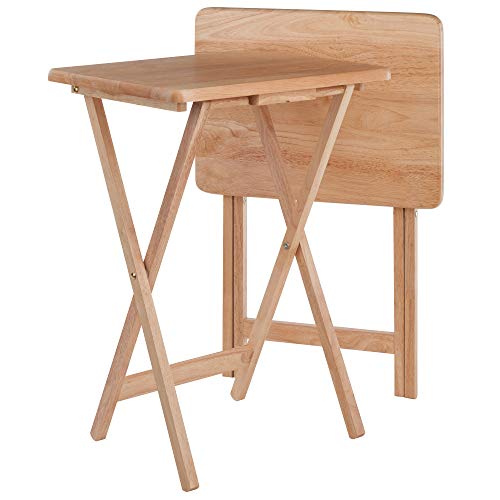
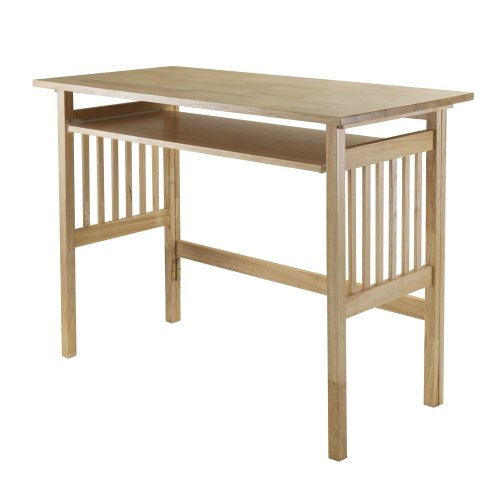
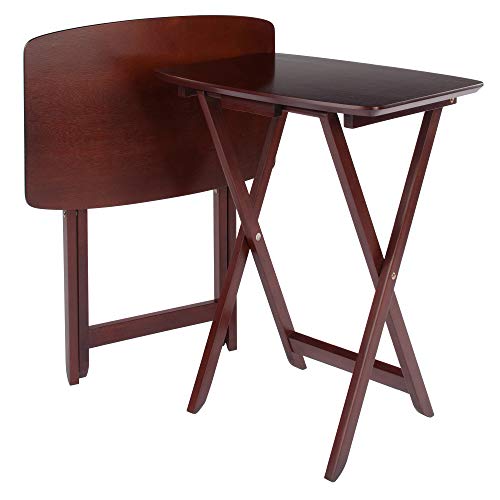
As an Amazon Associate we earn from qualifying purchases at no extra cost to you. Ratings are shown as listed on Amazon.
Solid Wood vs Plywood vs Engineered Wood: What You’re Actually Buying
All three are sold as “wooden folding tables” in 2026, but their construction is completely different. Understanding the core makes it easier to predict how the table will age, fold, and hold weight.
- Solid wood: Made from single boards or edge-glued planks of species like acacia, rubberwood, teak, or pine. Grain runs continuously, joints are glued and often reinforced with dowels or mortise and tenon. Usually finished with lacquer, oil, or hardwax.
- Plywood: Made from 7-13 thin veneer layers cross-laminated and pressed with adhesive, then faced with a hardwood veneer (oak, walnut, ash) and sealed. Edges are often banded with solid wood or veneer tape.
- Engineered wood (MDF / particleboard): Made from wood fibers or chips compressed with resin and covered with laminate, melamine, or printed vinyl wrap. The core is uniform but not water-resistant. Common for budget folding tables and folding desk carts.
Head-to-Head Comparison
| Feature | Solid Wood | Plywood (Veneered) | Engineered Wood (MDF/Particleboard) |
|---|---|---|---|
| Typical Weight (48″ x 30″ rectangle) | 28-42 lbs | 22-32 lbs | 24-36 lbs (denser core, but thinner top) |
| Weight Capacity (evenly distributed) | 100-150 lbs | 80-120 lbs | 50-80 lbs |
| Moisture & Warp Resistance | Low to moderate – can expand/contract with humidity | High – cross-grain layers resist warping | Low – swells permanently if water enters seams |
| Surface Hardness | High (especially acacia, oak, teak) | Moderate to high (depends on face veneer) | Low to moderate (laminate scratches less, but chips) |
| Repairability | Excellent – can sand, refinish, re-oil | Good – light sand and refinish, cannot sand deeply | Poor – laminate cannot be sanded, swollen board cannot be fixed |
| Fold Mechanism Stress | Hinges must be heavy-duty; wood can split if screws loosen | Holds screws well; stable around hinge plates | Screws strip easily over time, especially at leg mounts |
| Expected Lifespan (regular home use) | 10-20+ years | 7-12 years | 3-6 years |
| Price Range in 2026 (new) | usually $180–$450 | usually $120–$300 | usually $70–$180 |
Durability in Real Use
Solid wood wins for strength and impact resistance, but it moves. A solid pine or rubberwood top can expand up to 1/8 inch across a 30-inch width between dry winter and humid summer if unfinished underneath. That movement is why quality solid wood folding tables have elongated screw holes under the top and a sealed underside. Plywood barely moves, which is why it stays flat and keeps folding joints aligned after years in apartments with uneven heating and cooling.
Engineered wood is dimensionally stable until it gets wet. A single spill that sits at the edge banding or around the hinge cutout can cause MDF to swell and flake within 24-48 hours. Once swollen, it does not return to shape.
Finish and Appearance
Solid wood shows natural grain variation, knots, and color shifts. Oiled finishes feel warmer and can be spot-repaired with oil, but need re-oiling every 6-12 months. Lacquered solid wood is more wipe-proof but will show white rings if hot mugs sit directly on it.
Plywood with a hardwood veneer looks nearly identical to solid wood from the top, often with a more uniform grain because the veneer is sliced. Most plywood folding tables in 2026 come with a catalyzed lacquer or water-based polyurethane that resists stains better than oil. The giveaway is the edge: look for a thin seam where the edge banding meets the face veneer.
Engineered wood relies on a printed laminate. It can mimic oak or walnut well in photos, but up close the repeating pattern and plastic feel are visible. Laminate is the most stain-resistant initially, yet it cannot be refinished and will chip if the table is folded and bumped against a door frame.
Weight and Portability
Weight matters more for a folding table than a fixed one. Solid wood is the heaviest per square foot. A 48 x 24 inch solid acacia folding console at 35 lbs is sturdy when open but awkward to carry up stairs or hang on a wall mount. Plywood is 15-25% lighter for the same size, which makes it noticeably easier to fold, carry, and store in a closet.
If you plan to move the table daily — for dining, crafting, or a work-from-home setup — plywood is usually the sweet spot. For a table that stays open most of the time and folds only for guests, the extra weight of solid wood adds stability.
Fit, Height and Clearance: Will It Work in Your Space?
Folding tables are bought for small spaces, so measure before you buy. Use these 2026 standard reference numbers:
- Table height: Standard folding tables are 29-30 inches high. Counter-height folding tables are 34-36 inches. Desk-height for writing or laptop use is more comfortable at 28-29 inches if you are under 5’6″.
- Clearance for chairs: Leave 32-36 inches from the table edge to the wall behind a chair so someone can push back and stand. For walkways where people pass behind seated guests, leave 42-48 inches.
- Seating width: Allow 24 inches of table width per person and 18-20 inches of depth for a place setting. A 48-inch rectangular folding table seats 4 tightly, 2-3 comfortably. A 60-inch seats 4-6.
- Room-size fit: In a 10×12 ft room, a 48 x 30 inch table with four chairs needs a footprint of about 9 x 5.5 ft when in use. That leaves enough clearance on the long sides but blocks flow if the room has two doors. In that case, choose a 36-inch round or 48 x 24 inch narrow rectangle that folds to 2-3 inches thick for storage.
- Storage profile: Most wooden folding tables fold to 2.5-4 inches thick. A 48-inch table stored vertically needs a closet depth of at least 31 inches and a height clearance of 50 inches with legs folded.
- Doorway and elevator: Even folded, a 72-inch banquet-style wooden folding table will not turn through a 28-inch apartment doorway. Measure your narrowest doorway and hallway corner.
Assembly, Moving and What Wears Out First
Most wooden folding tables ship fully assembled or with legs pre-attached; you only unfold and lock them. Flat-pack engineered wood models may require attaching leg braces with 8-12 screws and an Allen key. Expect a box weight of 30-45 lbs for solid wood and 25-35 lbs for plywood in the 48-inch size. One person can manage it, but two people are safer for carrying up stairs.
What fails first is rarely the top — it is the folding hardware. Check for:
- Steel locking rings or slide locks vs thin wire latches. Steel rings hold better under lateral load.
- Hinge plates with 6-8 screws spread over 4-5 inches, not 3-4 screws clustered tightly.
- Plastic feet or leg caps to prevent floor scratches and reduce wobble on uneven floors.
- Cross-bracing or a stretcher bar between legs on tables longer than 48 inches; without it, the table will rack side to side.
For renters, consider floor protection: solid wood legs with no caps can dent vinyl and LVP flooring when dragged. Add felt pads rated for at least 20 lbs per leg.
Maintenance by Material
- Solid wood: Dust with a dry cloth, clean with a damp (not wet) cloth and mild soap. Re-oil oiled tops every 6-12 months. Use coasters and avoid placing within 2 ft of a radiator or heat vent, which accelerates cracking. Light dents can be steamed and sanded. Scratches can be spot-sanded with 220-grit and refinished.
- Plywood: Same daily cleaning, but avoid over-wetting the edge banding. Do not sand through the veneer — it is typically only 0.5-1.0 mm thick. Use furniture touch-up markers for edge nicks. Keep humidity between 35-55% to protect the veneer glue line.
- Engineered wood: Wipe spills immediately, especially at seams and screw holes. Never use abrasive cleaners. If laminate lifts at the edge, seal it quickly with wood glue and clamp to prevent moisture entry. Do not place heavy pots or sewing machines near the center without support — MDF sags permanently under sustained load above 40-50 lbs in the middle.
Decision Matrix: Which Should You Choose?
| Your Situation | Best Pick | Why |
|---|---|---|
| Small apartment, folding daily for work and dining | Plywood | Lighter to carry, stays flat in changing humidity, durable enough for laptops and meals |
| Need a heirloom table for regular hosting and want to refinish later | Solid wood (rubberwood, acacia, teak) | Highest weight limit and repairability, ages better |
| Kids and pets, frequent spills and bumps | Plywood with lacquered finish | More water-resistant than MDF, harder than soft pine, easy to wipe |
| Renter on a tight budget or need a temporary craft table | Engineered wood | Lowest upfront cost, acceptable for light, occasional use |
| Back pain or need to move table often alone | Plywood, 48 x 24 inch or smaller | Under 28 lbs, easier to lift and fold without straining |
| Outdoor-covered patio or high-humidity home | Solid teak or marine-grade plywood | Natural oils or waterproof adhesive resist moisture better than MDF |
If you are between solid wood and plywood at a similar price, choose based on how you will use it: daily folding and storage favors plywood; long-term stationary use with occasional folding favors solid wood.
What to Check Before You Buy in 2026
- Look underneath: solid wood should show the same grain as the top, plywood shows layered edges (even if banded), MDF shows a uniform brown fiber core at any open hole.
- Ask for the weight limit as tested, not estimated. A 48-inch plywood table rated for 80-100 lbs will handle four place settings and a centerpiece, but not a person sitting on it.
- Confirm folding thickness and whether it locks flat and stands upright on its own when folded.
- Check the finish type. If the listing says “wood grain paper” or “PVC wrap,” it is engineered wood with a print, not veneer.
- For solid wood, ask if both sides of the top are sealed. One-side sealing is a common cause of warping.
FAQ
Is plywood considered real wood?
Yes. Plywood is real wood veneer bonded in layers. It is more stable than solid wood and is not the same as MDF or particleboard, which are fiber-based.
Can I use a wooden folding table as a permanent dining table?
Solid wood and quality plywood can serve as a daily dining table if the leg locks are strong and the table has center support on lengths over 60 inches. Engineered wood is better kept for occasional dining, as the core will sag and joints will loosen faster under daily load.
Which wood species holds up best for folding tables?
For solid wood, acacia, rubberwood, and teak offer the best hardness and moisture resistance in this category. Pine is affordable and light but dents easily. For plywood, the face veneer matters more than the core — oak and ash veneers are harder than poplar or pine veneers.