
Key takeaways
- Tip-over shutoff: turns the heater off if it is knocked from its normal upright position.
- Overheat protection: interrupts operation if internal temperatures become excessive.
- Cooler-touch cabinet design: reduces, but does not eliminate, burn risk.
- Thermostat cycling: prevents unnecessary continuous operation once the target temperature is reached.
- Certified electrical construction: look for recognized safety certification on the product or packaging.
The best DR infrared heaters for efficient warmth are 1,500-watt cabinet models with adjustable thermostats, overheat protection, and a size matched to the room—not necessarily the model advertised for the largest square footage.
DR Infrared Heater’s portable cabinet-style units are designed to add zone heat while you lower the central thermostat. Most comparable models use a 120-volt outlet, draw up to 1,500 watts, combine infrared heating with a fan, and include digital temperature controls, a remote, a timer, and automatic safety shutoffs. Their practical advantage is steady supplemental warmth in occupied rooms; their main limitation is that electric resistance heat costs the same per watt-hour regardless of the brand.
Our top picks
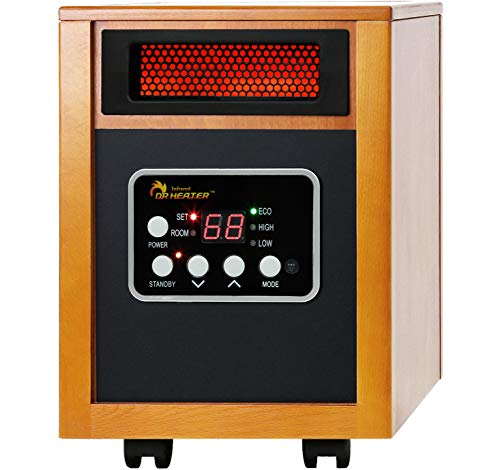

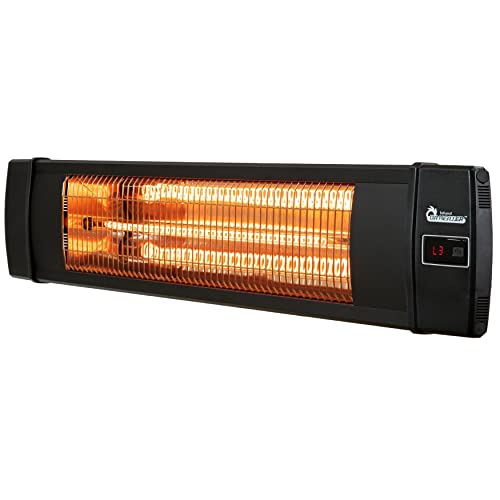
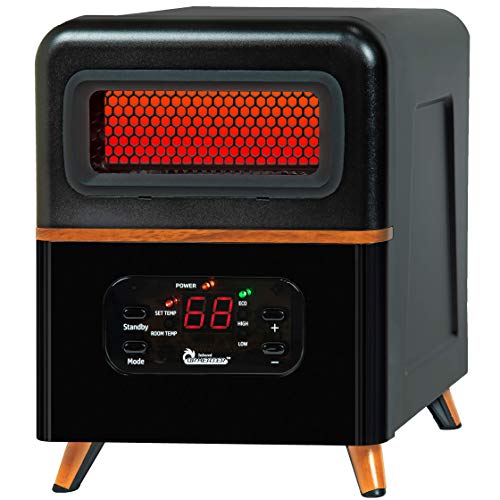
As an Amazon Associate we earn from qualifying purchases at no extra cost to you. Ratings are shown as listed on Amazon.
Best DR Infrared Heater choices by room and situation
| Situation | Recommended type | Useful room size | Why it fits |
|---|---|---|---|
| Small bedroom or studio | Compact 1,500-watt DR cabinet heater | Up to about 120–180 sq. ft. as supplemental heat | Small footprint, timer control, and enough output for a closed room |
| Home office | 1,500-watt model with low/high modes and thermostat | About 100–200 sq. ft. | Maintains a set temperature without running at full output continuously |
| Living room | Larger cabinet model with strong airflow and a remote | About 200–400 sq. ft. as zone heat | Better circulation and convenient adjustments from a sofa |
| Children or pets at home | Stable cabinet unit with tip-over and overheat protection | Room-dependent | Lower surface exposure than an exposed-coil heater, although supervision is still required |
| Renter needing occasional heat | Portable plug-in cabinet heater | One occupied room at a time | No installation, venting, or permanent electrical work |
DR infrared heater specifications that matter
Heating coverage: use conservative room-size expectations
Manufacturers may describe a 1,500-watt infrared heater as suitable for a very large area, but real performance depends on ceiling height, insulation, window area, outdoor temperature, and whether doors remain open. For a typical 8-foot ceiling, a 10-by-12-foot bedroom is a sensible target for comfortable supplemental heating. A 15-by-20-foot living room may need the heater positioned near the seating area, with the home’s main heating system handling the rest.
Infrared heat can make people and nearby surfaces feel warmer before the entire room reaches the displayed temperature. That makes a DR cabinet heater useful beside a desk or seating area, but it does not turn an open-plan home into one evenly heated zone. Close doors, reduce drafts, and place the unit where warm air can circulate rather than behind furniture.
Cabinet size and placement
Portable DR cabinet heaters are generally furniture-like boxes rather than narrow tower heaters. Check the exact product dimensions before ordering: a difference of several inches matters beside a bed or under a desk. Leave at least 12 inches of open space on the sides and back unless the product manual specifies more, and keep the front discharge unobstructed by at least 3 feet. Never place the heater under a desk where blankets, bags, or a chair can block airflow.
For a bedroom, position the unit several feet from bedding and curtains, not directly beside the bed. In an office, place it to the side of the desk rather than under it. A typical desk is about 28–30 inches high, while a sofa seat is commonly 17–20 inches high; a cabinet heater should sit on the floor, not on either surface, because raising it increases its chance of being knocked over.
Wattage, thermostat control, and operating cost
The 1,500-watt setting is the important comparison point. On a 120-volt circuit, that is approximately 12.5 amps, so the heater should be connected directly to a suitable wall outlet. Avoid extension cords, power strips, and sharing the circuit with high-draw appliances such as hair dryers, kettles, or portable air conditioners.
At full output, a 1,500-watt heater uses 1.5 kilowatt-hours per hour. The cost is calculated as:
1.5 × your electricity rate × hours of operation.
| Use pattern | Energy used | Cost at $0.18/kWh | Cost at $0.30/kWh |
|---|---|---|---|
| 1 hour at full power | 1.5 kWh | $0.27 | $0.45 |
| 4 hours at full power | 6 kWh | $1.08 | $1.80 |
| 8 hours at full power | 12 kWh | $2.16 | $3.60 |
A thermostat can reduce the average cost because the heating element cycles off after the room reaches the selected temperature. It does not make the heater more efficient than other electric resistance heaters: nearly all plug-in electric heaters convert electricity into heat at the point of use. The savings come from heating one occupied room instead of raising the temperature throughout the home.
Look for a clearly adjustable digital thermostat rather than relying only on “low” and “high” settings. A programmable timer is useful for shutting the heater off after bedtime or during a work break. Remote controls add convenience, but they do not improve efficiency.
Safety features worth prioritizing
- Tip-over shutoff: turns the heater off if it is knocked from its normal upright position.
- Overheat protection: interrupts operation if internal temperatures become excessive.
- Cooler-touch cabinet design: reduces, but does not eliminate, burn risk.
- Thermostat cycling: prevents unnecessary continuous operation once the target temperature is reached.
- Certified electrical construction: look for recognized safety certification on the product or packaging.
Keep the heater at least 3 feet from curtains, paper, clothing, upholstered furniture, and bedding. Do not cover it, use it in a bathroom unless specifically rated for that location, or leave it running while sleeping or away from home. Children and pets can still touch or overturn a cabinet heater, so place it outside normal traffic paths and supervise its use.
Construction, moving, and durability realities
A cabinet heater is easier to live with than a flimsy lightweight fan heater, but its furniture-like appearance does not mean it should be treated as a side table. The internal heating assembly, fan, controls, and cabinet can make these units awkward to carry even when the footprint is modest. Before buying, measure the doorway, stair turn, and storage location; allow at least 2 inches more than the listed cabinet width for maneuvering, and use two people if the boxed unit feels unstable to lift.
| Construction detail | Benefit | Trade-off |
|---|---|---|
| Wood-look cabinet or composite enclosure | Blends with bedroom and living-room furniture | Can be heavier and may show scratches or edge damage when moved |
| Metal internal frame and grille | Protects heating components and resists deformation | Can become warm and may add weight |
| Fan-assisted infrared element | Spreads heat beyond the immediate line of sight | Introduces fan noise and a component that may wear before the heating element |
| Digital controls and remote | Precise temperature selection and easier operation | Electronics and the remote add potential failure points; keep the remote accessible |
Dust is a practical maintenance issue. Unplug the heater, allow it to cool, and clean the intake and exhaust areas according to the manual. Blocked airflow makes the fan work harder and can trigger safety shutoffs. The fan, control buttons, remote, and power cord are usually more vulnerable to wear than the heating element, especially if the unit is moved frequently.
Which DR infrared heater is right for you?
Choose a compact cabinet model for a closed bedroom or small apartment where floor space matters. Choose a full-size 1,500-watt model for a home office when you want a thermostat, timer, and remote rather than constant manual adjustment. For a living room, prioritize airflow, a stable cabinet, and a long enough cord to reach a dedicated wall outlet—not a claimed maximum coverage number.
For back pain or anyone who feels cold while seated, place the heater several feet in front or to the side of the seating area so warmth reaches the body without blocking the heater’s outlet. It may improve comfort, but it should not be placed close enough to heat one part of the body intensely.
Bottom line
The best DR infrared heaters are the models that match one occupied room, use a genuine adjustable thermostat, fit safely in the available floor space, and run from a dedicated wall outlet. Expect roughly $0.27–$0.45 per hour at full power when electricity costs $0.18–$0.30 per kilowatt-hour, with lower average consumption when the thermostat cycles. Treat the advertised coverage as a starting point, measure the room and clearances first, and use the heater for targeted supplemental warmth rather than as a replacement for a properly sized whole-home heating system.


