Key takeaways
- Rated 3,000 watts at 240 volts, more output than plug-in picks.
- Hardwired wall installation frees floor space from portable appliance placement.
- Manufacturer engineering sheet documents a three-year product warranty.
A large room heater must replace heat escaping through windows, walls, and doors. Most portable 120-volt models top out around 1,500 watts, enough for supplemental warmth but not necessarily a drafty open-plan living room. A fixed 240-volt appliance can deliver more heat. Start with the room’s heat loss and available electrical service rather than a square-foot marketing claim. The US Consumer Product Safety Commission’s January 2026 guidance calls for three feet of clearance from combustibles and direct wall-outlet connections for portable heaters.
Quick Verdict: Stiebel Eltron CNS 300-2 Plus is Best Overall for a genuinely large room: it produces 3,000 watts at 240 volts but needs professional installation. For a standard outlet, choose Lasko CT22498 with 1,500 watts, tip-over protection, and a $69.99 listed price. These editorial picks use published October 2026 specifications, not in-house testing. Confirm the current price and electrical requirements before buying.
As an Amazon Associate we earn from qualifying purchases.
By DIY Ideas 4 Home Editorial Team
6 Large-Room Heating Options Reviewed
We selected six identifiable models from manufacturer product pages, technical manuals, product specification sheets, and published retail listings. Our ranking starts with usable heating output, then considers safe installation, temperature control, physical size, and the way heat reaches people across a room. US list prices in October 2026 ran from $69.99 for a plug-in tower to a $455 manufacturer suggested price for a hardwired heater, before installation. These figures are reference prices, not quotes for every retailer or ZIP code. Unlike an HVAC sizing report, the comparison does not assume every room has the same insulation or climate.
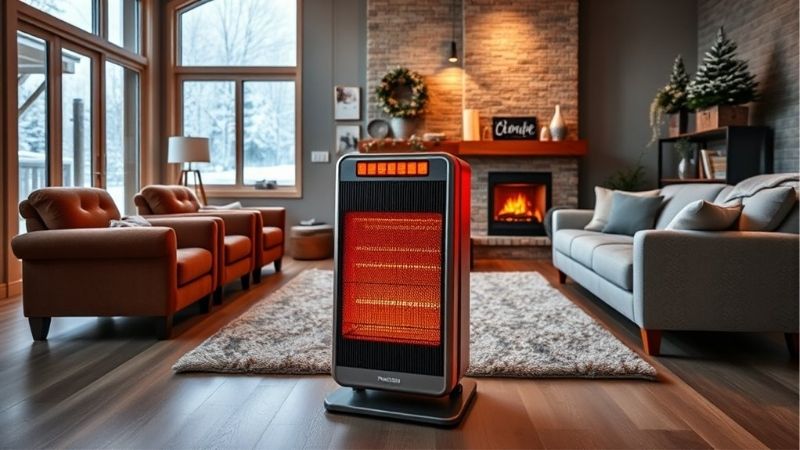
| Product | Best For | Key Spec | Listed Price (as of October 2026) | Watch Out For |
|---|---|---|---|---|
| Stiebel Eltron CNS 300-2 Plus | Best Overall: installed heat for a genuinely large room | 3,000 W at 240 V; hardwired | $455.00 MSRP | Licensed installation and compatible circuit required |
| Lasko CT22498 | Best Value: accessible plug-in zone heat | 1,500 W at 120 V; oscillation; tip-over switch | $69.99 | Supplemental heat, not a furnace replacement |
| Dreo Solaris 718 | Best for broad directional airflow | 1,500 W; customizable 120-degree oscillation | $129.98 | Tall cabinet needs a clear floor position |
| Dr. Infrared Heater DR-968 | Best for focused seating-area comfort | 1,500 W; quartz and PTC elements; remote | $129.99 | Twenty-pound cabinet is less portable |
| De’Longhi TRD40615E-6A | Best for fanless steady warmth | 1,500 W at 120 V; oil-filled; digital controls | $189.95 | Slow response after a room cools down |
| Vornado Velocity 5 EH1-0161-06 | Best for active air circulation | 750 or 1,500 W; automatic climate control | $107.38 at Home Depot | Compact fan makes noise; check seller stock |
Stiebel Eltron CNS 300-2 Plus: Best Overall
Best For: Homeowners seeking permanently mounted heat for a large room with adequate 240-volt electrical service.
The CNS 300-2 Plus addresses the problem that portable heaters cannot solve: moving significantly more heat into a large, cold room from one installed unit. Its wall-mounted convection design avoids the cord-and-floor-placement compromises of the other five picks. That higher capacity comes with a significant condition. It is not a plug-in appliance and should not be purchased until an electrician has checked the circuit and mounting location. For rentals or occasional use, the lower-output Lasko is a more practical purchase.
Stiebel’s installation manual for the CNS 300-2 Plus identifies item 202000 as a 3,000-watt heater on 240-volt power, drawing 12.5 amps and delivering 10,236 Btu per hour at rated voltage. On a 208-volt supply, the same manual specifies 2,250 watts, a material reduction worth confirming before installation. The manufacturer’s 2026.1 distributor MSRP sheet lists $455.00 for the CNS 300-2 Plus, excluding labor. The engineering specification sheet documents conformity to UL 1278 and an Intertek listing for this heater series; check the exact unit label when it arrives.
The appliance measures 41 5/16 inches wide, 17 3/4 inches tall and 3 15/16 inches deep, and weighs 24 pounds according to the installation manual. Plan a wall run wide enough for the cabinet and required clearances, away from drapery or furniture. The rear junction-box connection means an electrician must handle wiring and overcurrent protection under local code. The three-year warranty stated in Stiebel Eltron’s engineering sheet is useful for a permanently installed product, but installation labor and circuit modifications are separate expenses.
Pros:
- Rated 3,000 watts at 240 volts, more output than plug-in picks.
- Hardwired wall installation frees floor space from portable appliance placement.
- Manufacturer engineering sheet documents a three-year product warranty.
Cons:
- Requires a suitable 240-volt circuit and qualified electrical installation.
- At $455 MSRP before labor, upfront expense exceeds portable alternatives.
Who Should Buy It: Choose the CNS 300-2 Plus when room heat loss justifies a fixed 3,000-watt unit; choose Lasko CT22498 if only standard plug-in supplemental heating is feasible.
Lasko CT22498: Best Value
Best For: Families supplementing heat near a seating area without changing household wiring or spending over $100.
Lasko’s CT22498 is the sensible starting point when central heating works but one end of the living room stays uncomfortable. The heater is easier to reposition than the hardwired Stiebel, and its oscillation makes more sense near a sofa arrangement than a stationary directional heater. It does not create more heat than other 1,500-watt plug-in units. Its advantage is the balance between current cost, selectable control, and protective functions clearly named for this particular SKU.
Lasko’s product page for model CT22498 lists a $69.99 price, 900- to 1,500-watt settings on 120 volts, widespread oscillation, a 12-hour timer, and an adjustable thermostat. Its published product specifications identify ETL listing, automatic overheat protection, a tip-over switch, and a cool-touch housing. Lasko describes coverage up to 300 square feet, but that is a maker estimate, not a heat-loss calculation for a drafty room. The listed three-year warranty compares favorably with bare-bones budget towers at similar prices.
The CT22498 stands about 21.9 inches tall, with a footprint of roughly 7 inches wide and 9 inches deep, and weighs 5.4 pounds. Those dimensions make it easier to keep clear of walkways than a large radiator cabinet, although it still needs the safety clearance around textiles and furniture specified by CPSC. Its light housing makes moving the unplugged unit convenient; its tall upright design means the tip-over switch should remain unobstructed. Owners should clean the air openings as the Lasko manual instructs rather than covering the heater to silence the fan.
Pros:
- Manufacturer-listed $69.99 price undercuts other portable heaters in this comparison.
- Documented tip-over switch and overheat protection address two concrete risks.
- Three-year warranty and 12-hour timer extend beyond simple heat-only controls.
Cons:
- Its 1,500-watt ceiling cannot match the installed Stiebel’s thermal capacity.
- Oscillating fan operation may distract people who prefer silent radiant warmth.
Who Should Buy It: Buy the CT22498 for a low-cost occupied-room boost; choose De’Longhi TRD40615E-6A when fan noise is the main objection.
Dreo Solaris 718: Best for Wide Airflow
Best For: Households that move between several seating positions and want a tower with broad oscillation.
Where a compact fan directs warmth toward one corner, the Solaris 718 is built to sweep air across a wider section of a room. That makes it appealing near an open living-and-dining space, where people sit on both sides of a conversation area. Its multiple heating and fan choices also give more control over how air moves after the air temperature starts to recover. Extra movement does not raise its electrical heat output, so expectations should stay within the 1,500-watt plug-in class.
Dreo’s product page for the Solaris 718 silver version lists $129.98, a maximum 1,500-watt heating system, five heat settings, three fan settings, and customizable oscillation up to 120 degrees. It also publishes a digital thermostat setting range of 41 to 95 degrees F, in one-degree steps, and advertises multi-layer protection including a tip-over system. These are manufacturer-provided design claims, not independent room-warming benchmark results. The heater’s consumer price is higher than Lasko CT22498 primarily for control flexibility and distribution, not greater heating wattage.
The Solaris 718 measures approximately 7.9 inches wide, 7.9 inches deep, and 29.7 inches tall on Dreo’s specification page. Its narrow base makes a vertical arrangement possible beside a chair, provided all air inlets and outlets remain free and the heater stands on a stable floor. With a near-30-inch tower, buyers should check whether a curious pet or a narrow traffic passage makes an upright product a poor fit. Oscillation is most useful with an unobstructed arc; moving the heater behind a couch defeats that advantage.
Pros:
- Customizable 120-degree oscillation reaches seating across a broad viewing angle.
- Five heating selections offer finer adjustment than simple two-stage units.
- Thermostat adjusts from 41 to 95 degrees F in one-degree increments.
Cons:
- The tall cabinet needs a stable, unobstructed location on the floor.
- At about $130, airflow controls cost more without increasing maximum wattage.
Who Should Buy It: Select Solaris 718 for directional coverage across occupied seats; choose Vornado Velocity 5 EH1-0161-06 for a shorter fan-circulation design.
Dr. Infrared DR-968: Best for Seating Zones
Best For: Readers whose coldest area is a frequently occupied cluster of chairs rather than an entire open plan.
The DR-968 uses a quartz infrared element alongside a ceramic PTC heating stage and a fan, which makes it different from a purely fanless radiator. It is attractive for people who care about comfort near a specific sofa or desk cluster while existing home heating maintains the wider temperature. The combination does not supply more electric energy than other 1,500-watt units, despite broad marketing claims sometimes made for infrared heaters. It is a more substantial cabinet than the Lasko tower and less convenient for frequent room changes.
Dr. Infrared Heater’s product page for the DR-968 lists $129.99 and describes a 1,500-watt, roughly 5,200-Btu-per-hour system on a standard 110-volt three-prong supply. Its maker-stated electronic thermostat spans 50 to 85 degrees F; a 12-hour automatic timer, remote, tip-over shutoff and overheat protection are also specified. The company calls the DR-968 UL certified on its product page; confirm the model’s safety label rather than inferring certification for other Dr. Infrared products. The manufacturer’s claimed 39-dB sound level lacks a published measurement setup, so it should not be treated as directly comparable with competing noise figures.
At about 20 pounds, 16 inches high, 11 inches wide and 13 inches deep, the DR-968 requires more floor and lifting space than the Lasko CT22498. It suits a stable corner near occupied seating better than a crowded hallway. Casters make moving the unit across a clear floor easier, but a damaged caster or blocked air opening should stop use until the issue is corrected. The DR-968 replacement-parts catalog identifies a model-specific heating element and power board, a practical maintenance advantage for owners willing to pursue qualified service instead of immediately replacing the entire appliance.
Pros:
- Quartz and PTC heating elements support its directional and convective design.
- Remote and 12-hour timer allow adjustment from a nearby chair.
- Maker offers identified replacement heater and power-board parts for DR-968.
Cons:
- Twenty-pound cabinet is less convenient to lift between rooms.
- Infrared branding cannot increase heat output beyond its 1,500-watt electrical input.
Who Should Buy It: Choose DR-968 for a mostly stationary seating zone; choose Dreo Solaris 718 when wide oscillation matters more.
De’Longhi TRD40615E-6A: Best for Quiet Heat
Best For: Homeowners who prefer gradual fanless heat during occupied evenings rather than a jet of warm air.
De’Longhi’s Dragon radiator fills a different role from the other portable heaters: the sealed oil stores heat so the heater warms and cools more gradually, without needing a blower. That can be more comfortable in a living room where fan sound interferes with conversation or television. The oil does not burn or need regular refilling. A cold room will not rebound as rapidly as it might with an actively circulating fan, and the cabinet takes time to cool before it is moved.
De’Longhi’s product page for TRD40615E-6A specifies a 1,500-watt maximum at 120 volts, three heat settings, digital controls, an ECO function, an adjustable thermostat, a child lock, and thermal cutoff protection. The same manufacturer’s US radiator catalog lists the 2026 purchase reference at $189.95. The radiator is a fanless electric resistance appliance, not a lower-energy technology at the same continuous wattage. Its advantage comes from heat delivery and thermostat cycling in an occupied zone, and its sealed reservoir reduces routine maintenance compared with fuel-burning equipment.
De’Longhi’s technical data lists dimensions of approximately 16.4 inches wide, 10.3 inches deep and 26.1 inches high, with a 25.61-pound product weight. The integrated wheels help with room-to-room positioning after the appliance is switched off and has cooled. It uses more floor space and is harder to store in a narrow closet than a compact fan heater. Buyers should leave ventilation space around the radiator and avoid draping blankets or laundry over it. The closed oil circuit is not user-serviceable; leaking oil or a damaged supply cord calls for stopping use and contacting service.
Pros:
- Fanless oil-filled construction avoids blower noise in conversation areas.
- Three heating levels and digital controls support occupied-evening adjustments.
- Child lock and thermal cutoff appear on De’Longhi’s exact-model product page.
Cons:
- At $189.95, it costs substantially more than a compact fan heater.
- Slow warm-up is inconvenient for a briefly occupied cold room.
Who Should Buy It: Select TRD40615E-6A for quiet extended sessions; choose Vornado Velocity 5 EH1-0161-06 when rapid air circulation is preferable.
Vornado Velocity 5: Best for Air Circulation
Best For: People who want a compact fan-driven heater that circulates warm air without a tall oscillating tower.
Vornado approaches uneven room temperature by circulating air rather than turning the heater toward one seat at a time. The Velocity 5 has automatic climate control intended to respond to changing room conditions, which suits living areas where occupants dislike constant manual adjustments. Its shorter cabinet is easy to place on an open floor with clearance from furniture. Buyers who are particularly sensitive to fan noise should favor the De’Longhi instead; air movement is integral to how the Vornado works.
Vornado’s Velocity 5 product page states a $114.99 manufacturer price, two heat settings, automatic climate control, a 12-hour timer, lockable controls, a nighttime display mode, ETL listing, and a five-year satisfaction guarantee. The manufacturer’s Velocity 5 owner’s guide identifies the high-heat setting as 1,500 watts and low heat as 750 watts, and describes tip-over shutdown and a fan cool-down cycle. Vornado’s own checkout was marked out of stock when checked, while Home Depot’s listing for SKU EH1-0161-06 showed $107.38 and an Add to Cart option; confirm delivery availability for your area rather than assuming all stores have units.
Retailer-supplied dimensions for the EH1-0161-06 configuration are approximately 11.5 inches high, 9 inches wide and 7.5 inches deep, with a reported 5.5-pound weight and 72-inch power cord. This is a relatively compact footprint for a fan heater, but neither its cord length nor its low profile permits placing it under curtains or against upholstered furniture. Keep the intake clear, and follow the manufacturer’s cool-down instructions instead of disconnecting a hot unit mid-cycle. The five-year guarantee is notably longer than the three-year figure published for the Lasko CT22498.
Pros:
- Automatic climate control adjusts operation without a tall oscillating column.
- Manufacturer’s guide documents 750- and 1,500-watt heat selections.
- Five-year satisfaction guarantee provides longer documented support than many rivals.
Cons:
- Manufacturer storefront showed no stock despite a separate retailer listing.
- Active fan circulation is less discreet than a fanless radiator.
Who Should Buy It: Buy Velocity 5 if compact air circulation is the priority; choose Stiebel Eltron CNS 300-2 Plus if heat output, not distribution, is the limiting factor.
How to Choose a Heater for a Large Room
The first buying decision is whether you need a heater to support an existing system or to deliver most of the room’s required warmth. A large connected living area, tall ceilings, leaky windows, or a poorly insulated exterior wall can overwhelm a plug-in appliance even if its box advertises extensive coverage. Check the wall outlet and breaker arrangement before comparing features. A heater you can safely power and position is more useful than one whose claimed room size looks impressive but ignores building conditions.
Match Real Wattage to the Room’s Heat Loss
Among these models, the five portable 120-volt heaters deliver a maximum of 1,500 watts each; the Stiebel Eltron CNS 300-2 Plus delivers 3,000 watts at 240 volts. The Stiebel installation manual also shows how using it at 208 volts reduces output to 2,250 watts. Those ratings represent actual heating capacity, whereas a square-foot figure is a manufacturer estimate shaped by unknown insulation and outside temperature. In a mild climate with a functioning central system, a 1,500-watt heater can make a seating area comfortable without heating unused rooms.
If the entire space stays cold despite proper central heating, first investigate drafts and the heating system itself. A bigger portable fan will not produce more heat when both appliances draw the same 1,500 watts. For an extension, sunroom, or consistently underheated large room, ask a qualified HVAC or electrical professional for a heat-loss estimate. A permanently installed room heater or correctly sized heat pump may be more appropriate than operating one or more portable units for long hours.
Choose How Heat Travels Across the Room
Airflow changes the location and speed of perceived warmth, not the number of watts created. Dreo’s Solaris 718 sweeps through a claimed 120-degree arc, while the Vornado Velocity 5 circulates air without relying on the same tower movement. Lasko CT22498 offers oscillation at a lower price, and Dr. Infrared DR-968 directs heat from its quartz and PTC assembly near occupied furniture. Those differences matter when people are spread across a sofa, worktable, and dining corner. Think about where occupants actually sit rather than directing a fan toward empty floor area.
The De’Longhi TRD40615E-6A uses a sealed oil-filled body and no blower, so it suits a room that is occupied for several hours and does not require immediate warm air. Stiebel’s wall-mounted convection heater is better considered part of the room’s planned heat source than a movable comfort appliance. Decide whether changing location or steady fixed heating matters more. Keep manufacturer-required openings clear, and do not confuse an advertised low sound level with a lab comparison unless the brand supplies comparable measurement conditions.
Account for Circuits, Safety and Operating Cost
The CPSC’s January 2026 space-heater guidance says to keep portable heaters three feet away from bedding, drapes, furniture and other combustibles, connect them directly to a wall outlet rather than a power strip or extension cord, and turn them off while sleeping. A 1,500-watt appliance draws approximately 12.5 amps from a 120-volt circuit, so other devices sharing that branch circuit matter. Inspect cords and plugs before winter use, and check current CPSC recall information using the exact model number. Look for model-specific tip-over and overheat safeguards and a recognized safety listing on the unit, not just a brand-wide claim.
Electric resistance heating converts essentially all of the electricity it consumes into heat at the room, according to US Department of Energy technical guidance; a different branding label does not create free heat. For an illustration, a 1,500-watt heater running at full power for four hours daily for 30 days would use about 180 kilowatt-hours, costing about $36 at an assumed electricity rate of 20 cents per kilowatt-hour. A thermostat may lower real consumption if the unit cycles off. By contrast, a 3,000-watt installed unit can use more electricity per operating hour, though it may also satisfy a higher room heat load. Compare total usage and any electrician’s installation estimate before ordering.
Frequently Asked Questions
Many questions about room heaters are really questions about what a home’s electrical supply and insulation will allow. The answers below cover common buying concerns that remain after comparing model specifications.
Can one portable heater warm an open-plan living area?
Not reliably if that area loses more heat than a 1,500-watt appliance can replace. Open stairwells, adjoining kitchens, and high ceilings increase the air volume and potential heat loss. A portable heater can still improve comfort where people sit if central heating supplies most of the base temperature. Treat manufacturer square-foot claims as rough comparisons rather than guarantees for a particular home.
Is a higher thermostat number the same as more power?
No. The thermostat setting specifies when the appliance should cycle, not how much heat its element can produce at its rated power. A 1,500-watt heater set to 85 degrees F cannot deliver 3,000 watts. If the room never reaches the setting, the problem may be room heat loss rather than a faulty thermostat. Use a separate room thermometer away from the heater to assess whether the occupied area is improving.
Should I buy two plug-in heaters instead of a 240-volt unit?
Not before checking your home’s circuits with a qualified professional. Two separate 1,500-watt appliances could demand a combined 3,000 watts, but they may overload a shared branch circuit and create extra cord and placement hazards. They are not an automatic substitute for a properly designed installed heater. For persistent heating problems, professional heat-loss and electrical assessments are a safer first step than adding another high-draw appliance.
Do room-heater timers make overnight use safe?
No. A timer changes how long a heater runs; it does not remove the hazards from bedding, a damaged cord, or unattended operation. CPSC’s 2026 advice is to turn portable heaters off during sleep. For rooms that need overnight temperature control, evaluate the home’s permanent heating system and the manufacturer instructions for equipment designed for that purpose. A safety label is also not permission to ignore required clearances.
Final Thoughts
The Stiebel Eltron CNS 300-2 Plus is the strongest choice here for a large room whose measured heat load calls for a dedicated fixed heater, but the decision only makes sense after confirming a compatible 240-volt circuit and the total installed cost. If you are merely supplementing a working system and have a safe 120-volt outlet, Lasko CT22498 is the more economical and flexible purchase. Before clicking through to check current prices, measure the available wall or floor space, check the exact model’s safety label, and determine whether your problem is a localized cold seat or an inadequately heated room.