Key takeaways
- Thermostat spans 41 to 95 degrees F in fine increments.
- Selectable 900 and 1,500-watt heating adapts to different workloads.
- Built-in timer permits planned shutdown after one to twelve hours.
Lower heating bills depend on how much space you warm and for how long, not on the word “efficient” printed on a box. An energy efficient heater is useful for occupied-room supplemental heating when its thermostat, timer, wattage, and placement match the job. Nearly all electric resistance heaters turn the electricity they consume into heat indoors; a 1,500-watt model cannot magically produce the same heat for half the electricity simply by switching from ceramic to oil or infrared technology.
Quick Verdict: The Dreo Atom One is our Best Overall for flexible room-by-room supplemental heating because its 900-to-1,500-watt operating range, adjustable thermostat, and 1-to-12-hour timer make it easier to avoid unnecessary run time. The Envi LE5012P is a better fit when a fixed 500-watt heat source can meet a small room’s load. Editorial choices use October 2026 documentation, not in-house testing. Check current prices and electrical requirements before ordering.
As an Amazon Associate we earn from qualifying purchases.
By DIY Ideas 4 Home Editorial Team
5 Energy-Conscious Electric Heaters Reviewed
We selected exact models with manufacturer product pages, documented power ratings, identifiable temperature or time controls, and practical use cases rather than unsupported efficiency percentages. This comparison centers on total electricity use during zone heating, not on a claim that one resistance element makes more heat per kilowatt-hour. US manufacturer or brand-store prices ranged from $49.99 to $179.95 during October 2026; the Honeywell retailer listing was $99.95. Heater safety and installation suitability remain separate purchase gates.
| Product | Best For | Key Spec | Listed Price (as of October 2026) | Watch Out For |
|---|---|---|---|---|
| Dreo Atom One | Best Overall: flexible spot and room heat | 900 to 1,500 W; 1 to 12 h timer | $49.99 | Small fan heater, not a whole-home solution |
| Honeywell HeatGenius HCE840B | Best For planned short sessions | Six heat modes; 2 h HeatPhase timer | $99.95 | No remote or app control |
| Envi LE5012P | Best For small fixed zones | 500 W; wall mounted; 120 V | $179.95 | Insufficient output for larger heat losses |
| DeLonghi TRRS0715E-6A | Best For extended fanless warmth | 1,500 W; 24 h timer; ECO control | $159.95 | Slow response, 21.39 lb body |
| Heat Storm A-1500-PHX-WIFI | Best For scheduled wall heat | 750/1,500 W; Wi-Fi schedules | $149.99 | Wall-only mount; 3 ft cord |
Dreo Atom One: Best Overall
Best For: Someone heating a home office or occupied sitting area at different hours of the day.
Some energy-saving features are useful because they make it easier to stop running a heater after the room is comfortable. The Atom One combines a thermostat with an adjustable off timer and a choice between lower and higher output, making it a reasonable starting point for renters who want a portable unit. A shopper seeking a permanently warmed room, however, may prefer the silent and fixed Envi LE5012P instead of aiming a ceramic fan every workday.
Dreo’s product page for the Atom One specifies a 900-to-1,500-watt range, a thermostat adjustable from 41 to 95 degrees F in 1-degree increments, a 1-to-12-hour timer, and 70-degree oscillation. The manufacturer listed the unit for $49.99 in October 2026. Its ECO setting changes heater operation according to the temperature control rather than increasing thermal conversion efficiency. Dreo also advertises tip-over and overheat protection; buyers should confirm the safety label and instructions on the exact unit supplied.
At 6.7 by 5.5 by 10.3 inches and a stated 3.8 pounds, it travels easily between a desk-side floor area and another occupied room. The 6-foot cord is useful for positioning but must reach a wall outlet directly rather than an extension lead. Its washable inlet filter needs periodic cleaning to preserve normal airflow. Dreo’s compact design trades the settled silence of the DeLonghi radiator for faster directed airflow; operating a blower is an audible part of this choice.
Pros:
- Thermostat spans 41 to 95 degrees F in fine increments.
- Selectable 900 and 1,500-watt heating adapts to different workloads.
- Built-in timer permits planned shutdown after one to twelve hours.
Cons:
- Fan noise may bother people who record calls or audio.
- Portable airflow does not solve a room’s underlying insulation problem.
Who Should Buy It: Choose Atom One for changing daytime locations; choose the Honeywell HeatGenius HCE840B if a gradual two-hour shutdown fits your routine better.
Honeywell HCE840B: Best For Short Sessions
Best For: A person who wants heating that steps down automatically during a reading or work session.
The HeatGenius approaches time management differently from a conventional countdown timer. Its HeatPhase function gradually lowers the heat before switching off, making it distinctive for someone who typically forgets to turn the setting down once warm. This is a convenience mechanism, not a measured energy-saving percentage, and it will not beat a heater that is already switched off. It makes more sense for short sessions than for a room that needs constant background heat.
Honeywell’s HeatGenius HCE840B product page documents six customized heating selections, including personal, floor and room-oriented modes, a programmable thermostat, and the HeatPhase timer. Honeywell’s owner documentation describes timed operation, while the Honeywell Store listed the HCE840B at $99.95 during October 2026. The HeatPhase feature reduces the chosen heat level at 30-minute steps before stopping after two hours. Product literature also names tip-over and overheating safeguards; the exact room and personal settings should not be mistaken for published, comparable heating-efficiency test results.
Its manufacturer-stated body measures 17.3 inches wide, 18.1 inches tall and 8.4 inches deep, so it needs more horizontal clearance than the narrow Dreo. Honeywell’s product support page lists a three-year limited warranty and a cool-touch housing, though neither replaces proper distance from fabrics. The control layout rewards users who want one predictable routine rather than app automation. Before buying, check available outlet placement and whether the unit’s larger face conflicts with walkways or furniture.
Pros:
- HeatPhase lowers the selected setting at 30-minute intervals.
- Six settings let users direct heat toward different occupied zones.
- Three-year limited warranty is identified in Honeywell’s product documentation.
Cons:
- Wide housing requires a relatively open floor position.
- The fixed two-hour HeatPhase pattern will not fit every schedule.
Who Should Buy It: Use Honeywell for repeatable short heating sessions; the Heat Storm A-1500-PHX-WIFI suits buyers needing customized wall-mounted schedules.
Envi LE5012P: Best For Small Fixed Zones
Best For: An owner with a modest enclosed room that needs quiet supplemental heat and free floor space.
Envi’s main distinction is not that it extracts more heat from electricity, but that it deliberately limits maximum demand to 500 watts. That can reduce hourly power draw when the smaller heat output is sufficient. In a drafty or larger room, however, 500 watts may simply fail to reach the desired temperature, and keeping it on longer can erode the advantage. Wall placement also removes a freestanding unit from a frequently used passageway, which can be attractive in a narrow room.
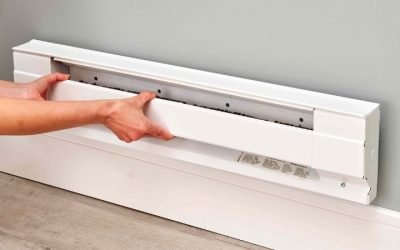
Envi’s product page for the LE5012P identifies a 120-volt plug-in, third-generation panel with a built-in manual thermostat, a 500-watt rating and a listed price of $179.95 as of October 2026. Eheat states that a wall-presence safety switch disables the unit if removed from its mounting clips. The company also describes a thermal cutoff and compliance with applicable UL and CSA standards; shoppers should verify the current model’s label rather than infer a certification from a brand name alone.
The unit measures 19.3 inches wide by 2 inches deep by 22.2 inches tall, weighs 10 pounds without packaging and carries a 6-foot cord. Its narrow profile is a substantial practical difference from the Honeywell floor model. Envi states a three-year warranty on new heaters. Installation still requires suitable wall clearance, correct mounting and an accessible wall outlet, and the heater should not be treated as a substitute for the output of a 1,500-watt appliance in an uninsulated space.
Pros:
- 500-watt draw fits genuinely modest supplemental heating demands.
- Two-inch-deep wall profile preserves valuable small-room floor space.
- Wall-presence switch cuts power if the heater is dismounted.
Cons:
- Less heat capacity than every other model in this comparison.
- Permanent mounting limits movement between rooms during changing routines.
Who Should Buy It: Buy Envi for an adequately insulated small zone; select the DeLonghi TRRS0715E-6A for more flexible fanless supplemental warmth.
DeLonghi TRRS0715E-6A: Best For Fanless Warmth
Best For: A household using the same room for long stretches and wanting to avoid fan-driven air movement.
The Radia S ECO Digital radiator serves a different daily rhythm from a ceramic fan. It warms its sealed oil reservoir and transfers heat gradually without using a blower, which makes it appealing when the room stays occupied for hours. Its strength is stable delivery and programmable temperature management, not a dramatic reduction in watt-hours at full output. If someone needs a blast of warmth for a brief lunch break, the Dreo Atom One will typically be a more responsive and less expensive purchase.
DeLonghi’s product page for the TRRS0715E-6A specifies a maximum of 1,500 watts at 120 volts, three heat settings, an ECO function and a 24-hour timer. The company’s published manual describes temperature settings and delayed start or stop options. DeLonghi listed this US-specific model for $159.95 in October 2026 and identifies thermal shutoff and a child lock. The manufacturer does not establish on that product page a model-specific tip-over certification, so buyers should check the owner’s manual and safety markings rather than assuming every protective feature offered on ceramic heaters is present.
The published dimensions are 6.3 by 14.56 by 25.2 inches, and the heater weighs 21.39 pounds. Preassembled wheels help relocation, but moving a heavy radiator between separate floors is different from carrying a compact ceramic unit. Because it holds heat after its element cycles off, temperature changes arrive less quickly than a fan heater’s directed airflow. The permanently sealed oil needs no owner refilling; damaged housings, leaks or abnormal controls call for service rather than home repair.
Pros:
- 24-hour timer gives broader daily timing flexibility than Honeywell’s HeatPhase.
- Three power settings support controlled heat delivery across longer sessions.
- Sealed radiator operates without a fan or replaceable wick.
Cons:
- Heavy 21.39-pound body is less convenient to reposition frequently.
- Thermal inertia makes rapid room-temperature changes less practical.
Who Should Buy It: Choose DeLonghi for prolonged fanless use; take the Envi LE5012P if lower maximum wattage and wall clearance are more important.
Heat Storm A-1500-PHX-WIFI: Best For Wall Schedules
Best For: A shopper with a suitable wall location who wants predictable daily room-heating schedules.
Heat Storm makes most sense when scheduling, not portable convenience, is the deciding factor. Its Wi-Fi interface allows a prearranged heating routine, helping a buyer avoid keeping a supplemental heater active through hours when the room does not need warmth. The setup is more complex than twisting a dial and requires a practical wall outlet location. The convenience also should not be interpreted as evidence that infrared quartz elements make proportionally more heat per unit of electricity than resistance panels.
Heat Storm’s product page for the Phoenix Wi-Fi lists the A-1500-PHX-WIFI at $149.99 in October 2026, with 750- and 1,500-watt selections, an ECO control mode, thermostat settings of 40 to 99 degrees F, and app-based schedules. The company describes a tip-over safety shutoff and remote control. Its advertised secondary-heating coverage is an estimate rather than a heating-load calculation, and its claim that the appliance will not trip a breaker is not a guarantee on an already loaded electrical circuit.
The enclosure is 19 inches long, 4 inches deep and 16 inches tall, weighing 8.45 pounds. A 3-foot cord can severely constrain mounting height and outlet choice; the Wi-Fi version is explicitly wall-mounted and does not include floor feet. Heat Storm’s storefront advertises a one-year warranty. Buyers should read the mounting guide for prohibited locations, airflow clearances and the approved circuit arrangement before selecting a wall rather than placing it near a curtain or in a high-traffic path.
Pros:
- Custom Wi-Fi scheduling can reduce unnecessary occupied-room heating hours.
- 750- and 1,500-watt modes offer two distinct output levels.
- Four-inch-deep housing frees floor area in a small office.
Cons:
- Three-foot cable sharply limits safe mounting locations near outlets.
- App setup adds dependence on a compatible home network.
Who Should Buy It: Pick Heat Storm for custom fixed-location routines; choose Honeywell HCE840B for a simpler timer without networking.
How to Choose a Heater That Uses Less Electricity
A heater’s rated watts establish its maximum electrical demand while its controls, room conditions and run time determine actual consumption. For perspective, the US Department of Energy explains that electric resistance heating converts essentially all incoming electricity into heat at the point of use, whereas a heat pump moves heat and can deliver substantially more heating per unit of electricity. The five products above are resistance heaters, not mini-split heat pumps; compare them as supplemental appliances rather than replacements for an efficient central system.
Compare Wattage With Actual Heating Needs
At full output, a 1,500-watt heater uses 1.5 kilowatt-hours of electricity for each hour the element remains on. A 500-watt panel uses 0.5 kilowatt-hours in an hour at full output but supplies only one-third as much thermal energy. Neither is inherently more effective at converting electricity to room heat. Selecting the smaller model works best when the space is already insulated and the heat loss is modest enough for the lower output to maintain comfort.
At an illustrative assumed electricity rate of 20 cents per kilowatt-hour, an uninterrupted hour at 1,500 watts costs 30 cents and an uninterrupted hour at 500 watts costs 10 cents. These are examples, not posted utility tariffs; local rates, cycling, fixed charges and demand patterns change actual bills. A thermostat may interrupt a 1,500-watt heater during the hour, and a 500-watt unit might run continuously, so nameplate power alone cannot predict a monthly difference.
Choose Controls You Will Actually Use
The Dreo Atom One has a 1-to-12-hour off timer, Honeywell uses a two-hour stepped sequence, DeLonghi offers daily timer options, and Heat Storm supports Wi-Fi schedules. Those controls can change consumption only when they reduce unnecessary operating time or unwanted overheating. If a buyer sets every model to the same temperature and each supplies the same amount of heat over the same interval, the electricity consumed will be broadly similar before small differences in cycling and distribution.
Many people overvalue advertised ECO modes. A brand may use that term for changing heat settings or operating to a thermostat target, not for doubling thermal efficiency. Ask which specific operation the mode changes and whether the preset is convenient enough to keep using. For an unpredictable schedule, accessible manual controls may save more electricity in practice than a sophisticated app that nobody updates.
Verify Safe Installation and Circuit Capacity
The Consumer Product Safety Commission’s January 2026 winter guidance directs users to keep portable space heaters at least three feet from combustibles, plug them directly into wall outlets rather than power strips or extension cords, and turn them off when sleeping. A 1,500-watt electric heater draws about 12.5 amps on a 120-volt circuit when at full output. That is a substantial load on a common 15-amp branch circuit, especially when other devices share it, so a licensed electrician should evaluate any questionable installation.
Look for model-specific information about thermal shutoff, tilt protection, cord and plug condition, the safety listing and relevant CPSC recalls. Do not assume that wall-mounting, a child lock, or a timer authorizes unattended operation against the manufacturer’s instructions. The Envi LE5012P requires its supplied mounting system; the Heat Storm Wi-Fi Phoenix requires a permitted wall location and an outlet close to the short cord. Fixed wiring and inappropriate room locations demand professional assessment.
Frequently Asked Questions
Heating efficiency claims often mix appliance power, central-heating savings and room comfort into a single number. These answers separate what a portable unit can realistically change from what requires a different heating system or building improvement.
Are infrared heaters cheaper to run than ceramic heaters?
No, not automatically. At the same wattage and run time, infrared and ceramic resistance heaters draw roughly the same electricity and deliver comparable total heat indoors. Infrared warmth may feel more direct to a seated person, allowing a different placement or thermostat setting, while a ceramic fan may distribute air more quickly. Any bill reduction comes from the changed operating pattern, not a superior electricity-to-heat conversion rate.
Do portable space heaters earn ENERGY STAR certification?
Portable electric resistance space heaters are not presented as an ENERGY STAR certified category in the EPA’s residential Product Finder as of October 2026. ENERGY STAR instead lists eligible heating technologies such as heat pumps and qualifying HVAC equipment. Beware of a marketplace badge that may refer to a different product category, or of marketing that treats the phrases energy saving and ENERGY STAR as equivalent certifications.
Should I replace electric room heaters with a heat pump?
For substantial recurring space heating, often yes, after comparing installation feasibility and full ownership cost. The Department of Energy explains that air-source heat pumps move heat rather than create it by resistance and can significantly reduce electrical consumption compared with electric furnaces or baseboards. A portable heater can still be sensible for occasional use in an occupied room, particularly when the full home would otherwise be heated for a single person.
Can I rely on a timer for overnight heating?
No. A timer does not eliminate contact with fabrics, electrical overloading or other ignition hazards. The CPSC’s 2026 guidance says to turn portable heaters off while sleeping. If a bedroom needs dependable overnight heat, explore a properly installed heating system, suitable thermostat settings, improved air sealing and other solutions rather than treating an unattended portable heater as an equivalent permanent installation.
Final Thoughts
The Dreo Atom One remains our Best Overall energy efficient heater choice for occasional occupied-room use because its modest entry price and easy temperature and timer adjustments support practical zoning. But if the same small insulated room needs regular gentle heat, the Envi LE5012P’s 500-watt fixed output may better match its heat loss; a household with consistently high heating demand should compare a heat pump before buying several resistance units. Before placing an order, check the current listing price, the model-specific safety instructions, and whether your intended room truly needs the appliance’s rated wattage.