Key takeaways
- Measure countertop thickness and confirm the mounting hardware is long enough.
- Check whether the faucet includes a deck plate for a three-hole sink.
- Allow at least 5–8 inches of usable cabinet space for the sensor control box, depending on the design.
- Make sure a pull-down hose weight will not strike a garbage disposal, water filter, shelf, or drawer track.
The best touchless kitchen faucets depend on your priority: choose a battery-powered single-sensor faucet for a renter-friendly installation, a dual-sensor model for the fastest everyday response, or a hardwired faucet with battery backup for the most reliable long-term use.
Our top picks


As an Amazon Associate we earn from qualifying purchases at no extra cost to you. Ratings are shown as listed on Amazon.
Best touchless kitchen faucets by situation
| Situation | Best choice | Why it fits | Watch for |
|---|---|---|---|
| Small apartment | Compact battery-powered single-sensor faucet | Fewer parts under the sink and usually a reach of about 8–9 inches | A short spout may not cover a wide or deep sink |
| Kids, pets, or frequent cooking | Dual-sensor pull-down faucet | Wave activation reduces handle contact while the pull-down head adds flexibility | More sensor surfaces need regular cleaning |
| Renter or occasional DIY installer | Single-hole, battery-powered model with manual handle override | Typically installs through an existing single-hole opening without an electrical outlet | Confirm cabinet clearance for the battery box and control module |
| Hard water area | Metal-bodied faucet with a removable, easy-clean aerator | Better resistance to surface wear and simpler mineral-deposit maintenance | Touchless electronics do not prevent limescale buildup |
| Maximum reliability | AC-powered faucet with battery backup | Steady sensor power without losing operation during an outage | Requires a nearby outlet and careful cord routing |
Head-to-head: what separates the leading faucet designs?
Dual-sensor versus single-sensor activation
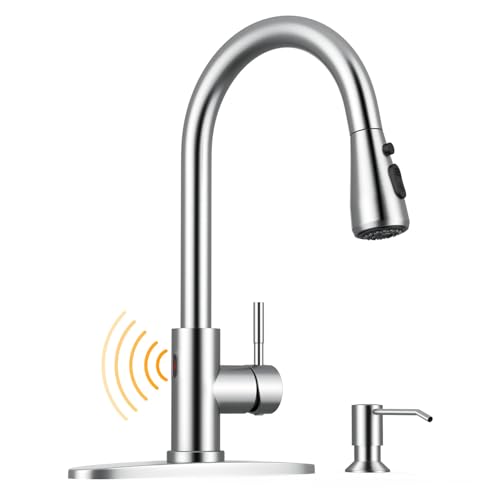
A single sensor is usually positioned near the base or under the spout. It keeps the design simple and can respond quickly when your hands enter the detection zone. A dual-sensor faucet adds a second activation point, commonly at the top or front of the spout. That arrangement gives you more control when washing large pans, but it also creates another surface that can collect splashes.
Look for a response time of about 0.5–1 second in the manufacturer’s specifications. Sensor range is commonly adjustable or falls somewhere around 2–6 inches, although the actual trigger distance changes with hand color, lighting, water droplets, and the angle of approach. A faucet that activates too easily can be frustrating beside a busy prep area; one with a narrow range may require deliberate hand placement.
Touchless does not mean handle-free
Most kitchen faucets still include a manual handle for setting temperature and flow. The sensor normally starts and stops water at the temperature selected by that handle. This is safer and more practical than requiring electronics to regulate hot and cold water every time, particularly in homes with children.
Some models allow the handle to remain open while the sensor controls flow. Others require a particular handle position or have a small control module under the sink. Read the operating instructions before buying: the difference affects whether the faucet is convenient for filling a pot slowly or washing delicate produce.
Spout reach and spray performance matter more than the sensor
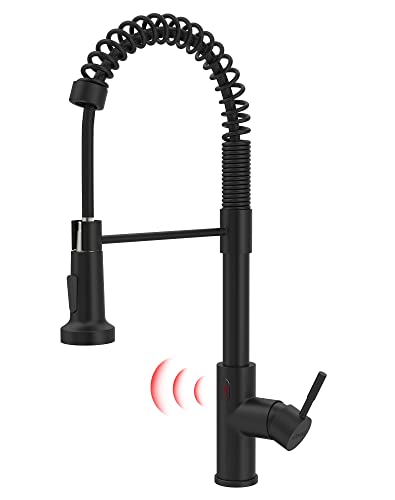
Measure your sink before comparing finishes. A typical pull-down touchless faucet has a spout reach of roughly 8–10 inches and a height of about 15–17 inches. That works well for many standard sinks, but a tall spout can hit a cabinet shelf, window trim, or low backsplash. The water stream should land near the center of the basin rather than against the rear wall.
| Kitchen measurement | Useful target | Why it matters |
|---|---|---|
| Spout reach | 8–10 inches for a standard sink | Helps the stream reach the basin center without excessive splash |
| Spout height | 15–17 inches, subject to cabinet clearance | Provides room for tall cookware without striking overhead obstructions |
| Pull-down hose travel | 18–24 inches of usable movement | Lets you rinse corners and fill containers beside the sink |
| Under-sink clearance | At least 3 inches behind the water lines; 5–8 inches for a control box | Prevents hoses, weights, batteries, and electronics from colliding with drawers |
| Sink depth | 8–10 inches pairs comfortably with most standard spouts | A deep basin combined with a short reach can make filling pots awkward |
For daily cleaning, a pull-down head with separate stream and spray buttons is generally more useful than a simple aerated stream. A pause button can save water while moving between dishes, but it adds another switch that may eventually become stiff or clogged. Rubber spray nozzles are easier to wipe clean than fixed metal openings, especially in hard-water regions.
Power options: batteries, plug-in power, or both
Battery-powered faucets are the easiest choice when no outlet is available. Depending on sensor use and battery type, a battery pack may last roughly one to three years. The exact interval varies considerably with household traffic, so choose a model with an accessible compartment rather than one buried behind plumbing.
AC-powered models avoid routine battery replacement and are sensible for a busy household, but the outlet should be protected from leaks and located within the manufacturer’s permitted distance. The strongest arrangement is AC power with battery backup. It costs more—often placing the faucet in the roughly $350–$700 market range—but keeps the sensor usable during a power interruption.
Do not use an extension cord loosely across the cabinet floor. If an outlet is not already present, have a qualified electrician install one in accordance with local electrical rules. Keep the control box elevated and leave enough slack to remove the faucet or shutoff valves later.
Installation realities that product pages often omit
Most touchless kitchen faucets fit a one-hole countertop opening, commonly about 1 3/8 inches in diameter. A three-hole sink may need a deck plate, and some thick countertops require a longer mounting shank. Before ordering, check these four points:
- Measure countertop thickness and confirm the mounting hardware is long enough.
- Check whether the faucet includes a deck plate for a three-hole sink.
- Allow at least 5–8 inches of usable cabinet space for the sensor control box, depending on the design.
- Make sure a pull-down hose weight will not strike a garbage disposal, water filter, shelf, or drawer track.
Installation usually involves shutting off both supply valves, removing the old faucet, securing the new faucet from below, connecting hot and cold lines, attaching the control module, and flushing the supply lines before use. A capable DIYer may finish in one to three hours, but corroded shutoff valves, cramped cabinets, or a hardwired outlet can turn this into a plumber or electrician job.
Cleaning durability and what wears first
Look for a solid brass or stainless-steel waterway and a corrosion-resistant exterior finish. “Metal faucet” does not always mean every component is metal; spray heads, sensor windows, hoses, and internal cartridges commonly contain plastic. That is not automatically a problem, but replacement parts should be available for the cartridge, aerator, hose, and batteries.
The parts most likely to show wear are the spray-head buttons, pull-down hose, hose weight, sensor window, and rubber seals. Wipe the sensor with a soft damp cloth rather than an abrasive pad. Remove mineral deposits from the aerator according to the instructions; soaking an electronic sensor or control box in vinegar can cause damage. Avoid bleach, scouring powder, and harsh acidic cleaners on the finish.
For a household with hard water, a removable aerator and silicone spray nozzles are more valuable than a premium finish. Brushed finishes tend to disguise water spots better than polished chrome, while matte black can show white mineral residue quickly.
Which well-known faucet lines are worth comparing?
Delta Touch2O models are a useful reference if you want touch activation alongside conventional handle operation; confirm whether a particular version is touch-only, touchless, or both. Moen MotionSense Wave and MotionSense-equipped faucets are known for hands-free activation options and pull-down designs. Kohler Sensate models emphasize hands-free control and commonly include a pull-down spray head. Pfister React models are another option to compare when a more budget-conscious sensor faucet is preferred.
Model names and configurations change, so compare the exact version’s sensor arrangement, power method, mounting requirements, warranty, and replacement-part availability rather than relying on the product family name. Touchless kitchen faucets typically cost about $200–$700, with simpler battery models at the lower end and dual-sensor, AC-powered, or premium-finish models at the higher end.
Final buying checklist
- Choose dual sensors if several people will use the faucet repeatedly during cooking.
- Choose a single sensor if you want fewer electronics and a simpler cabinet installation.
- Measure reach, height, countertop thickness, and under-sink clearance before selecting a style.
- Prefer stream, spray, and pause functions with replaceable or cleanable components.
- Confirm whether the faucet operates with the handle open, closed, or in a specific position.
- Buy battery backup or keep spare batteries available if the faucet is your only sink water control.
- Prioritize replacement parts and finish-cleaning instructions over appearance alone.
For most homes, the best balance is a pull-down faucet with a responsive dual-sensor system, manual temperature control, battery power, a reachable battery compartment, and a spout around 8–10 inches. A smaller single-sensor model is the better fit for limited cabinets or a rental, while an AC-powered unit with battery backup is worth the extra installation work in a high-use kitchen.