Key takeaways
- Eight listed fan speeds from 63 to 203 CFM
- Low 1.1 to 12.3 watt draw across settings
- Fits floor registers up to 6 by 12 inches
A vent booster fan sits on or inside one supply register and pushes a little more conditioned air into a room that always runs a few degrees behind the rest of the house, but it only earns its keep once the duct feeding that register is sound.
Quick Verdict: For most rooms, the Suncourt Equalizer EZ8 HC600 is the pick because it covers floor registers up to 6 by 12 inches and offers eight fan speeds rated from 63 to 203 CFM in the brand table. If you want a unit that drops flush into a 4 by 10 opening, the Suncourt Flush Fit HC500-B is the better fit. This is an editorial pick based on published specifications as of October 2026, not in-house testing. Confirm your register size on the listing before you buy.
As an Amazon Associate we earn from qualifying purchases.
By DIY Ideas 4 Home Editorial Team
The Best Vent Booster Fans Reviewed
We selected these six register boosters based on published specifications and manufacturer documentation rather than in-house testing, as of October 2026, drawing on brand airflow tables, spec sheets and retailer listings. Plug-in register boosters in this group run from about 60 to 97 dollars at major retailers, and the right one is decided by the opening it has to cover, not by the loudest CFM number.
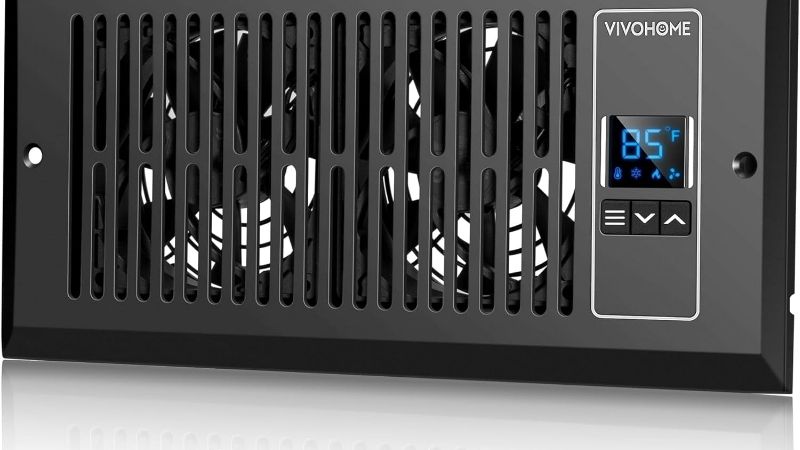
| Product | Best For | Key Spec | Listed Price (as of October 2026) | Watch Out For |
|---|---|---|---|---|
| Suncourt Equalizer EZ8 HC600 | Floor registers up to 6 by 12 in | 8 speeds, 63 to 203 CFM (brand table) | $64.99 | Wall mounting needs a separate kit |
| AC Infinity AIRTAP T4 AC-RBF4-W | Programmable 4 by 10 registers | 8 W; 16 dBA brand rating | $59.99 | Fits 4 by 10 only; CFM listing conflict |
| Suncourt Flush Fit HC500-B | Flush floor or wall installs | 5 speeds, up to 132 CFM | $59.99 | Larger openings need an adapter plate |
| AC Infinity AIRTAP T6 AC-RBF6-W | 6 by 10 registers, distant outlet | 6 W; 12 ft cord | $59.99 | Dedicated 6 by 10 size only |
| Tjernlund Duct Booster RB12 | All-metal 4 by 12 register | 75 CFM; 1,800 RPM | $80.00 | Manual switch, no automatic cycling |
| Tjernlund Duct Booster RB10W | Basic white steel grille | 75 CFM; 20 W | $96.99 | Highest price here, manual only |
Suncourt Equalizer EZ8 HC600: Best Overall Floor Register Fan
Best For: A homeowner with a standard floor register up to 6 by 12 inches who wants adjustable output and easy on-top installation.
What sets this one apart from the fixed-size competition is range: where the AC Infinity and Tjernlund units each lock to one opening, the Equalizer sits on top of most floor registers and lets you dial airflow up or down to taste, which is why it is the most forgiving choice for a room whose needs change through the day.
Suncourt’s product page lists eight fan speeds spanning 63 to 203 CFM in the brand per-speed table, with power draw climbing from 1.1 to 12.3 watts across those settings, and the floor-only kit is listed at $64.99 at Walmart as of October 2026. Those figures describe fan output on a bench, not guaranteed air delivered into your room, because duct pressure changes the result.
The unit measures 14-7/32 inches long and 6-27/32 inches wide, weighs 1.50 pounds and ships with a 6 foot cord, so it reaches a nearby floor outlet without an extension. It projects above the floor rather than dropping flush, carries a three-year limited warranty, and needs the separate HC6WK1 kit if you later move it to a wall.
Pros:
- Eight listed fan speeds from 63 to 203 CFM
- Low 1.1 to 12.3 watt draw across settings
- Fits floor registers up to 6 by 12 inches
Cons:
- Bulky top-mounted body projects above the floor
- Wall use requires an extra mounting kit
Who Should Buy It: Buy this for a floor register that needs flexible output; for a flush fit in a 4 by 10 opening, pick the Suncourt Flush Fit HC500-B instead.
AC Infinity AIRTAP T4 AC-RBF4-W: Best For 4 by 10 Registers
Best For: Someone with a 4 by 10 register who wants quiet, programmable cycling tied to vent air temperature.
Against the Suncourt pair, the T4 trades universal fit for a tidy recessed look and temperature-aware operation, so it suits a bedroom where a protruding floor housing would be in the way and automatic start matters more than a wide speed range.
AC Infinity’s product page states 8 watts and a 16 dBA fan rating for this exact white 4 by 10 model, running a 12 volt DC fan from an included adapter, at a $59.99 listing as of October 2026. Note that the brand page shows 140 CFM while some retailer titles still read 120 CFM, so this unit should not anchor any strongest-airflow claim.
The housing measures 11.49 inches long, 5.51 inches wide and 2.12 inches deep and includes a 6 foot cord. It is built for the 4 by 10 size only, so measuring the opening first is essential, and its trigger reads supply-air temperature rather than acting as a room thermostat.
Pros:
- Documented fit for a 4 by 10 opening
- Low 8 watt draw and 16 dBA fan rating
- Temperature-triggered automatic cycling
Cons:
- Brand and retailer CFM figures disagree
- Dedicated 4 by 10 size limits placement
Who Should Buy It: Buy this for a recessed 4 by 10 register; if your opening is 6 by 10, step up to the AC Infinity AIRTAP T6 AC-RBF6-W.
Suncourt Flush Fit HC500-B: Best For Flush Installs
Best For: A buyer who wants a low-profile booster that drops into a 4 by 10 floor or wall register without standing proud of the surface.
Where the Equalizer sits on top, this model recesses into the opening, so it is the pick when a raised housing would be a trip risk or an eyesore, trading the bigger unit’s eight-speed span for a cleaner installation.
Suncourt’s spec sheet lists five fan settings reaching up to 132 CFM and a running draw of up to 3.9 watts, and the brown HC500-B is listed at $59.99 at Menards as of October 2026. As with any booster, that 132 CFM is a brand bench figure rather than a promise of air into the room.
The booster measures 11-5/8 inches long and 5-5/8 inches wide, weighs 1.45 pounds and carries a 6 foot cord. Openings wider than 4 by 10 need the paid HC5PL1 adapter plate, ceiling installation is discouraged, and the warranty runs only twelve months.
Pros:
- Five speeds up to a listed 132 CFM
- Low-profile flush floor or wall fit
- Light 1.45 pound body with 6 foot cord
Cons:
- Larger openings require a paid adapter plate
- Short twelve-month limited warranty
Who Should Buy It: Buy this for a flush 4 by 10 install; if you prefer adjustable output on top of the register, the Suncourt Equalizer EZ8 HC600 is the alternative.
AC Infinity AIRTAP T6 AC-RBF6-W: Best For 6 by 10 Registers
Best For: A room with a 6 by 10 supply register and an outlet that sits well across the wall.
This larger sibling exists for the wider opening the T4 cannot cover, and its longer cord answers the common problem of a register that is nowhere near a receptacle, so reach is the reason to choose it over the smaller model.
AC Infinity’s listing gives 6 watts and a 16 dBA fan rating for this white 6 by 10 unit at $59.99 as of October 2026, and here too the brand page shows 140 CFM while Home Depot’s title reads 120 CFM, so the headline airflow is not a ranking number.
The body measures 11.54 inches long, 7.50 inches wide and 1.96 inches deep and comes with a 12 foot cord that doubles the T4’s reach, though that extra cable needs trip-safe routing. It is strictly a 6 by 10 fitment, so the opening must match.
Pros:
- Covers a wider 6 by 10 register opening
- Long 12 foot cord reaches distant outlets
- Low 6 watt listed power draw
Cons:
- Headline CFM differs between brand and retailer
- Longer cord needs careful routing
Who Should Buy It: Buy this for a 6 by 10 opening with a far outlet; for a narrower 4 by 10 register, the AC Infinity AIRTAP T4 AC-RBF4-W is the right size.
Tjernlund Duct Booster RB12: Best For a 4 by 12 Register
Best For: An owner of a 4 by 12 register who wants a rugged all-metal grille and a simple switch.
Unlike the low-voltage electronic units, this is a straightforward line-voltage fan, so it appeals to anyone who would rather flip a switch than program a controller, at the cost of any automatic behavior.
Tjernlund’s model manual reports 75 CFM for the RB12 in the matching 4 by 12 size, with a 20 watt, 115 volt motor spinning at 1,800 RPM and a declared loudness of 1.4 sones, and Home Depot lists it at $80.00 as of October 2026. Because the brand quotes sones rather than decibels, it should not be called quieter than a 16 dBA model.
The all-metal housing measures 11-15/16 inches long and includes a 6 foot cord. It runs on a manual on-off switch with an optional external speed control, and its 20 watt draw is higher than the 6 to 12.3 watts of the low-voltage entries here.
Pros:
- Manufacturer 75 CFM rating at 4 by 12 fit
- Durable all-metal grille and housing
- Published 1.4 sones and 1,800 RPM figures
Cons:
- Manual switch with no automatic cycling
- Higher 20 watt draw than DC models
Who Should Buy It: Buy this for a metal 4 by 12 register and simple control; for a 4 by 10 steel grille instead, look at the Tjernlund Duct Booster RB10W.
Tjernlund Duct Booster RB10W: Best For a Basic 4 by 10 Grille
Best For: A buyer who wants a plain white steel 4 by 10 booster and does not care about app or thermostat control.
This white-grille version serves the 4 by 10 opening with the same manual simplicity as the RB12, so it is the pick when looks on a wall register matter and digital features do not, though it carries the highest price in this group.
Tjernlund’s spec sheet gives 75 CFM for the RB10W at a 4 by 10 register, with a 20 watt, 115 to 120 volt motor and a declared 1.4 sones, and Home Depot lists it at $96.99 as of October 2026. That sone figure should not be converted into a decibel comparison against the electronic units.
The white steel grille measures 11-3/4 inches long and 5-3/4 inches wide and ships with a 6 foot cord. It needs a suitable recessed boot behind the opening and, like the RB12, offers only a manual switch with no built-in thermostat.
Pros:
- Manufacturer 75 CFM at a 4 by 10 fit
- Low-profile white steel grille finish
- Published 20 watt and 1.4 sones figures
Cons:
- Highest quoted price of these six units
- Manual switch with no thermostat or app
Who Should Buy It: Buy this for a tidy white 4 by 10 grille; if your register is 4 by 12, the Tjernlund Duct Booster RB12 is the matching size.
How to Choose a Vent Booster Fan
The right booster is the one that fits your opening and controls the way you want, so work through these four checks before airflow numbers sway you.
Measure the Opening and Decide Floor or Wall
Measure the register boot, not just the visible grille, and note whether it is 4 by 10, 6 by 10 or 4 by 12 inches and whether it sits in a floor or a wall. A 14-7/32 inch on-top unit like the Equalizer suits a floor, while a flush model fits where a raised housing would be a hazard. Buyers with an odd size should expect to add an adapter plate.
Match the Control Type to Your Routine
Decide among a manual switch, a vent-air temperature trigger and automatic cycling. A temperature-triggered unit such as the AIRTAP series starts when warm or cool air reaches the register, which suits a bedroom you leave for hours, while a manual Tjernlund grille wants someone to flip it on. None of these reads a room thermostat directly.
Read CFM, Noise and Wattage Without False Comparisons
Brands measure airflow at different static pressures, quote noise in sones or decibels, and list 6 to 20 watts depending on motor type, so a single headline figure cannot rank them. Treat the 63 to 203 CFM Suncourt table as per-speed fan output, remember 1.4 sones is not 1.4 dBA, and read wattage as running cost, not cooling power.
Check the Duct Before You Pay for a Fan
If a room stays stubbornly off-temperature, inspect for duct leaks, a closed damper, a dirty filter or a blocked return before assuming a booster is the cure. The EPA program ENERGY STAR reports that roughly 20 to 30 percent of duct air can be lost to leaks in a typical house and advises sealing with mastic or metal tape. Keep the outlet and adapter dry, keep the cord out of walkways, and never hardwire a plug-in booster against its manual; Tjernlund limits its RB units to a 140 degree Fahrenheit maximum and bars bathroom or laundry moisture exposure.
Frequently Asked Questions
These are the questions shoppers ask most often before adding a register booster.
Will a vent booster fan lower my energy bill?
No, not reliably. A booster moves a little more air into one room but does not add heating or cooling capacity, and the published figures here are hypothetical energy costs, not savings. The gain, if any, is comfort in a lagging room, not a smaller utility bill.
How do I know which register size to buy?
Measure the metal boot opening behind the grille in inches. Common sizes are 4 by 10, 6 by 10 and 4 by 12, and most of these fans fit exactly one of them, so a wrong measurement means an ill-fitting unit or a paid adapter plate.
Are these fans loud enough to notice in a bedroom?
It depends on the model and speed. Brands rate these units at figures like 16 dBA or 1.4 sones under lab conditions, but those scales are not interchangeable, and real loudness rises with speed and duct resonance, so run a new unit on a low setting first.
Can a booster fan fix a room with no airflow at all?
Usually not. A register that delivers almost nothing often points to a disconnected or badly leaking duct, a closed damper or a crushed flex run, and a booster cannot repair those. Diagnose the duct first, then add a fan if the opening simply runs weak.
Final Thoughts
Across these six, the Suncourt Equalizer EZ8 HC600 remains the most adaptable pick thanks to its wide register fit and eight-speed range, though a bedroom that needs a clean recessed look is better served by the flush HC500-B and a metal 4 by 12 opening by the Tjernlund RB12; whichever you choose, measure the boot and rule out duct leaks first, then confirm the opening size and current price on the listing before you order.