Key takeaways
- Smoke and carbon monoxide in one unit
- Google Home support with mobile alerts
- Round 5.75 inch wide ceiling footprint
A smart smoke alarm earns its name by sounding locally and pushing a phone alert at the same time, but the app is a supplement to the siren, never a replacement, so hardware and safety standard come first.
Quick Verdict: For a wired Nest Protect replacement, the First Alert SC5 Hardwire is the pick because it combines smoke and carbon monoxide sensing with Google Home support in a 120-volt unit at $129.99. If you want the cheapest native-alert entry, the Kidde Ring RGSDR-RW smoke alarm is $49.97. This is an editorial pick based on published specifications as of October 2026, not in-house testing. Check the current price and confirm the UL 217 marking on the listing before you buy.
As an Amazon Associate we earn from qualifying purchases.
By DIY Ideas 4 Home Editorial Team
The Best Smart Smoke Alarms Reviewed
We selected these based on published specifications and manufacturer documentation rather than in-house testing, weighing each model’s power type, native app support and stated safety standard as of October 2026. Connected alarms here run roughly $40 to $130 per unit at major retailers, and the set spans six discrete configurations across three brands rather than listing two colors of one alarm as separate picks.
| Product | Best For | Key Spec | Listed Price (as of October 2026) | Watch Out For |
|---|---|---|---|---|
| First Alert SC5 Hardwire | Wired Nest Protect replacement | Smoke plus CO, 120V, Google Home | $129.99 | Only select First Alert and Nest units interconnect |
| First Alert SC5 Battery | Battery Nest Protect replacement | Smoke plus CO, replaceable batteries | $129.99 | A different power SKU, not a color variant |
| Kidde Ring RGSDR-RW | Budget Ring smoke only | Smoke only, 2 AA, Ring app | $49.97 | No CO sensor |
| Kidde Ring RGSAR-RW | Wired Ring smoke only | 120V hardwire, AA backup | $54.98 | Mixed interconnect support is unclear |
| Kidde Ring RGCUDR-RW | Battery Ring smoke plus CO | Smoke and CO, 2 AA | $69.97 | Optional paid monitoring |
| X-Sense XS01-WX | Wi-Fi entry model | 2.4GHz Wi-Fi, smoke only | $39.99 | UL 217 model listing not retrieved |
First Alert SC5 Hardwire: Best For a Wired Nest Protect Replacement
Best For: Homes with existing 120-volt alarm wiring that want smoke and carbon monoxide plus phone alerts in one unit.
Against the smoke-only options here, the wired SC5 earns the top slot by covering two hazards and tying into Google Home, which makes it the natural successor where a Nest Protect once hung.
First Alert’s product page describes the SC5 Hardwire as a smart smoke and carbon monoxide alarm with mobile alerts and Google Home compatibility, running on a 120-volt adapter, at a $129.99 list price as of October 2026, with the Home Depot listing near $128.98.
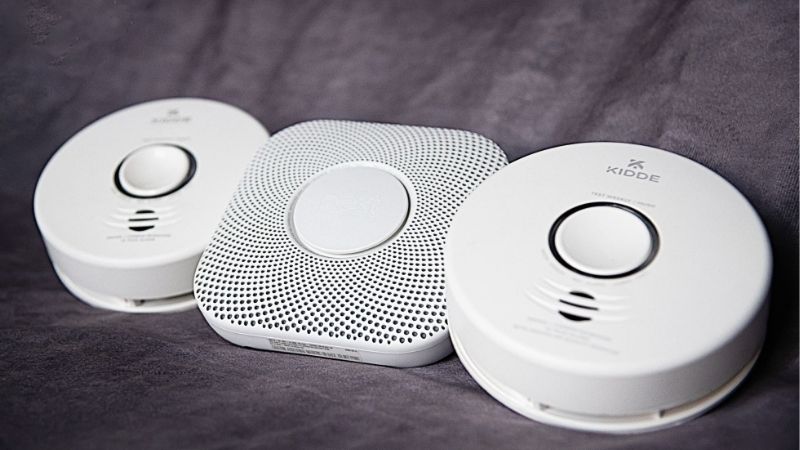
The SC5 measures 5.75 inches wide and 1.6 inches deep and weighs about 1 pound, a standard round footprint for a ceiling can. Its constraint is interconnect: only select First Alert, BRK and Nest models link together, so you should physically test the system after installation rather than assume every old alarm will join.
Pros:
- Smoke and carbon monoxide in one unit
- Google Home support with mobile alerts
- Round 5.75 inch wide ceiling footprint
Cons:
- Higher price per unit
- Interconnect limited to select brands
Who Should Buy It: Pick the wired SC5 where 120-volt wiring exists; homes without that wiring should choose the battery SC5, or for smoke only the Kidde Ring RGSDR-RW, instead.
First Alert SC5 Battery: Best For a Battery Nest Protect Replacement
Best For: Rooms with no alarm wiring that still want smoke, carbon monoxide and the same Google platform support.
Compared with the hardwire SC5 above, this version swaps the 120-volt feed for replaceable batteries while keeping the sensing and app features, so it installs anywhere without an electrician.
First Alert’s product page lists the SC5 Battery as a smoke and CO alarm on the same Google Home and Nest platform as the wired model, powered by replaceable batteries with app status, at $129.99 as of October 2026, with Home Depot near $129.96.
The battery SC5 shares the family 5.75 inch wide body and roughly 1 pound weight, so it looks identical on the ceiling. Its trade-off is upkeep: it depends on batteries you must maintain and replace per the guide, and you cannot assume it will interconnect by wire with every existing alarm.
Pros:
- Smoke and CO without any wiring
- Same Google platform as the wired model
- Installs where no hardwire exists
Cons:
- Batteries need periodic replacement
- No native Apple HomeKit support
Who Should Buy It: Choose the battery SC5 for rooms without wiring; if you only need smoke sensing on a budget, look at the Kidde Ring RGSDR-RW instead.
Kidde Ring RGSDR-RW: Best Budget Ring Smoke Alarm
Best For: Ring households that want the cheapest way to add native smoke alerts to the app.
Set against the dual-hazard alarms here, this unit is smoke only, which keeps the price down and makes it the entry point for Ring users who already run the ecosystem.
Kidde’s RGSDR-RW product page confirms Ring app smoke notifications and compatible wireless interconnect, runs on two replaceable AA batteries, and lists at $49.97 as of October 2026, as a smoke-only alarm rather than a combination unit.
Kidde’s brochure lists the RGSDR-RW at about 5 inches in diameter out of the box and 0.86 pound, matching the 5 inch square and 1.88 inch deep form of its wired sibling. Its honest limit is coverage: there is no CO sensor, and while the local siren is free, optional Ring response monitoring is a paid add-on.
Pros:
- Lowest price here at $49.97
- Runs on two replaceable AA cells
- About 5 inch diameter out of the box
Cons:
- No carbon monoxide sensor
- Interconnect depends on compatible units
Who Should Buy It: Buy the RGSDR-RW for budget smoke alerts; shoppers who want an even cheaper standalone Wi-Fi alarm should look at the X-Sense XS01-WX instead.
Kidde Ring RGSAR-RW: Best For Wired Ring Smoke Only
Best For: Ring users with 120-volt wiring who want a hardwired smoke alarm with battery backup.
Unlike the AA-only RGSDR-RW, this model draws from house power with AA backup, so it suits homes that already run wired alarms and want Ring alerts layered on.
Kidde’s RGSAR-RW product page confirms Ring app alerts, 120-volt hardwiring and a two-AA backup, listed at $54.98 as of October 2026, with wireless interconnect compatibility that the maker notes is model dependent.
Kidde’s data sheet lists the RGSAR-RW at 5 inches wide and 1.88 inches deep, weighing 0.4 pound out of the box, a slim round can. Its caveat is mixing power types: vendor answers about interconnecting battery and wired Ring units have been contradictory, so do not promise a mixed setup without checking the current manual.
Pros:
- 120-volt wired with AA backup
- Native Ring app alerts
- Slim 1.88 inch deep body
Cons:
- Needs a safe hardwired install
- No carbon monoxide detection
Who Should Buy It: Pick the RGSAR-RW for a wired Ring smoke alarm; buyers who want carbon monoxide in a comparable wired unit should look at the First Alert SC5 Hardwire instead.
Kidde Ring RGCUDR-RW: Best For Battery Ring Smoke Plus CO
Best For: Ring homes that want smoke and carbon monoxide coverage on batteries with app alerts.
Compared with the smoke-only Ring units, this model adds CO sensing, so it is the dual-threat battery option for people already in the Ring app.
Kidde’s RGCUDR-RW product page confirms smoke and carbon monoxide sensing with Ring notifications, runs on two AA batteries, and lists at $69.97 as of October 2026, with optional Ring monitoring at about $5 a month that is not required for the local siren.
Kidde’s brochure lists the RGCUDR-RW at roughly 5 inches in diameter out of the box and about 1.0 pound, on the same round body as its smoke-only siblings. Its trade-off is cost and upkeep: it runs more than the smoke-only RGSDR-RW and needs battery maintenance, and interconnect still requires precise pairing.
Pros:
- Smoke and CO in one battery unit
- Native Ring real-time alerts
- About 5 inch diameter round body
Cons:
- Costs more than smoke-only RGSDR-RW
- Battery maintenance required
Who Should Buy It: Choose the RGCUDR-RW for battery smoke and CO in the Ring app; for a Google-platform wired unit, the First Alert SC5 Hardwire is the alternative.
X-Sense XS01-WX: Best For a Wi-Fi Entry Model
Best For: Budget shoppers who want direct Wi-Fi smoke alerts without buying into a larger ecosystem.
Against the brand-tied alarms here, the X-Sense connects straight to 2.4GHz Wi-Fi, which makes it the cheapest standalone way to get phone alerts, with a caveat on paperwork.
The XS01-WX product page from X-Sense describes a 2.4GHz Wi-Fi smoke alarm with an on-device sound and replaceable batteries, not a CO detector, at a $39.99 regular price with an observed $27.99 sale as of October 2026; the sale figure should not be treated as the list price.
The XS01-WX measures 3.0 inches wide and 1.9 inches deep and weighs about 0.20 pound, the smallest body here. Its real limitation is documentation: it does not sense carbon monoxide, it is not compatible with the SBS50 base station, and a model-level UL 217 listing was not retrieved in this research, so it cannot claim the top safety slot.
Pros:
- Direct 2.4GHz Wi-Fi at $39.99
- Compact 3.0 inch wide body
- Replaceable batteries
Cons:
- Cannot sense carbon monoxide at all
- UL 217 model listing not retrieved in this research
Who Should Buy It: Buy the XS01-WX for a low-cost Wi-Fi smoke alert; for a documented dual-hazard unit, the First Alert SC5 Hardwire is the stronger choice.
How to Choose a Smart Smoke Alarm
A connected alarm still has to be a good alarm first, so judge the safety basics before the app. Four questions sort the field.
Confirm a Local Siren and the UL 217 Standard
Every pick must sound on the device itself and carry UL 217, the residential smoke standard, which is separate from UL 2034 for carbon monoxide and UL 1484 for gas. A phone alert is a supplement, so prioritize a model whose smoke listing you can confirm, and treat a missing registry record as a reason to pause.
Decide Between Hardwire and Battery
Match power to your home. A 120-volt hardwired alarm suits houses with existing alarm wiring and interconnect, while a battery unit installs anywhere but needs upkeep. Note that wired and battery models from the same line do not always interconnect, so confirm limits before mixing them.
Check the Native App, Not a Listener
Make sure alerts come from the alarm itself, not from a separate smart speaker listening for a beep. A native app alarm pushes a notification directly, but remember that app alerts depend on power and internet, so the local siren is what protects you during an outage.
Compare Per-Unit Price, CO and Expiry
Count the real per-alarm cost and what it covers. The Kidde Ring smoke-only RGSDR-RW at $49.97 steps up to $69.97 for the smoke-plus-CO RGCUDR-RW, a $20.00 difference for the added hazard, while the First Alert SC5 adds CO and Google support at $129.99. Alarms also expire, typically at 10 years from the manufacture date, so factor replacement in.
Frequently Asked Questions
These answers address the setup and safety questions connected-alarm buyers raise most.
Is a smart speaker smoke listener the same as a smoke alarm?
No. A listener only recognizes an existing alarm’s sound and forwards a notification; it does not detect smoke itself. You still need a listed smoke alarm on the wall or ceiling.
Do app alerts work when the power or internet is out?
Not reliably. App notifications depend on power and a working connection, so during an outage the local siren is your protection. That is why every pick here sounds on the device itself.
Where should smoke alarms be installed?
Place them inside each bedroom, outside every sleeping area and on every level of the home, and test monthly. The US Fire Administration guidance and each maker’s manual set the specifics for your layout.
How often should a smart smoke alarm be replaced?
Replace each alarm by its manufacturer date, typically after 10 years, regardless of battery type. A 10-year rating refers to the device life, not a guaranteed battery runtime.
Final Thoughts
For a wired home the First Alert SC5 Hardwire stays the pick because it pairs smoke and carbon monoxide with Google Home support, while battery homes can take the SC5 Battery, Ring users have three native options and budget shoppers can start with the X-Sense; before you order, confirm the model’s UL 217 marking and interconnect limits on the listing, and have an electrician handle any 120-volt work.