Key takeaways
- Manufacturer rates maximum output at 1,300 CFM and 160 MPH.
- Included attachment changes discharge direction from side toward the front.
- Rear 12-inch solid wheels avoid routine tire inflation.
A walk behind leaf blower starts making sense when leaves cover long driveways, broad lawns, parking areas, or paths that would take repeated trips with a handheld blower. But the wheeled format carries a cost: machines are heavy, their discharge can move gravel as well as leaves, and a motorized wheel drive is not standard. This comparison covers five identifiable gasoline-powered U.S. models, from a homeowner-priced Champion to a self-propelled Little Wonder built for extended grounds work.
Quick Verdict: The Champion 200947 is our Best Overall choice for most large-yard owners: its published 1,300 CFM and 160 MPH, adjustable discharge and $599 Home Depot listing make the purpose of the machine clear without a commercial-equipment price. A professional clearing long paved runs should consider the self-propelled Little Wonder 9270-12-01 instead. These editorial judgments use manufacturer specifications and current retailer or dealer listings as of October 2026, not testing performed by our team.
As an Amazon Associate we earn from qualifying purchases.
By DIY Ideas 4 Home Editorial Team
The 5 Best Walk-Behind Leaf Blowers Reviewed
We selected current named models rather than generic blower categories, compared manufacturer-published engine, discharge, drive and physical specifications, and checked U.S. sellers for actual asking prices. Entry-level gas wheeled blowers in these listings begin near $600, compact dealer machines sit around $975, and professional equipment runs beyond $4,000 as of October 2026. Airflow figures are not measured identically or published by every brand: Little Wonder and Champion quote CFM and MPH, while Billy Goat’s U.S. F6/F9 pages give air velocity without a comparable CFM rating. No ranking here treats an unreported number as zero.
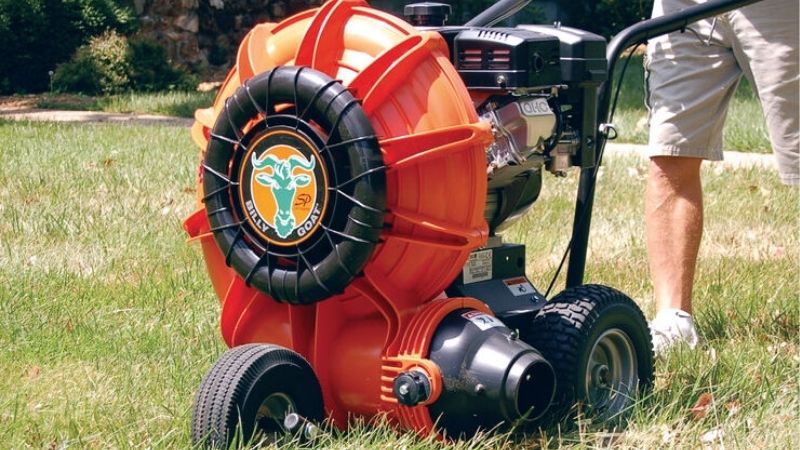
| Product | Best For | Key Spec | Listed Price (as of October 2026) | Watch Out For |
|---|---|---|---|---|
| Champion 200947 | Best Overall: sizable residential yards | 224cc; 1,300 CFM; 160 MPH; push drive | $599.00 at Home Depot | 104 lb; gas engine; no powered drive |
| Billy Goat F602X | Tight routes and compact storage | 208cc; just under 200 MPH; 22-in width | $974.99 at Southern States Milford | 83 lb but no self-propulsion; airflow CFM not stated |
| Billy Goat F902H | Contractor paths and controlled discharge | 262cc Honda; just under 200 MPH; 4-in outlet | $2,099.00 at Pro-Mow Equipment Sales | 143 lb push machine; 29.25-in width |
| Little Wonder 9160-04-01 | Dense windrows on open ground | 208cc; 1,700 CFM; 190 MPH; push drive | $1,704.22 at HTS Supply | 108 lb; manual rather than remote airflow control |
| Little Wonder 9270-12-01 | Long routes needing powered wheels | 270cc Honda; 2,260 CFM; 143 MPH; self-propelled | $4,149.00 at Russo Power Equipment | 202 lb; expensive and often supplied after dealer lead time |
Champion 200947: Best Overall for Large Yards
Best For: Homeowners clearing lengthy lawns and driveways who want substantial wheeled airflow without a professional machine’s purchase cost.
Most home properties do not require a contractor’s transmission or an engine that occupies most of a garden shed. The Champion is the most approachable complete blower here because its price is less than half that of several specialist dealer machines and the front wheel pivots for maneuvering around beds. The trade-off is ordinary human pushing power: it can shift leaves quickly, but it does not pull itself up an incline. The adjustable throttle is more useful near loose mulch than a single maximum-output setting.
Champion’s official 200947 product page publishes maximum air volume of 1,300 CFM and maximum air velocity of 160 MPH for its 224cc four-stroke engine. Its 200947 operator’s manual identifies the cited maximum figures as rated under ANSI/OPEI B175.2 and gives a sound-pressure figure of 85 dB(A) measured at 20 feet. That rating is not a promise of quiet operation close to the handle. Home Depot’s October 2026 listing displayed $599.00 for model 200947, including the forward-flow attachment. It is the most accessible documented price point in this specific comparison, not a guarantee of the lowest market price in every ZIP code.
At 104 pounds and approximately 35.9 inches long, 26.8 inches wide and 47.4 inches high, this blower still needs floor space and deliberate loading. Champion’s product page specifies 12-inch never-flat rear wheels, a lockable or swiveling front wheel and a handle that can fold for storage. The 0.8-gallon fuel tank and four-stroke engine mean fuel, engine-oil checks and seasonal service remain part of ownership. Champion publishes a two-year limited warranty and lifetime technical support, though coverage conditions should be confirmed in its warranty document. Work away from windows, parked cars and gravel paths when the discharge could propel stones.
Pros:
- Manufacturer rates maximum output at 1,300 CFM and 160 MPH.
- Included attachment changes discharge direction from side toward the front.
- Rear 12-inch solid wheels avoid routine tire inflation.
Cons:
- The 104-pound chassis still requires pushing across uneven grades.
- A published 85 dB(A) rating at 20 feet warrants hearing protection.
Who Should Buy It: Choose the Champion 200947 for occasional substantial residential cleanup; choose the Little Wonder 9160-04-01 if documented higher CFM for frequent heavy leaf windrows matters more than acquisition cost.
Billy Goat F602X: Best for Tight Routes
Best For: Owners of narrow paved approaches who value a smaller rolling footprint over published airflow-volume comparisons.
A compact wheeled blower earns its place when the storage doorway and the path between plantings are more restrictive than the leaf load. Billy Goat’s F602X has the narrowest specified chassis in this shortlist, so it may reach areas that exclude the broader F902H or either Little Wonder machine. Its composite rounded housing also avoids the rust risk associated with an exposed steel blower shell, although the engine, fasteners and wheels still require routine care. Buyers who need a numeric CFM-versus-CFM matchup will find its published specification less helpful than Champion’s.
Billy Goat’s U.S. F6 Force Blower product page identifies the F602X’s 208cc Briggs & Stratton XR950 engine, 16-inch composite fan with 16 blades, and published air velocity of just under 200 MPH. It does not provide a standardized CFM value for this model, so its higher velocity wording cannot honestly be converted into greater debris-moving capacity than the Champion. Southern States Milford Co-Op listed a new 2025 F602X at $974.99 in October 2026; that is a specific dealer offer for a named stocked unit, not a national manufacturer MSRP. Its Aim N Shoot control redirects the output while the operator remains behind the handle.
The U.S. F6 specification lists the F602X at 83 pounds, 43.5 inches long and 22 inches wide, with a 45-inch handle height. Rear 10-inch pneumatic tires provide some compliance on paved-to-grass transitions, while an 8-inch semi-pneumatic front wheel does not require the same inflation routine. There is no wheel-drive mechanism, and the folding handle helps only after the engine has stopped and cooled. Billy Goat’s F6 warranty page distinguishes its one-year housing warranty from the Briggs consumer and commercial engine terms; check the exact claim coverage before assuming the machine receives the longer warranties attached to other Force series.
Pros:
- Specified 22-inch chassis width helps with shed-door clearance.
- Lightest documented machine here, at 83 pounds.
- Aim N Shoot control directs airflow without repositioning the whole unit.
Cons:
- Manufacturer does not list CFM for direct airflow-volume comparison.
- The 208cc push machine may struggle on steep lawns without assistance.
Who Should Buy It: Choose the Billy Goat F602X for storage-constrained routes; choose Champion 200947 when a published 1,300 CFM figure and lower listed purchase price are higher priorities.
Billy Goat F902H: Best for Contractor Paths
Best For: Maintenance crews needing precise discharge near fences, curbs and repeated commercial clearing routes with room for a larger push unit.
The F902H moves beyond the compact F6 format into a chassis designed around persistent debris-clearing work. Its factory forward-discharge arrangement can be useful beside fences and walls, where a sideways jet forces repeated repositioning. Unlike the Little Wonder self-propelled choice, it remains a push machine, so operators should not confuse greater engine capacity with easier travel uphill. The sensible reason to pay for this version is its discharge control, pneumatic wheel setup and service-focused construction, not a claim that it automatically outperforms every other model’s CFM.
Billy Goat’s U.S. F9 Force Blower specifications list a 262cc Honda engine, a 17-inch 16-blade composite fan, a 4-inch discharge and velocity described as just under 200 MPH. No numeric airflow-volume rating appears on that U.S. product page. Pro-Mow Equipment Sales had a new 2026 F902H listed in stock at $2,099.00 in October 2026, a dealer asking price that may change with freight and setup. Billy Goat’s page also distinguishes a three-year Honda engine term, two-year machine term and five-year housing term. Verify those warranty periods against the applicable registration and commercial-use conditions.
The larger housing is about 58 inches long, 29.25 inches wide and 45 inches high at the handle, and the listed machine weight is 143 pounds. Billy Goat equips it with 13-inch pneumatic rear wheels and a 10-inch pneumatic front wheel; its accessories include a parking-brake kit, caster kit and foam-filled front-tire option. These upgrades can make sense for crews moving between sites, but they introduce extra expense rather than being part of the quoted base machine. The heavier push chassis will still demand effort on inclines, wet turf and sharp turns, and trailer securing should follow the owner’s manual.
Pros:
- Standard forward discharge supports focused work along walls and fencing.
- 13-inch pneumatic rear wheels aid movement over imperfect paved approaches.
- Manufacturer specifies a 17-inch fan and 262cc Honda engine.
Cons:
- At 143 pounds, repeated uphill pushes can tire an operator.
- The base $2,099 dealer listing excludes optional brake and caster kits.
Who Should Buy It: Buy the Billy Goat F902H when directional control is critical for a crew with sufficient physical access; choose Little Wonder 9270-12-01 for powered travel on longer routes instead.
Little Wonder 9160-04-01: Best for Dense Leaf Rows
Best For: Owners moving thick windrows across open lawns who want published professional airflow without paying for powered wheels.
This push Optimax is a compelling middle step between homeowner equipment and heavy self-propelled units. Its maker publishes more air volume than Champion and gives both CFM and MPH figures, making the performance case easier to understand than on Billy Goat models with unpublished CFM. Little Wonder uses an all-steel housing and a low discharge, a construction choice aimed at moving stubborn debris in a concentrated path. However, the manual rather than handle-remote flow control means an operator who constantly changes direction may prefer a more expensive Optimax configuration.
Little Wonder’s product page for the Optimax Push Blower and its Optimax specification sheet identify SKU 9160-04-01, a 208cc Briggs & Stratton XR 6.5 engine, 17-inch seven-blade impeller, maximum listed 1,700 CFM and 190 MPH. Its 0.8-gallon fuel tank is comparable in nominal capacity to Champion’s, but that alone cannot predict fuel use per hour. HTS Supply’s October 2026 listing displayed $1,704.22, compared with its higher crossed-out reference price. These are manufacturer-stated performance figures and a third-party dealer offer, not results of our independent field measurement. Front/side discharge is integrated, but the 9160 series uses manual air-flow control instead of the remote arrangement on the larger models.
At 108 pounds and 56 inches long, 28 inches wide and 42 inches tall, the steel machine needs considerably more shed depth than Champion 200947 despite similar scale on the ground. Its 10-inch pneumatic front and rear wheels suit regular paved or fairly even lawn approaches, and the company documents a two-position adjustable handle. The manufacturer advertises a strong welded-steel construction; practical ownership still means checking tire pressure, clearing the housing with the engine off and maintaining a four-stroke motor. If your route contains frequent curbs or gate openings, think about clearance and maneuverability before the higher CFM tempts you.
Pros:
- Little Wonder documents 1,700 CFM and 190 MPH for this SKU.
- Seventeen-inch seven-blade impeller sits inside a welded steel housing.
- Integrated front or side outlet supports long leaf-row passes.
Cons:
- Manual airflow adjustments interrupt frequent changes of direction.
- A 56-inch overall length complicates storage in shallow sheds.
Who Should Buy It: Choose Little Wonder 9160-04-01 for open-ground airflow at a mid-professional budget; choose Billy Goat F602X when 22-inch width and lower handling weight matter more.
Little Wonder 9270-12-01: Best Self-Propelled
Best For: Commercial operators clearing long runs who need mechanical wheel drive more than the convenience of a compact machine.
This is the outlier that changes how the work feels rather than merely increasing the blower’s size. While the other four picks rely on the operator to move the wheels, Little Wonder’s 9270-12-01 propels itself forward or backward through a variable-speed drivetrain. That is useful when clearing large campuses or multi-property contracts, particularly where numerous heavy leaf rows demand repeated passes. The penalty is significant capital cost and a much heavier machine to load, transport and store; self-propulsion does not remove the need to steer or work safely around slopes.
Little Wonder’s product page for the Self-Propelled Optimax lists the Honda GX270 at 270cc, a 17-inch seven-blade impeller, 2,260 CFM and 143 MPH. The maker specifies forward travel up to 4.1 MPH and reverse travel up to 2.5 MPH, with an operator-controlled split-stream deflector and 1.4-gallon fuel tank. Russo Power Equipment’s October 2026 listing showed the exact SKU 9270-12-01 at $4,149.00 with typical sourcing of five to ten business days, subject to manufacturer lead time. Note that the higher CFM and lower reported MPH relative to the 9160 are both real published specifications: air volume and velocity describe different properties and neither one predicts all debris conditions.
The manufacturer identifies a weight of approximately 202 pounds, dimensions of 58 inches long by 28 inches wide by 43 inches high, and pneumatic tires sized 10 inches in front and 13 inches at the rear. A variable-speed belt-driven chain transmission with an open-center differential adds moving parts and maintenance considerations absent from push-only designs. Little Wonder’s current resources should govern transmission service, belt inspection, operator control use and transport tie-downs. This investment fits operators who can recover its expense through repeated work; the motorized drivetrain offers much less value for a few autumn afternoons on a typical suburban lot.
Pros:
- Forward and reverse drive speeds are adjustable up to published limits.
- Maker lists 2,260 CFM with remote split-stream discharge control.
- The 1.4-gallon tank is larger than the 9160’s specified capacity.
Cons:
- At approximately 202 pounds, transport demands proper loading equipment.
- The $4,149 asking price is difficult to justify for occasional cleanup.
Who Should Buy It: Consider Little Wonder 9270-12-01 for recurring grounds contracts; choose Billy Goat F902H for controlled contractor discharge without the higher drivetrain cost.
How to Choose a Walk-Behind Leaf Blower
The purchase decision begins with the route, not the biggest engine. A narrow garden entry, wide parking area and sloping institutional lawn pose different problems even with the same volume of fallen leaves. Check the property’s hard-surface length, the likely debris depth and whether a machine must be loaded into a truck each week. The next four checks distinguish published output from operator convenience and prevent you from paying for capability that creates new handling problems.
Compare CFM and MPH as Separate Measures
CFM describes air volume, while MPH reports air velocity. A large airflow volume helps move broad loose windrows, and a focused high-velocity stream can dislodge heavier debris, but nozzle shapes and the maker’s measurement conditions influence the numbers. Champion quotes 1,300 CFM and 160 MPH, Little Wonder lists 1,700 CFM and 190 MPH for the 9160, and 2,260 CFM and 143 MPH for the 9270-12-01. Those published figures are useful screening information, not a same-day lab comparison on identical leaves.
Billy Goat’s F602X and F902H instead describe air velocity as just under 200 MPH on their U.S. product pages. Because the accompanying CFM figures are absent, neither can be fairly positioned on a chart of air volume beside the Champion or Little Wonder units. If wet oak leaves and large turf expanses dominate your work, ask the dealer for a demonstration under realistic conditions instead of guessing output from engine displacement. Even a strong blower will move small stones, so direct its outlet away from people, glass and parked vehicles.
Choose Push or Self-Propelled Drive
Push wheel drive is the default across the Champion 200947, Billy Goat F602X and F902H, and Little Wonder 9160-04-01. A push blower can be simpler to service and less expensive up front, but all its engine power goes to moving air, not the wheels. The difference matters after repeated turns across grades, soft turf or lengthy paved stretches. Think about the same operator repeating the route at the end of a long landscaping shift, not simply pushing the machine a few yards in a showroom.
Little Wonder’s 9270-12-01 provides variable-speed forward and reverse drive. Its weight is much higher at 202 pounds, so the transmission improves movement during work but not lifting it onto a trailer. It also introduces drive-belt and chain servicing. Homeowners clearing a driveway a few weekends per season rarely get enough usage to justify that complexity; maintenance crews operating across several sites may find the assistance more important than peak airspeed.
Check Tires, Width, Weight, and Gate Clearance
Measured width is a nonnegotiable constraint: the F602X is 22 inches wide, Champion is 26.8 inches, the two Little Wonder choices are 28 inches, and F902H is 29.25 inches. Before ordering, measure the smallest usable gate or shed opening, including hinges, latches and obstacles, and allow a safe turning margin. A machine that technically fits a gate with no clearance may still be impractical to steer through on uneven ground. Storage length also differs: the compact Champion measures 35.9 inches, while a Little Wonder push unit is about 56 inches long.
Tires and loading weight shape the experience more than a brochure’s generic description of maneuverability. Champion’s solid rear tires avoid puncture and inflation maintenance; the Little Wonder machines use pneumatic wheels for a different ride feel, and Billy Goat’s F902H has taller 13-inch rear wheels. The published machine weights span 83 to 202 pounds, excluding any trailer or optional accessories. Match the ramp’s rated load capacity, the vehicle’s tie-down points and the available storage floor before spending money. Avoid pushing a running blower on slopes that exceed its operator guidance.
Budget for Engine Care and Local Rules
All five selected models use gasoline engines; these are not electric cordless blowers. A four-stroke engine needs the oil grade, service intervals, fuel handling and storage precautions described in its own manual. Champion’s included oil and front-flow attachment reduce some first-day add-on costs, while a Little Wonder transmission or Billy Goat optional parking brake changes the maintenance and accessory budget. Compare a machine’s true delivered cost, including any dealer setup, freight, applicable tax, optional accessories and maintenance parts, rather than only its advertised price.
Noise and emissions restrictions vary by city, county and state, and a manufacturer statement of EPA or CARB conformity does not mean a gas blower is allowed during every local quiet hour. Champion rates 85 dB(A) at 20 feet for the 200947, which does not describe the operator’s exact exposure. Wear hearing and eye protection, keep bystanders away from the discharge and stop the engine before clearing a blocked outlet. Gas-powered blowers also must not be run inside enclosed garages or sheds because exhaust contains carbon monoxide. Confirm local use rules and service support with a dealer before buying.
Frequently Asked Questions
These buyer questions address ownership details that can change the decision after you narrow the models by airflow, price and drive type.
Can a Walk-Behind Blower Replace a Leaf Vacuum?
No. A wheeled blower moves leaves across the property into rows or piles, whereas a leaf vacuum collects them into a bag, trailer or other container. A blower can accelerate the first part of a large cleanup, but you still need a rake, pickup method or collection service to remove the material. If the actual problem is disposal volume, compare dedicated mulching and collection equipment instead of assuming a higher-CFM blower reduces the final bag count.
Do Walk-Behind Blowers Work on Gravel Driveways?
They can move leaves across gravel, but a concentrated jet may also propel stones, especially at close range. Start with lower throttle or angle the outlet away from loose material, and keep people, glass and vehicles outside the discharge path. Work from an area where the operator can see the material being moved and never treat the manufacturer’s top MPH rating as a recommended setting for gravel. A demonstration on a matching surface is useful before choosing a more powerful machine.
How Should I Store a Gas Blower for Winter?
Follow the specific engine manual rather than a universal fuel-storage shortcut. Let the engine cool fully, clean dry leaves from the cooling intake and housing, inspect fasteners and tires, and follow its instructions on fuel treatment or draining. Store the machine upright in a ventilated place away from heaters and ignition sources. A folding handle, as on Billy Goat’s F602X, helps fit a lower storage space but does not remove gasoline vapor or carbon-monoxide hazards.
Are Walk-Behind Leaf Blowers Legal Everywhere?
No. Gas-powered landscape equipment can be subject to local noise ordinances, permitted operating hours and restrictions on particular engine types or equipment classes. Rules also change, so do not infer permission from a nationwide retailer listing or an EPA-related claim on a product page. Check the current municipal code and any property or homeowners-association restrictions for where you will operate, then confirm the model and emission label with your dealer if state-specific sale rules apply.
Final Thoughts
Champion 200947 remains our Best Overall walk behind leaf blower for substantial residential fall cleanup because its 1,300 CFM and 160 MPH specifications, adjustable outlet and documented $599 listing offer a clear purchase case. A job site changes the decision when machine travel becomes the main source of fatigue: Little Wonder 9270-12-01 has powered forward and reverse wheels for that workload, while the narrower Billy Goat F602X is easier to place in tight access routes. Measure your gate and ramp first, verify gas-blower restrictions for the property, and ask the seller to confirm the exact model, included attachments and October 2026-era quote before paying.