Key takeaways
- Adjustable skids are explicitly covered in the 38838 operating instructions.
- Twenty-eight-inch path covers winding residential routes without a 30-inch chassis.
- Six forward and two reverse speeds suit variable snow density.
A gravel driveway snow blower has a different job from a machine that scrapes bare pavement. Its intake must travel above loose stones while moving enough snow to keep a long, unpaved entrance passable. Two-stage machines with adjustable skid shoes are the practical starting point, but not every blower handles turns, ruts, packed snow, and storage equally well. These five choices range from a relatively affordable 24-inch gas unit to an adjustable-height tracked model and a 28-inch cordless kit.
Quick Verdict: The Toro Power Max HD 828 OAE 38838 is our Best Overall pick for most established gravel drives because its adjustable skids, 28-inch intake path, and assisted steering balance coverage with controllability. Choose the Honda HSS724ATD instead when variable surface height and traction matter more than purchase cost. This is an editorial comparison of published documentation as of October 2026, not an in-house equipment test.
As an Amazon Associate we earn from qualifying purchases.
By DIY Ideas 4 Home Editorial Team
5 Snow Blowers for Gravel Driveways Reviewed
Selection started with a nonnegotiable requirement: a two-stage pickup design and a manufacturer-documented way to keep the scraper and auger housing above loose aggregate. We then compared maneuverability, working width, machine size, starting method, and the actual US model configuration. Toro’s operating manual, Ariens’ skid-shoe guidance, Honda’s specification comparison, Husqvarna’s ST 224/227/230 manual, and EGO’s product documentation informed the surface-specific assessment. Published asking prices range from approximately $1,099 to $3,299 as of October 2026; regional dealers, freight, battery bundles, and seasonal promotions can change checkout totals.
| Product | Best For | Key Spec | Listed Price (as of October 2026) | Watch Out For |
|---|---|---|---|---|
| Toro Power Max HD 828 OAE 38838 | Best Overall: varied home driveways | 28-in path; 252cc; two-stage; adjustable skids | $1,749.00 Toro list | Gas upkeep and dealer-only online availability |
| Ariens Classic 24 920036 | Best Value: shorter gravel entries | 24-in path; 212cc; two-stage; skid adjustment | $1,099.00 Home Depot | Narrower pass, simpler steering controls |
| Honda HSS724ATD | Best for rutted slopes | 23.8-in path; track drive; adjustable auger height | $3,299.00 Honda MSRP | 243-lb weight and premium price |
| Husqvarna ST 230 970528802 | Best for wide straight runs | 30-in path; 23-in intake; skid plates | $1,599.00 Husqvarna MSRP | 31-in body width needs storage clearance |
| EGO POWER+ SNT2807 | Best for cordless clearing | 28-in path; 2 x 12.0Ah batteries; two-stage | $2,419.00 Ace Hardware | Cold-battery planning and higher kit cost |
Toro Power Max HD 828 OAE 38838: Best Overall
Best For: Homeowners clearing moderate to long gravel routes with turns, parked vehicles, and recurring plow banks.
Toro earns the all-around position for combining a broad path with steering that is less cumbersome than simply wrestling a wide, heavy chassis around each bend. The triggerless steering helps when the first lane follows a curved driveway instead of a straight parking pad. Unlike a compact machine, the 828 OAE has the intake capacity to make repeat passes through plow-packed edges less tedious. Its real compromise is ownership: this is a gasoline machine that needs fuel management, periodic service, and a safe outdoor starting area.
Toro’s product page for model 38838 specifies a 252cc four-cycle engine, 28-inch clearing width, 21-inch intake, six forward and two reverse speeds, and an advertised throwing distance up to 45 feet under favorable conditions. The same product page lists $1,749.00 in October 2026. Crucially, Toro’s Power Max HD 828 OAE operator manual describes adjustable skids for gravel, warning that they must be set lower to keep rocks from entering the machine. Its quoted distances are performance claims, not an independently measured distance on wet gravel snow.
Storage takes planning because Toro’s manual gives approximate overall dimensions of 63 inches long and 29 inches wide. The official product listing quotes about 240 pounds, while an available manual version lists 256 pounds; confirm the specification for the dealer’s exact revision before choosing loading equipment. Replace or invert worn skids as the manual allows, inspect the scraper, and use the supplied chute cleanout tool only after a full shutdown. On exposed aggregate, a neat pavement-level finish is not the goal; leaving a thin snow layer is preferable to launching driveway stones.
Pros:
- Adjustable skids are explicitly covered in the 38838 operating instructions.
- Twenty-eight-inch path covers winding residential routes without a 30-inch chassis.
- Six forward and two reverse speeds suit variable snow density.
Cons:
- The 252cc gasoline engine requires fuel handling and seasonal servicing.
- Dealer availability and machine weight complicate an impulse online purchase.
Who Should Buy It: Select the 38838 for a mixed-width property where quick direction changes matter; consider Honda HSS724ATD for uneven grades where tracked traction and front-height control justify a higher budget.
Ariens Classic 24 920036: Best Value
Best For: Households with a manageable unpaved driveway and a firm spending ceiling near the lower end of the two-stage market.
The Classic is compelling for a different reason: it puts the surface-control feature that matters most on gravel into a straightforward 24-inch machine without asking the owner to pay for every premium steering feature. A narrow housing is often more practical at a gate, beside a parked truck, or near a mailbox. It cannot match the pass width of the Husqvarna ST 230, and there is no reason to buy it if clearing acres of driveway after every storm is the routine. For ordinary residential use, simpler controls may also be easier to learn and maintain.
The manufacturer’s product page for Ariens model 920036 names a 24-inch clearing path, an AX 212cc engine with electric start, a steel 11-inch serrated auger, and the Classic’s 2.5X quick-turn chute design. Home Depot’s current manufacturer-branded listing shows $1,099.00 for this exact 920036 configuration. Ariens’ guidance on snow-blower performance specifically recommends adjusting the skid shoes with 1/2-inch spacers for gravel, compared with 1/8-inch spacers on smooth pavement. That is a manufacturer setup example, not a universal safe clearance for every rock size or surface.
Home Depot gives the 920036 overall dimensions as approximately 54.4 inches deep, 26.4 inches wide, and 42.9 inches high. Those numbers matter when the storage door has less space than the driveway itself. The Classic line carries a three-year residential warranty according to Ariens’ current series page; keep purchase documentation, check the actual machine’s serial number, and source the approved shear bolts before the first major storm. Its lower cost is meaningful only if the narrower housing will finish the typical job without excessive repeat passes.
Pros:
- Published $1,099 price provides a grounded lower-cost two-stage option.
- Twenty-four-inch class footprint fits tighter entrances and typical residential sheds.
- Ariens publishes distinct 1/2-inch gravel and 1/8-inch pavement setup guidance.
Cons:
- Twenty-four-inch coverage adds passes on a very broad parking area.
- Basic steering demands more active turning than Toro’s 38838.
Who Should Buy It: Buy model 920036 if most clearing is narrow and predictable; move to Husqvarna ST 230 when a 30-inch open run would justify a much wider intake.
Honda HSS724ATD: Best for Rutted Slopes
Best For: Owners with uneven gravel grades who will pay for tracked propulsion and adjustable front-housing position.
Honda is the specialist choice because its track drive and independently adjustable auger-housing height address problems that a wider wheeled machine does not solve by itself. On an entrance with a crest, wheel ruts, or changing snow buildup, controlling front contact is valuable. The hydrostatic drive also avoids forcing the operator to choose between a few preset forward ratios. This premium configuration is hard to justify on a short flat drive, but it addresses the most demanding topography in this group with more than a large engine number.
Honda’s comparison sheet for the HSS724ATD confirms a GX200 196cc four-stroke engine, a 23.8-inch clearing width, 21.7-inch clearing height, hydrostatic tracked drive, skid shoes, and thumb-operated gas-strut auger-height adjustment. The DC electric start belongs to the ATD version, not the otherwise related recoil-start AT model. Honda’s snow-blower product listing shows $3,299.00 MSRP for the ATD, compared with $2,799.00 for the AT. These are different purchase configurations, so do not substitute the AT price when ordering electric start.
At 58.5 inches long, 24.8 inches wide, 43.5 inches high, and 243 pounds dry, the ATD requires a deliberate storage and transport plan. Honda specifies a three-year residential warranty, but its hydrostatic drive, track adjustment, and associated service parts are reasons to locate a nearby servicing dealer first. Front-height adjustment does not eliminate the danger of a rock entering the impeller; evaluate exposed aggregate before each pass and maintain the clearance prescribed in the applicable Honda owner’s manual. On a mixed gravel-and-pavement route, avoid assuming one housing position is right everywhere.
Pros:
- Track drive provides a distinct traction option for uneven grades.
- Gas-strut control varies the auger housing height without fixed gear steps.
- ATD includes DC electric start alongside a recoil backup.
Cons:
- At $3,299 MSRP it costs substantially more than wheeled alternatives.
- A 243-pound tracked chassis is demanding to transport or reposition unpowered.
Who Should Buy It: Choose HSS724ATD for rough terrain where adjustable front geometry matters; prefer Toro 38838 for a less expensive, more maneuverable wheeled machine on established gravel.
Husqvarna ST 230 970528802: Best for Wide Runs
Best For: Owners who have broad, mostly straight gravel approaches and adequate shed-door width.
Husqvarna places 30 inches of clearing width into a price bracket below the tracked Honda and cordless EGO kits. That is its advantage on a wide approach where each pass can be long and uninterrupted. The trade-off is physical: extra housing width and a 239-pound body are less pleasant among landscaping, tight corners, or cars parked along the lane. It should be chosen for open coverage, not because more width automatically makes the machine safer on aggregate.
Husqvarna’s ST 230 product page for NA article 970528802 lists 30 inches of working width, a 23-inch intake height, six forward transmission settings and one reverse, together with a $1,599.00 MSRP as of October 2026. The manufacturer’s ST 224, ST 227 and ST 230 owner’s manual explains how to change skid-plate height and says rough surfaces require the scraper to be above the top of the ground. It also specifically cautions that stones must not enter the equipment because ejected objects can cause injury. This makes the setup instruction more useful than a generic claim of gravel compatibility.
Its published assembled dimensions are 58.5 inches long, 31 inches wide and 41.5 inches high. The 239-pound weight and one reverse speed are worth considering before committing to a narrow turn-around near a garage. Husqvarna provides a model-specific support and parts page, where wear components and accessories can be checked ahead of a winter season. The large intake height is helpful when banks build up, but intake dimensions do not guarantee a certain clearing rate in heavy, refrozen snow.
Pros:
- Thirty-inch width reduces travel lanes across an expansive straight driveway.
- Husqvarna’s current manual covers skid-plate settings on rough ground.
- $1,599 MSRP undercuts several narrower premium two-stage designs.
Cons:
- Thirty-one-inch physical width creates access problems at narrow shed doors.
- One reverse setting is less flexible when backing around parked vehicles.
Who Should Buy It: Choose the ST 230 for long unobstructed passes; the Ariens Classic 24 920036 is easier to justify when gates and turning space are narrow.
EGO POWER+ SNT2807: Best for Cordless Clearing
Best For: Owners already invested in 56V EGO batteries who prefer indoor charging over gasoline engine upkeep.
EGO changes the operating routine rather than simply copying a gas machine. It brings a two-stage, self-propelled 28-inch layout into a battery platform, avoiding cold fuel starts and the smell of stored gasoline. Electronic chute adjustment and assisted steering are welcome when throwing toward a distant gravel-safe snowbank. The price is higher than several capable gas models, and a single long, wet-snow session may call for a charging pause or extra batteries. Its fit depends on how regularly the owner can recharge after a storm.
EGO’s product page for the SNT2807 identifies a 28-inch clearing width, 21-inch intake, two included 12.0Ah 56V battery packs, 200-degree electronic chute movement, and IPX4-rated weather resistance. It advertises snow throw up to 60 feet, a best-case figure rather than a guaranteed gravel-driveway outcome. Ace Hardware’s exact kit listing posts $2,419.00. EGO’s skid-shoe accessory documentation specifically describes use over uneven walks and gravel and lists compatibility with the SNT2807. Make sure the skid shoes are fitted and adjusted using the correct manual instructions before starting the auger.
EGO’s 2026 product catalog places bare-tool weight at 181 pounds for the SNT2807, excluding the two included batteries; the catalog also identifies rugged 16-by-5-inch tires. This is still a substantial unit to maneuver without powered drive. Unlike the gas picks, the main seasonal maintenance budget involves battery care, charging access and wear-part replacements rather than fuel, oil and engine service. The manufacturer states a five-year tool warranty and a five-year battery warranty with registration, subject to published warranty terms. Confirm charger type and battery count on the retail box.
Pros:
- The SNT2807 kit includes two 12.0Ah 56V battery packs.
- EGO explicitly lists gravel-driveway use for compatible replacement skid shoes.
- Twenty-eight-inch clearing, heated grips, and 200-degree electronic chute control.
Cons:
- $2,419 kit pricing is a large premium over Ariens Classic.
- Repeated heavy passes can require recharge time or costly spare batteries.
Who Should Buy It: Buy SNT2807 if you want a battery workflow for a substantial driveway; select Toro 38838 if refueling quickly during consecutive storms is more valuable than cordless convenience.
How to Choose a Snow Blower for a Gravel Driveway
Start with the driveway surface, not the power source. A properly set skid shoe controls how close the scraper travels to loose stones, and that can matter more than a nominal 45-foot or 60-foot throwing claim. Assess the size and mobility of the machine only after confirming the exact model’s manual includes safe adjustments for uneven ground. Gravel is not uniform: freshly spread pea gravel behaves differently from an older compacted driveway with larger aggregate.
Set Scraper Clearance Before the First Pass
Two-stage blowers use an auger to feed snow toward an impeller, so the machine must not scrape loose rock into that moving system. Ariens gives a useful concrete starting reference: place 1/2-inch spacers under the scraper ends for gravel, lower both skid shoes to the surface and tighten the fasteners evenly. The same Ariens article suggests 1/8-inch spacers on paved ground. That difference explains why bringing a snow blower directly from a concrete pad onto loose aggregate without resetting it is risky.
Different machines specify different setups. The Toro 38838 manual tells operators to set the skids lower on gravel so the machine does not collect rocks, while Husqvarna’s ST 230 family instructions say the scraper must remain above the highest points of rough ground. Follow your own model’s exact adjustment method and check whether the driveway’s stones protrude more than the example spacer height. After the first small trial pass, inspect for scratching, stone movement and unusually loud impacts. No adjustable blower makes loose rocks safe projectiles; point the chute away from buildings, vehicles, people and roads.
Match Width, Traction and Steering to the Terrain
Across these five machines, listed clearing widths range from Honda’s 23.8 inches to Husqvarna’s 30 inches. A wide bucket can shorten travel along a straight country lane, but it makes turns between cars or near stone walls more awkward. Toro’s assisted steering favors changing directions, while Honda’s track drive and controllable auger height distinguish it when the ground undulates. A wheeled machine may be simpler to roll around in a shed with the engine off; tracks can improve winter grip but complicate moving a disabled unit.
For slopes, check the exact manufacturer’s safe slope limits before shopping by drive type. A track is not permission to operate at any angle or to cross a slick sidehill. Also measure the smallest opening from storage to driveway. The 31-inch-wide Husqvarna housing and the roughly 29-inch overall Toro manual measurement make the point: nominal clearing width does not equal transport width. A 24-inch machine can be a smarter choice when the shed opening or gate determines whether the machine can be used at all.
Compare Total Ownership Costs, Not Just Engine Size
The $1,099 Ariens gas unit, $1,599 Husqvarna, $1,749 Toro, $2,419 EGO battery kit and $3,299 Honda tracked model serve different jobs. Those are manufacturer or major-retailer US reference prices in October 2026, not guaranteed nationwide transaction prices. Dealer assembly, delivery, taxes and availability add to the real cost; the EGO price specifically refers to the kit with two batteries and a charger, not a bare tool. A low advertised price for an excluded charger or an alternate Honda start variant is not a fair comparison.
Budget for the consumables that follow surface contact. Skid shoes and scraper bars wear, especially where gravel has settled into hard ridges; inspect those parts before each winter and after impacts. Gas models need manufacturer-approved oil, fuel management and eventual engine service. Batteries need temperature-aware storage and charging, and replacing a high-capacity pack can be expensive. Purchase from a seller who can supply the exact shear bolts and scraper hardware for the model number on your machine, rather than assuming one brand’s parts will fit another.
Frequently Asked Questions
These answers cover everyday decisions after selecting the machine, including when not to clear all the way down, what to do with exposed gravel, and the hazards that remain even on an adjusted two-stage unit.
Can I remove every inch of snow from a gravel driveway?
No. On loose aggregate, attempting a pavement-clean finish can lower the intake enough to collect stones, particularly where the surface is rutted. A small remaining snow layer is an intentional trade-off for clearance and safety. If bare gravel is already visible through shallow snow, wait for more cover or use a hand tool in sensitive areas rather than forcing the auger lower. The correct remainder varies with the gravel size and surface condition, so inspect the actual ground instead of relying on a universal minimum depth.
Do tire chains solve the problem of picking up rocks?
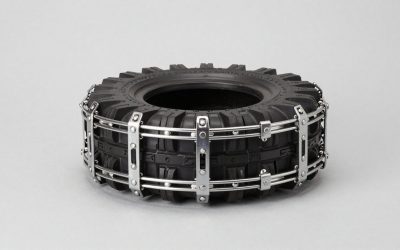
No. Chains can address some wheel-traction problems when approved for the tire and machine, but they do not change the height of the scraper bar relative to gravel. Ground clearance is set by the skid shoes or approved housing-height control. A wheel that grips more firmly may actually keep the blower moving into a stone-rich area unless the operator maintains proper clearance. Check accessory fitment and the manufacturer’s slope instructions before installing chains.
Can I use a single-stage snow blower on packed gravel?
Usually not as the first choice. Many single-stage machines use a rubber auger close to the surface to pull snow into the discharge path, which can expose loose gravel to the moving parts. A two-stage machine with documented adjustable skids is generally the more appropriate starting point, although its auger can still pick up stones if set too low. Confirm the specific machine manual and whether the gravel is compacted, covered by sufficient snow, or freshly spread before operating.
What if a stone jams the auger or discharge chute?
Stop immediately and do not reach into the chute or housing. The US Consumer Product Safety Commission instructs owners to shut the machine off and use a cleanout tool or a long stick, never their hands, for blockages. Follow the manual’s full shutdown procedure, including the ignition key or battery removal and any required waiting time. If a hard object struck the rotating components, inspect the shear protection and auger before restarting; have a service technician examine unexplained vibration or damaged parts.
Final Thoughts
Before ordering a gravel driveway snow blower, walk the full driveway without snow and mark raised stones, drainage grates, edging and the spots where gravel has migrated onto pavement; that simple survey may change the required machine width or front clearance. The Toro Power Max HD 828 OAE 38838 remains our Best Overall choice for the typical mixed-layout gravel property, with documented skid adjustment, assisted steering and a usable 28-inch path. Choose the Honda HSS724ATD only when terrain and traction justify its substantial extra cost, and take the exact machine’s operator manual to the first setup rather than treating any listed clearance as universally safe.