Key takeaways
- Five-foot heated length covers a common single-file entrance route.
- 2.5-amp load leaves room for additional compatible residential modules.
- Four securing grommets help reduce movement on appropriate surfaces.
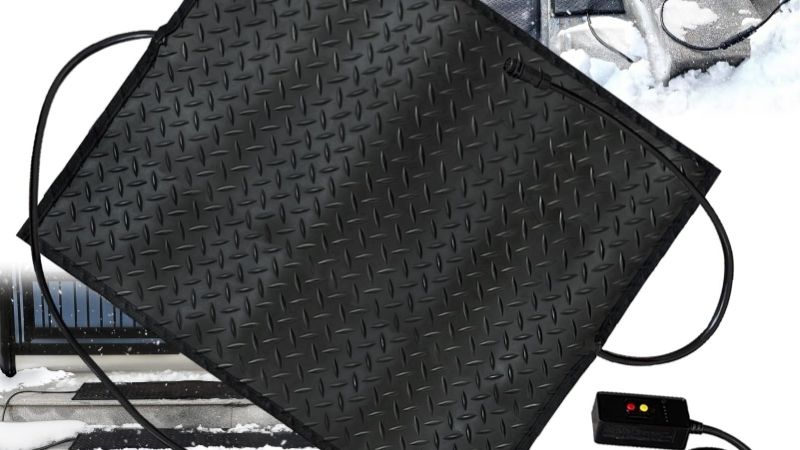
A snow melting mat is useful when the same short outdoor route keeps freezing: a few porch steps, the patch immediately outside a door, or a narrow walkway to the driveway. Instead of heating an entire paved surface, a portable mat places warmth exactly where people step. The important purchase is not merely the rubber rectangle. It is a correctly sized outdoor-rated electrical system with the matching protected power connection, reliable drainage, and a surface that stays in place.
Quick Verdict: For most homeowners who need a connected heated pathway, the HeatTrak HR20-60 is our Best Overall choice. Its 20-by-60-inch coverage, published 2.5-amp draw, and compatible stair modules make expansion straightforward. A separate $39.99 GFCI power unit adds to the $229.99 listed mat price. This editorial recommendation uses maker documentation and US listings as of October 2026, not independent detailed research.
As an Amazon Associate we earn from qualifying purchases.
By DIY Ideas 4 Home Editorial Team
6 Outdoor Heated Snow-Melting Mats Reviewed
We selected six individually listed residential mats from HeatTrak and HotStep by matching their published dimensions, electrical load, connection rules, surface applications, and US list prices in October 2026. Both manufacturers show products for distinct places, rather than treating bigger as automatically better. Across this group, listed mat prices run from $99.99 for a single stair tread to $729 for a large walking surface, before any separately required power controller. These evaluations are based on manufacturer product pages and system documentation, not tests conducted by our editorial team.
| Product | Best For | Key Spec | Listed Price (as of October 2026) | Watch Out For |
|---|---|---|---|---|
| HeatTrak HR20-60 | Best Overall: modular walkway | 20 x 60 in; 120 V; 2.5 A | $229.99 | Separate $39.99 GFCI power unit |
| HeatTrak HDM24-36P | Best for a doorstep landing | 24 x 36 in; 120 V; 1.9 A | $179.99 | Standalone; cannot daisy-chain |
| HeatTrak HR10-30 | Best for individual steps | 10 x 30 in; 120 V; 0.7 A | $99.99 | Power controller and some connectors extra |
| HotStep Passageway 48×20 | Best for narrower straight runs | 48 x 20 in; 120 V; 240 W / 2.1 A | $319.00 | HotStep GFCI unit sold separately |
| HotStep Doormat 24×40 | Best for broad entry thresholds | 24 x 40 in; 120 V; 240 W / 2.1 A | $319.00 | Not a complete powered package |
| HotStep Walkway XL 60×40 | Best for broad walking areas | 60 x 40 in; 120 V; 600 W / 5.3 A | $729.00 | Large cost and outlet-load commitment |
HeatTrak HR20-60: Best Overall
Best For: Homeowners who want one reliable walkway section now and the option to extend a route later.
The HR20-60 is the practical starting point when snow concentrates along a narrow pedestrian route. A single strip covers more forward travel than a small doormat, and HeatTrak’s residential connector system accommodates additional walkway and stair pieces without changing equipment brands. That matters more than buying the broadest mat for a property with several short, separate hazards. It loses to the HDM24-36P at a door landing because the latter includes its own power connection and does not need an expandable layout.
HeatTrak’s HR20-60 product page lists a 20-by-60-inch heated area, 2.5 amps at the 120-volt residential supply, and a $229.99 mat price as of October 2026. The same page describes a maker-stated snow-melting rate of up to 2 inches per hour. That is a manufacturer claim under unspecified weather conditions, not a promise that every storm leaves bare rubber. Its matching residential power unit, $39.99 on HeatTrak’s accessories listing, incorporates GFCI protection and supports up to 13 amps of compatible mats.
The 60-inch length makes the HR20-60 manageable on a straight section of sidewalk but less adaptable around tight corners than several small sections. HeatTrak supplies four 3/8-inch anchor grommets and a textured surface for securing the mat on an appropriate substrate. Its published two-year manufacturer warranty is useful for a product that spends months exposed to freezing wet weather; however, damaged connectors or pooling meltwater still require attention. HeatTrak’s residential product documentation prohibits covering the mat or using it indoors, and residential and industrial connectors are not interchangeable.
Pros:
- Five-foot heated length covers a common single-file entrance route.
- 2.5-amp load leaves room for additional compatible residential modules.
- Four securing grommets help reduce movement on appropriate surfaces.
Cons:
- The displayed mat price excludes the required protected power unit.
- A 20-inch path may feel restrictive with bulky winter gear.
Who Should Buy It: Choose this for a modular sidewalk run; select the HeatTrak HDM24-36P when only the doorstep landing needs heat and a self-contained package is preferable.
HeatTrak HDM24-36P: Best for Doorsteps
Best For: People with a compact porch landing who do not want to build a connected walkway network.
The HDM24-36P solves the point where wet shoes, a door swing, and refreezing slush meet. It is an entrance platform rather than a long travel strip. Unlike HeatTrak’s HR20-60 and HR10-30, its listing expressly includes a GFCI power unit, reducing both a hidden accessory purchase and the chance of ordering the wrong family of controller. The limitation is intentional: this is a standalone mat, so buyers planning a connected pathway should not treat it as the first link in a chain.
HeatTrak’s HDM24-36P product page shows a 24-by-36-inch mat rated at 1.9 amps on the residential system, a $179.99 US listed price, and an included power unit as of October 2026. It also lists the manufacturer’s approximate 2-inch-per-hour melting capability, a non-slip textured surface, and a two-year warranty. This choice is therefore cheaper as a complete one-mat doorstep setup than a number of larger mats that require a separate GFCI controller. Verify that the listing still specifies the included controller before ordering any bundle variation.
Its 36-inch width provides a more natural landing footprint than the 20-inch-wide HR20-60, while 24 inches of depth is not enough to heat a long sidewalk. The published product documentation says the standalone entrance model does not connect to walkway or stair modules. Four 3/8-inch grommets provide optional fastening points where the substrate and fasteners are appropriate. Measure the actual usable landing, allowing space for the threshold, door movement, and safe drainage rather than assuming the nominal porch size represents a clear installation area.
Pros:
- Includes the manufacturer’s GFCI controller at the listed $179.99 price.
- Three-foot width suits the area where people pause outside doors.
- Standalone design avoids unnecessary purchases for a single entrance.
Cons:
- Cannot be connected electrically to other HeatTrak residential mats.
- Two-foot depth leaves the route beyond the landing untreated.
Who Should Buy It: Buy this for a single doorstep platform; use the HotStep Doormat 24×40 when the entrance is wider and joining HotStep modules is more important.
HeatTrak HR10-30: Best for Stair Treads
Best For: Homeowners who need targeted heat across short outdoor stair treads rather than an entire landing.
The HR10-30 addresses the geometry that large rectangles handle poorly: separate elevated steps with gaps between them. Each section heats one tread, so coverage follows the way people climb instead of wasting mat area between risers. It is considerably easier to size a short stair flight with these modules than to improvise by bending a walkway mat over the edge. The trade-off is in the cables and separate power system, especially when stairs feed into a longer walkway. This is not a roll-up substitute for a properly secured stair installation.
HeatTrak’s HR10-30 product page identifies the 10-by-30-inch version as SKU HR10-30, draws 0.7 amp per tread, and lists $99.99 for each unit as of October 2026. The retailer-style list price is per tread, not per staircase. The page requires a separate GFCI-equipped HeatTrak residential power unit and describes a two-year warranty. HeatTrak also explains that a 20-inch watertight cable extender can be needed where a stair mat transitions back to a walkway mat, subject to connector direction.
At 10 inches deep and 30 inches wide, each HR10-30 covers the normal stepping portion of a suitably sized outdoor tread, but not necessarily every irregular stone step. Optional anchor holes are 3/8 inch, which gives a defined fastening arrangement instead of relying entirely on the mat’s weight. The maker’s residential stair documentation permits connection of multiple compatible treads within the 13-amp controller limit; route interconnecting cables away from feet and water collection. Before buying several, measure all step widths individually, since an uneven stair flight can make one standard-size tread unsuitable.
Pros:
- At 0.7 amp, individual treads have modest published electrical demand.
- 30-inch width targets a short, straight outdoor step.
- Residential connection system supports multi-step layouts within controller limits.
Cons:
- Each stair needs its own $99.99 heated section.
- Transitions to walkway mats may require additional watertight connector cables.
Who Should Buy It: Purchase individual treads for icy stairs; choose the HotStep Passageway 48×20 for a flat, continuous stretch without risers.
HotStep Passageway 48×20: Best for Narrow Walks
Best For: Buyers fitting a single narrow approach between an outdoor gate and a door without heating adjoining yard space.
HotStep’s Passageway mat offers a longer, slimmer route than the brand’s wider doormat. That format can be better for townhouses with a constrained side path or a narrow approach beside a railing. Its attraction is directional: it channels heated coverage where successive footfalls land. Against the HeatTrak HR20-60, it is shorter and considerably more expensive, so the main reason to prefer it is the HotStep ecosystem or a specific installation layout. It is not a performance upgrade established by head-to-head winter testing.
HotStep’s Passageway listing identifies a 48-by-20-inch mat at $319.00 in October 2026. The company’s How It Works product specification lists 120 volts, 240 watts, and 2.1 amps for the Passageway family, along with a separate compatible GFCI power unit. The manufacturer’s GFCI controller page lists the controller at $80.00 and a system limit of 13 amps. In other words, a first-time buyer should plan around the mat and controller as two different line items, and should not assume HeatTrak accessories fit the HotStep connectors.
The physical footprint is 48 inches long by 20 inches wide, requiring a smooth, appropriate outdoor surface and space for cable routing off the travel line. HotStep’s installation guidance recommends powering mats before snowfall and removing deep preexisting accumulation before activation; it also instructs owners to turn the system off after the surface clears and dries. Its published product information describes textured, weather-resistant rubber and a two-year warranty, but those statements are not evidence that every railing-side path drains properly. If melting water runs into an unheated depression, the dry strip can still end at a hazardous patch of refrozen ice.
Pros:
- 48-inch length follows a constrained single-file approach without widening it.
- HotStep publishes 240 watts for the specific Passageway mat type.
- Modular connections allow expansion using matching HotStep system accessories.
Cons:
- The $319 mat costs more than HeatTrak’s longer HR20-60.
- The $80 controller increases the initial system cost substantially.
Who Should Buy It: Pick the Passageway for HotStep-compatible narrow routes; the HeatTrak HR20-60 offers a lower listed mat price for a longer run.
HotStep Doormat 24×40: Best for Wide Thresholds
Best For: Households with a broad front-door approach who prefer a HotStep entry module over a walkway strip.
The Doormat reverses the Passageway’s priorities: more side-to-side space at a doorstep, less distance along a path. It suits the moment when several people cluster while opening a door or carrying packages rather than walking single file along a fence. A buyer already using HotStep mats might choose this shape for continuity of connectors and controls. For a stand-alone porch, the HeatTrak HDM24-36P is harder to ignore because its GFCI power unit is included, whereas HotStep’s entry module uses a separate matching controller.
HotStep’s Doormat product page and active US collection list the 24-by-40-inch product at $319.00 as of October 2026. Its How It Works specifications identify a 120-volt, 240-watt, 2.1-amp doormat; those values match the Passageway’s published electrical figures even though the footprints differ. The manufacturer’s connected-mat documentation requires the corresponding HotStep GFCI unit, priced at $80.00 on the brand’s own accessories page. Thus a first standalone entry setup is meaningfully more expensive than its $319 displayed mat price suggests.
At 40 inches across and 24 inches deep, the Doormat can accommodate a fairly broad exterior threshold without using a long, narrow walking section sideways. Check whether that width interferes with a railing base, furniture legs, or the opening sweep of a storm door. HotStep’s operating directions call for its rubber mats to be cleaned with mild soap, dried completely, and stored indoors outside winter; prolonged summer exposure is discouraged by the maker. Those maintenance rules differ from HeatTrak’s winter-only placement guidance and matter for homeowners who normally leave entrance mats down all year.
Pros:
- 40-inch width favors an entrance with multiple approaching foot positions.
- The listed 240-watt draw simplifies comparison with other HotStep modules.
- Uses the same HotStep control family as its Passageway product.
Cons:
- Initial ownership cost includes the separately purchased GFCI controller.
- Only 24 inches deep, so nearby steps still require protection.
Who Should Buy It: Choose the HotStep Doormat for a wider landing within that brand’s system; prefer the HeatTrak HDM24-36P for a simpler standalone doorway purchase.
HotStep Walkway XL 60×40: Best for Broad Paths
Best For: Owners of a wide entrance path who value a substantial continuous heated rectangle above low upfront cost.
The Walkway XL is the obvious specialist for a wide paved approach where two people frequently walk beside each other. It covers a very different job from HeatTrak’s narrow HR20-60, making it useful when the property layout would otherwise require several small strips. However, the expansion in coverage brings higher electrical demand and a major price increase. Do not buy it solely because the heating specification is larger; a broad mat does nothing useful for unheated icy steps farther along the route.
HotStep’s XL product page lists the 60-by-40-inch version at $729.00 as of October 2026, with a previously displayed $749 regular price. The manufacturer’s compatible-mat specification publishes 120 volts, 600 watts, and 5.3 amps for the XL. HotStep’s product information states the mat requires a brand-matched GFCI power unit, not included with the mat, and describes its UL 499 and CSA C22.2 No. 72-10 compliance as a manufacturer certification claim. The product page also states a two-year warranty. We did not independently inspect its certification file or measure its snow clearing speed.
The 60-inch length and 40-inch width produce a footprint that needs a genuinely broad, flat installation area rather than an awkward overlap onto mulch or a raised edge. That matters for the safety of the edges as much as it does for warmth. HotStep’s documented maximum is 13 amps on one GFCI controller, which makes electrical load planning essential if the XL will later be joined to smaller HotStep mats. The manufacturer’s winter-use directions allow operation during cold weather, but recommend removing deeply accumulated snow and switching power off when melting is no longer needed.
Pros:
- 40-inch width provides significantly more side-by-side walking room.
- Published 600-watt rating helps plan the cost and electrical load.
- HotStep provides a specific 5.3-amp figure for connected-system sizing.
Cons:
- At $729, the mat alone costs far more than narrow options.
- The wide rectangle is inefficient where the route bends sharply.
Who Should Buy It: Select the XL for a genuinely broad pavement section; use the HotStep Passageway 48×20 for a narrow route and lower controller load.
How to Choose a Snow-Melting Mat
These mats remove snow from a defined patch of pavement, not an entire property. Start by identifying which patch becomes unsafe first and whether meltwater can leave that area. A six-foot-long walk with one slippery stair is a different installation from a sheltered porch door that grows an ice ridge. Read electrical specifications for the exact mat configuration, because brands count controllers, cords, and connected loads differently.
Measure the Unheated Gaps First
The most useful measurement is often the section that stays outside the mat’s heated footprint. A 20-inch-wide walkway strip may leave the area beside it icy, while a wide landing mat cannot protect the first stair below. Sketch the full path from the door to the point where plowed or shoveled pavement begins. Include step depth, threshold height, slopes, and where pedestrians will step if two people pass each other. Treat any uncovered transition as an area that still needs ordinary snow and ice maintenance.
Do not bend a flat walkway mat over a stair riser or stack a mat on top of another unless the exact manufacturer’s installation instructions expressly allow it. The sensible solution for a staircase is a separate tread-sized product such as the HR10-30. A straight sidewalk, by contrast, benefits from long modules such as the HR20-60. A broad, accessible approach may justify the 40-inch-wide HotStep XL, but a nominally larger footprint is not evidence of more reliable melting under wind or deep snowfall.
Price the Controller With the Mat
The listed mat cost is not always the functioning system cost. HeatTrak’s HR20-60 and HR10-30 require the $39.99 residential GFCI power unit, while the HeatTrak HDM24-36P is a standalone entrance product with its unit included. HotStep lists a separate $80 GFCI unit for the mats in this comparison. This means two products with similar mat prices can produce substantially different bills when a buyer has not yet bought the correct power accessories.
Confirm the connectors, any mandatory extension cable, and the outlet location before checkout. HeatTrak’s residential and industrial versions do not share interchangeable system connections. HotStep’s connector family is also proprietary to HotStep, so appearance alone does not establish compatibility between brands. Ask the seller to confirm included cables and the exact mat variant, not merely whether the advertisement uses the phrase ‘plug and play.’ An attractive discount can disappear once an additional controller and extension are required.
Use Published Load, Not Melting Claims
HeatTrak lists its HR20-60 at 2.5 amps and HR10-30 at 0.7 amp, while HotStep provides both amps and watts for its residential mat categories. HotStep’s larger Walkway XL uses 5.3 amps according to the manufacturer’s table; that load matters when several modules share a controller and circuit. Both brands publish a 13-amp connected-system limit for their relevant GFCI controls. Do not use a published amp rating as permission to exceed an outlet, branch-circuit, or extension-cable rating.
Published melting rates are marketing or manufacturer performance statements, not standardized independent comparisons here. HeatTrak describes up to 2 inches of snow per hour; HotStep discusses melting that depends on weather and existing accumulation. Snow depth, wind, temperature, and the time at which a mat is powered can alter the outcome. Start before snowfall when the instruction manual permits it. Clearing an already deep layer by hand can be necessary, and running a heater under buried snow does not replace checking the route for refreezing at its edges.
Check Traction, Drainage, and Electrical Safety
A textured surface may improve shoe grip, but it cannot guarantee a slip-free path when runoff freezes beside the mat. Examine slope and drainage before treating heated coverage as a finished safety solution. Use only outdoor-approved equipment with the precise GFCI protection the manufacturer requires. Inspect cords for damage, keep connectors out of standing water as the installation instructions direct, and test the controller using its documented procedure before winter operation.
HeatTrak explicitly says its residential mats are not for indoor operation or covering and warns against using them in animal enclosures. HotStep’s own guidance calls for keeping installation flat and managing snow buildup before switching on. Because a snow-melting mat stays energized in wet conditions, changing its plug, cutting the rubber, improvising wiring, or hiding a damaged cord beneath a carpet is not an acceptable shortcut. If the needed outdoor receptacle is missing, arrange an appropriate installation instead of relying on a permanent string of household extension cords.
Frequently Asked Questions
Questions about placement matter as much as advertised heat output. Many mishaps begin when a mat is treated like ordinary floor covering rather than a sealed outdoor electrical appliance. The manufacturer and the exact model manual should settle installation questions before the first storm.
Can you cut a heated snow mat to fit a curved path?
No. A portable heated mat has enclosed electrical components, so trimming a corner or cutting a cable can compromise insulation and electrical protection. For an irregular route, use smaller manufacturer-approved modules to trace the usable walking area while keeping the units flat. Check the maker’s authorized connection methods rather than attempting field modifications. If the shape cannot be covered safely by standard modules, a fixed installation designed for that pavement may be the more suitable project.
Are these mats suitable for a wooden deck?
Some may be, depending on the exact product and deck construction. HotStep’s product guidance identifies wooden decks among possible surfaces but specifically tells buyers to check details to avoid heat-related warping. That is not universal permission for every mat, wood finish, or composite board. Obtain written clearance for your specific surface from the mat manufacturer and confirm that meltwater will not collect against the building. Avoid installing a mat over damaged decking or loose boards.
Can a car drive across a snow-melting walkway mat?
Do not assume so. HotStep’s Walkway XL product page states that the product supports vehicle traffic, but that is the manufacturer’s claim for its particular design, not a feature shared by every residential heated mat. The six products here are principally compared for pedestrian routes. Check the written load and traffic instructions for the precise model if tires could cross it. If regular tire traffic is the real job, research a purpose-built driveway-rated mat rather than choosing a residential walkway product by size alone.
What happens when the electricity goes out during a storm?
Melting stops, and residual water may freeze as temperatures fall. A heated mat does not store enough useful heat to keep a walkway clear indefinitely without power, so it should complement rather than replace an ordinary winter maintenance plan. Keep a shovel or traction material available for power interruptions, and inspect the path after electricity returns. Follow the maker’s restart and GFCI-test instructions instead of assuming every controller resumes operation automatically.
Final Thoughts
Before ordering any snow melting mat, identify where water will travel after the warmed surface clears; an unheated downslope landing can become the next ice problem. For a typical narrow residential walkway that may need additional sections, the HeatTrak HR20-60 remains our Best Overall pick because its 20-by-60-inch coverage, 2.5-amp specification, and modular residential family provide a practical foundation. Choose the HeatTrak HDM24-36P instead for a single doorway where the included power unit matters more than expansion. Confirm current model, US price, GFCI accessory, and surface instructions before purchasing.