Key takeaways
- The manufacturer’s sheet confirms 1,500 watts of room heating on 120 volts.
- Its 70.6-CFM fan distributes warmth more quickly than passive panels.
- Published UL 1278 conformity gives a specific safety standard to check.
A wall mounted heater frees floor space, but the installation details matter more than the shape of the front grille. A 500-watt panel plugged into a nearby outlet and a 1,500-watt recessed fan heater wired into the wall serve different rooms and budgets. Compare the actual watts, circuit requirements, wall depth and controls before choosing one. For plug-in heaters, the US Consumer Product Safety Commission’s 2026 guidance says to connect directly to an outlet, keep portable heating appliances away from combustibles and turn them off before sleeping. Fixed heaters require the clearances in their own installation manuals.
Quick Verdict: For most buyers who want strong supplemental heat without cutting a recess, the Stiebel Eltron CK 150-1 Trend is our Best Overall. Its manufacturer’s 2025 sheet specifies 1,500 watts on 120 volts, a plug-in cord and published conformity to UL 1278. Buy the Envi LE5012P instead if silent, lower-output background heat matters more than fast airflow. These are editorial selections based on published manufacturer documents and US listings as of October 2026, not in-house testing.
As an Amazon Associate we earn from qualifying purchases.
By DIY Ideas 4 Home Editorial Team
The Best Wall-Mounted Heaters Reviewed
How we selected these models: we matched six identifiable US-market products to manufacturer sheets or named product listings, then compared electrical input, mounting method, controls, physical dimensions and safety disclosures. We did not treat an advertised square-foot coverage claim as a measured result. The listed examples span roughly $116 to $283 before any electrical work, based on retailer and manufacturer prices available in October 2026. A plug-in unit avoids a new recessed box; a hardwired wall heater can be neater but may cost substantially more to install. Product descriptions below distinguish published facts from seller claims.
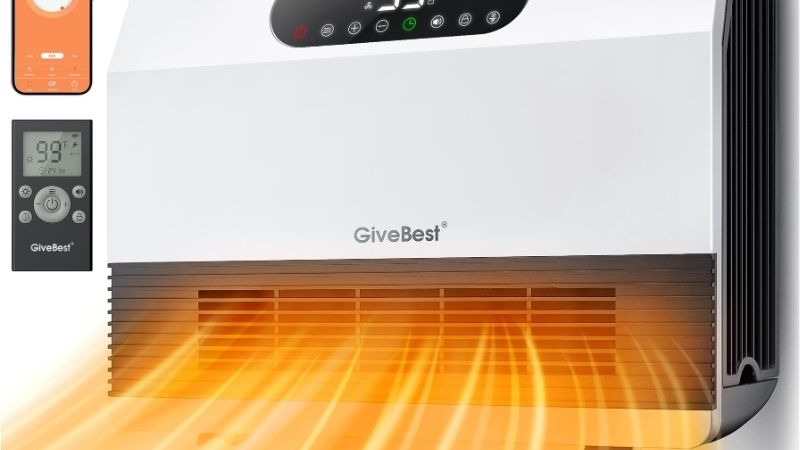
| Product | Best For | Key Spec | Listed Price (as of October 2026) | Watch Out For |
|---|---|---|---|---|
| Stiebel Eltron CK 150-1 Trend | Best Overall | 1,500 W, 120 V, plug-in surface mount | $115.71 at Lowe’s | 12.5 A draw and audible fan |
| Heat Storm A-1000-WX-WiFi | Best for Remote Scheduling | 500 or 1,000 W, wall mount, Wi-Fi | $129.99 from Heat Storm | Lower maximum heat than 1,500 W units |
| Envi LE5012P | Best for Quiet Background Heat | 500 W, fanless, 120 V plug-in | $179.95 from Envi | Slow temperature recovery in drafty rooms |
| Cadet CSC151TW | Best for Recessed Renovations | 1,500 W, 120 V, included wall can | $167.00 at Home Depot | Hardwiring and wall opening required |
| King Electric PAW1215-BW | Best for Adjustable Installed Output | 250 to 1,500 W selectable, 120 V | $283.23 at Home Depot | Thermostat usually purchased separately |
| EconoHome 400W Heater with Heat Guard | Best for a Guarded Wall Panel | 400 W, 120 V, guard and thermostat included | $159.00 from EconoHome | Gentle heat, large wall area needed |
Stiebel Eltron CK 150-1 Trend: Best Overall
Best For: Homeowners who want a straightforward surface-mounted heater with full 1,500-watt output and a regular household plug.
The CK Trend solves a specific problem: you can mount a heater at a useful height without opening a large hole for a recessed wall can. Its fan moves warmth toward occupied space rather than relying on slow convection. That makes it a better match for a cool office or guest room needing a noticeable temperature lift than either 400-watt panel in this list. The penalty is fan noise, and the heater still needs a wall location near an appropriate outlet.
Stiebel’s spec sheet, the January 2025 CK Trend Technical Specifications, identifies item 236304 as the CK 150-1 Trend. It states 1,500 watts at 120 volts, a 12.5-amp draw, 70.6 CFM of airflow and a 45 to 95 degree F thermostat range. The same sheet reports 49.0 dB(A) under the manufacturer’s measurement conditions and conformity to UL 1278 and UL 2021. Lowe’s listed the CK 150-1 TREND for $115.71 as of October 2026, the lowest published selling price among these six comparisons.
The cabinet measures 15.75 inches tall, about 10.88 inches wide and 5.13 inches deep, and the unit weighs 5.5 pounds. Its 47-inch power cord limits where you can place it without reaching for an unsafe extension lead. Stiebel lists a bimetal thermostat and high-limit control; keep the air path and mounting clearance exactly as the installation guide requires. Periodically clear dust from the intake with the heater disconnected rather than reaching inside its live enclosure.
Pros:
- The manufacturer’s sheet confirms 1,500 watts of room heating on 120 volts.
- Its 70.6-CFM fan distributes warmth more quickly than passive panels.
- Published UL 1278 conformity gives a specific safety standard to check.
Cons:
- At 12.5 amps, full output leaves little margin on a shared circuit.
- The published 49.0 dB(A) figure rules out truly silent operation.
Who Should Buy It: Pick the CK Trend for fast surface-mounted supplemental heat; choose the Envi LE5012P where any fan noise would be distracting.
Heat Storm A-1000-WX-WiFi: Best for Remote Scheduling
Best For: An occupied home office where daily schedule changes make app access and lower power settings worthwhile.
Heat Storm trades some maximum heating power for finer daily control. A remote and phone scheduling help when you use one room at predictable times, while the 500-watt mode gives you a gentler option after the space is comfortable. Compared with the Stiebel fan heater, this is a control-first choice rather than the higher-output one. Do not interpret the app as permission to leave an electric heater operating unattended; follow Heat Storm’s manual and local safety guidance.
Heat Storm’s product page for the WX Wi-Fi Wall Heater identifies model A-1000-WX-WiFi, priced at $129.99 in October 2026. The manufacturer’s published specification lists 500-watt and 1,000-watt heat settings, a 4.1 to 8.3-amp draw, and claimed noise readings of 40 to 44 dB. Its digital thermostat, child lock, included remote and Wi-Fi scheduling are specifically described. Heat Storm also advertises a cool-touch exterior; treat that as a maker’s statement, not a substitute for checking clearances or keeping children away from the outlet and cord.
This white unit is 17 inches tall, 13 inches long and 4 inches deep and weighs 6.1 pounds. Mounting hardware comes in the box, so the heater need not stand on a desk or floor. The owner still has to locate a sound wall anchor position and a safe nearby receptacle. The warranty information on Heat Storm’s website describes a one-year term; confirm the particular warranty terms at purchase, especially for the electronics and Wi-Fi module. Basic operation remains available with its included remote.
Pros:
- App scheduling and the supplied remote permit two ways to adjust heat.
- At 500 watts, the lower setting draws roughly 4.1 amps.
- Manufacturer specifications report a compact 4-inch cabinet depth when mounted.
Cons:
- Maximum heat output is one-third lower than a 1,500-watt model.
- Remote app functions introduce network and software dependencies absent from dial-only units.
Who Should Buy It: Choose Heat Storm when scheduled controls matter; the Stiebel Eltron CK 150-1 Trend better serves rooms demanding maximum plug-in output.
Envi LE5012P: Best for Quiet Background Heat
Best For: Light sleepers or study spaces that need low-power heat without fan airflow or display clutter.
For someone who dislikes the continual movement and sound of forced air, Envi’s natural-convection panel offers a distinct alternative. It gently draws cooler room air into internal channels rather than blowing a directed jet at the occupant. You sacrifice quick warm-up: 500 watts cannot replace the high-output Stiebel in a cold, drafty room of the same dimensions. The Envi is most useful when you maintain a modest temperature in an insulated room, not when you need rapid recovery after leaving a door open.
Envi’s product page for the LE5012P 3rd Generation model and its Gen3 Cut Sheet specify a 500-watt, 120-volt plug-in design drawing 4.17 amps. The brand’s product listing prices a new LE5012P at $179.95 as of October 2026. It uses a built-in manual thermostat, and Envi describes its Wall-Sens feature as cutting power when the heater is lifted from its mounted position. The company states that the model conforms to relevant UL and CSA standards; purchasers should check the actual listing mark and model label before installation.
Its broad face measures 19.3 inches wide and 22.2 inches tall but projects only 2 inches from the wall. The heater weighs 10 pounds and has a 6-foot factory cord, making outlet placement less restrictive than with the CK Trend. Envi advertises a three-year warranty on new units. The absence of a fan removes a moving part and the accompanying cleaning burden, but dust still gathers at the convection openings. Keep furniture and drapes clear of the intake and outlet so air can move naturally.
Pros:
- Fanless natural convection avoids a blower motor during quiet evening study.
- A six-foot cord provides more placement flexibility than several competing heaters.
- The named LE5012P includes a three-year new-product warranty from Envi.
Cons:
- Only 500 watts are available when outdoor temperatures suddenly fall.
- The 22.2-inch tall panel requires substantially more free wall area.
Who Should Buy It: Select the Envi LE5012P for quiet maintenance heat; the Heat Storm A-1000-WX-WiFi offers stronger adjustable output and app control.
Cadet CSC151TW: Best for Recessed Renovations
Best For: Renovators who can provide a dedicated circuit and want a complete recessed heater with its thermostat built in.
When you are already opening a wall for electrical work, Cadet’s Com-Pak deserves attention because its listed package includes the heater assembly, wall can, grille and local temperature control. That is an important distinction from a bare heating element that still needs several separate accessories. Its low-profile grille is less intrusive than a surface cabinet, though the visible finish will not satisfy someone who expects a completely concealed heating system. Compared with King Electric’s PAW model, Cadet prioritizes a ready-to-install single wattage configuration.
Cadet’s spec sheet for the Com-Pak lists model CSC151TW, part 67509, with 1,500 watts at 120 volts, a 12.5-amp draw and about 5,120 BTU per hour of nominal output. The built-in thermostat range is given as approximately 40 to 85 degrees F. Home Depot listed the complete white model for $167.00 in October 2026. Unlike a plug-in heater, the CSC151TW must be wired into an appropriately protected branch circuit; choosing this model may therefore make an electrician’s labor the largest variable in the total project cost.
Cadet’s sheet shows a 9-inch-wide, 12-inch-tall finished grille and a rough opening 8 inches wide, about 10.13 inches tall and 4 inches deep. The complete assembly weighs 7 pounds. A deeper framing cavity is required than for an Envi panel sitting on the surface. The factory thermostat is convenient but not a room-remote sensor; if placement is near a draft, perceived temperature may differ from elsewhere in the room. Check the model’s installation instructions for required clearances, wiring method, protective devices and any limitations related to bathroom placement.
Pros:
- Part 67509 arrives with wall can, white grille and thermostat together.
- A 9-inch grille width suits wall bays with modest visible space.
- Manufacturer data specifies 1,500 watts and 12.5 amps at 120 volts.
Cons:
- Installing the 4-inch-deep wall can means cutting into finished construction.
- Built-in temperature sensing may be less convenient than a remote wall thermostat.
Who Should Buy It: Buy the CSC151TW during a planned renovation; choose the Stiebel Eltron CK 150-1 Trend if opening drywall is undesirable.
King Electric PAW1215-BW: Best for Adjustable Installed Output
Best For: Owners upgrading a fixed wall-heating system who need an electrician to select output for a particular room.
King’s Pic-A-Watt approach is useful when the room’s heating requirement is uncertain before installation. Rather than committing permanently to the full rated output, the installer selects a setting that suits the calculated load. For a smaller room, this can avoid fitting an unnecessarily powerful installed unit. The downside is that you are paying for configuration flexibility and a substantial recessed assembly; a simple 120-volt plug-in choice costs considerably less and avoids line-voltage thermostat work.
King’s product page for the PAW Model names PAW1215-BW and specifies selectable ratings of 250, 500, 750, 1,000, 1,250 and 1,500 watts on a 120-volt supply. Corresponding current spans about 2.1 to 12.5 amps. King describes Smart Limit Protection, a squirrel-cage blower and cULus listing, and backs this series with a five-year limited warranty. Home Depot displayed about $283.23 for PAW1215-BW as of October 2026. An external line-voltage thermostat or separately purchased inbuilt thermostat kit is normally needed, so the displayed heater price is not necessarily the whole materials bill.
King’s PAW Submittal Sheet shows a finished grille approximately 13.63 inches wide and 7.13 inches high. It also identifies the standard PAWIC recessed wall can, whose cavity depth is about 4.5 inches. King separately lists a 9.5-pound shipping weight, which is not the installed net weight. An optional surface can, PAWS-BW, is sold separately. A proper wall-can installation needs accurate rough-in measurements and cable routing before drywall closes. The factory instructions and any thermostat chosen by the electrician are decisive because the heater runs on line voltage and selectable wiring terminals, not a low-voltage smart-thermostat cable.
Pros:
- Six selectable 120-volt wattages range from 250 to 1,500 watts.
- King specifies a five-year limited warranty for the PAW series.
- The model uses a 20-gauge steel grille and a squirrel-cage blower.
Cons:
- At roughly $283, the base heater costs far more than Cadet’s Com-Pak.
- Final control requires compatible line-voltage thermostat hardware and professional wiring.
Who Should Buy It: Consider PAW1215-BW for a customized fixed installation; choose Cadet CSC151TW when an integrated thermostat simplifies the job.
EconoHome 400W Heater: Best for a Guarded Wall Panel
Best For: Small, reasonably insulated spaces where a guard over the heating panel is part of the purchase requirement.
EconoHome’s guarded panel is not trying to produce the strongest blast of warm air. Its draw is the bundled combination of a low-wattage convection panel, a separate cover and a plug-in thermostat. That package suits buyers who want a broad, flat wall-mounted source with no spinning fan and who would otherwise have to buy a shield separately. Do not read the manufacturer’s safe-touch advertising as a guarantee that every part stays cool or that the heater is suitable for unattended use.
EconoHome’s product page titled 400W Wall Heater with Thermostat and Heat Guard Cover lists 400 watts on 120 volts and 3.33 amps. The retailer-manufacturer page offered the package for $159.00 as of October 2026. It states that the supplied plug-in thermostat adjusts over 41 to 86 degrees F and includes a heat reflector. The company also advertises cETL approval and conformity to UL 2021; these are brand-reported statements, not certifications independently checked by our editors. Buyers should verify markings on the actual unit and the manufacturer’s installation documentation.
The bare heating panel is approximately 24 inches tall and 24 inches wide, with a published thickness of 0.40 inch before accounting for the guard and wall stand-offs. EconoHome specifies a 1.8-meter power cord and a three-year manufacturer’s warranty. This model demands a relatively large open wall surface despite its slim heating element. Since the brand includes an extra guard, measure the completed assembly and check front, side and upper clearance requirements, not just the nominal bare-panel thickness. Paint or modifications, if allowed at all, must follow its written instructions.
Pros:
- The package includes a heat guard instead of charging separately for one.
- A 400-watt rating draws about 3.33 amps from 120-volt wiring.
- Its provided plug-in thermostat is specified for 41 to 86 degrees F.
Cons:
- The wide 24-inch panel may overwhelm a narrow mounting location.
- Four hundred watts will not recover room temperature like a larger fan heater.
Who Should Buy It: Choose this EconoHome package when a bundled guard matters; choose Envi LE5012P for a narrower fanless panel.
How to Choose a Wall-Mounted Heater
Begin with the wall and the electrical supply, not an online claim about room coverage. Wall heating falls into two practical categories: a surface-mounted unit that plugs into a receptacle, and a permanently wired heater requiring a recessed can, suitable circuit protection and often a separate thermostat. A model’s safety features must suit that installation, and its wattage must be appropriate for the room’s heat loss. If the circuit or framing is unknown, get an electrician’s assessment before committing to a hardwired unit.
Choose the Right Mounting and Electrical Connection
A plug-in Stiebel, Heat Storm or Envi heater can reduce renovation work, but it still needs sound fasteners and an outlet positioned within its factory cord reach. Surface-mounted does not mean freestanding: only place the unit in its approved wall orientation. The 120-volt Cadet and King recessed units require wiring, properly sized cavities and compliance with local code. A heater designed for 240 volts cannot simply run at its full nameplate output from a 120-volt receptacle.
For homeowners reusing an old wall cavity, take the existing opening measurements before ordering a new grille. Nominal brand dimensions rarely establish replacement compatibility; compare the back box and clearances, and have a licensed electrician evaluate wiring integrity. Do not assume that a nearby 15-amp outlet can safely power a 1,500-watt heater alongside computers, kitchen appliances or other heavy loads.
Match Wattage to Real Heating Needs
Heater watts determine how much resistance heat enters the room per hour. On a 120-volt supply, 1,500 watts draw about 12.5 amps, whereas 500 watts use about 4.2 amps. The lower-power panel uses less electricity while active, but it also supplies substantially less heat. If it runs constantly and fails to maintain the target temperature, its low wattage is not an efficiency advantage. Published coverage areas are manufacturer estimates that depend on insulation, drafts, ceiling height and climate.
Ask whether you are offsetting occasional chill or replacing a missing heating zone. A well-insulated spare room may need only supplementary 400 to 500-watt heat. A room with a cold exterior wall and frequent door openings may benefit more from 1,000 to 1,500 watts or a properly designed permanent system. Do not size an electric heater solely by comparing its square-foot number to a floor plan.
Decide Which Controls Matter Every Day
Heat Storm offers phone scheduling, Envi relies on a manual thermostat and King accommodates a compatible remote wall thermostat. Each approach has a different failure mode. Network-linked controls add convenience but also app maintenance. A thermostat on the unit reads air near that heater rather than necessarily at the sofa, bed or desk. An external thermostat can be better positioned, but only if it is electrically compatible with the heating equipment.
Look for a genuine off position, sensible control range and overheat protection in the exact manual for the SKU you intend to purchase. If you need only occasional heat, mechanical adjustment may be sufficient. Where several people share a room, schedule and child-lock settings can reduce inadvertent adjustments but should never replace supervision and proper placement.
Verify Clearances, Certification and Total Cost
The CPSC’s 2026 portable-heater guidance calls for approximately 3 feet between portable heaters and flammable furnishings and says not to use extension cords or power strips. For permanently mounted products, the manufacturer specifies the actual minimum floor, side, top and front clearances; these are model-specific and may differ from general portable-heater advice. Do not install a regular indoor heater over a bathtub or in another wet location merely because a website mentions bathroom use. Check the model’s listing, instructions, outlet protection and local rules.
Finally, compare full installed costs rather than the heater’s shelf price. A cheaper recessed heater can require wall repairs, wiring, permits and a thermostat. A low-cost plug-in model may need no electrician but could still be unsuitable for the available circuit. Confirm the exact model’s UL or ETL label, search the CPSC recalls database, and retain the owner’s manual. A professionally sized installation is generally worth more than speculative energy-savings claims on a product page.
Frequently Asked Questions
These questions address practical installation and ownership decisions that often arise after a heater’s rating and purchase price have been checked.
Can I mount an electric heater on drywall alone?
Not without checking the mounting system and wall structure. Drywall anchors supplied for one model are not automatically appropriate for every wall type, and heavy or recessed units may require fastening to framing. Read the installation template, identify stud locations and confirm whether masonry or metal-stud walls need alternative hardware. For example, the lightweight surface-mounted Stiebel has different fastener requirements from King Electric’s in-wall PAW assembly. Never mount a unit where its cable becomes pinched or its ventilation openings are blocked.
Will a wall heater make the wall behind it hot?
Some heating of nearby surfaces is possible, even if a product advertises a relatively cool front. The temperature depends on its design, mounting spacers, clearances and operating conditions. EconoHome includes a separate reflector and guard with its panel, whereas recessed units use a purpose-built metal wall can. Neither approach permits ignoring the supplied instructions. If a wall surface discolors, smells scorched or feels abnormally hot, stop using the heater and consult a qualified electrician or the manufacturer before restarting it.
Is a wall-mounted model safe to run overnight?
Do not assume so from its permanently mounted appearance. The CPSC advises turning off portable electric heaters before sleeping, and each wall-mounted product has its own permitted-use instructions. A properly installed fixed heater with appropriate controls can serve a different function from a portable supplemental appliance, but this distinction is governed by the model’s listing, manual and electrical installation. When a manufacturer restricts unattended operation, follow that restriction. Do not rely on a Wi-Fi schedule, child lock or overheat switch as permission to disregard it.
Can one wall-mounted heater replace central heating?
Usually not for an entire home. A single 400 to 1,500-watt unit is intended for a limited heating zone, and its effect depends on how quickly the room loses heat. Several professionally sized fixed wall units can constitute a zoned heating system, but their combined electrical load and operating cost need to be evaluated. If bedrooms, bathrooms and living spaces all need routine heating, a qualified HVAC or electrical contractor can compare that approach with a heat pump and the home’s existing ductwork or wiring.
Final Thoughts
For a room that needs noticeable warmth from a mounted appliance and already has a suitable 120-volt circuit, the Stiebel Eltron CK 150-1 Trend remains our Best Overall: its 1,500-watt output, included plug and published technical documentation make the buying decision comparatively clear. Before paying, use a tape measure to verify its mounting location and the 47-inch cord path. If the best wall location lacks a suitable outlet, do not solve the problem with an extension lead; the correct next step is an electrician’s evaluation or a properly wired model such as the Cadet CSC151TW. That one installation fact can change which heater is actually the sensible purchase.