Key takeaways
- Water damage rarely announces itself. A slow drip behind a washing machine, a failing supply line under a bathroom sink.
Water damage rarely announces itself. A slow drip behind a washing machine, a failing supply line under a bathroom sink, or a water heater that weeps overnight can go unnoticed until the floor warps or the ceiling below stains. A water leak sensor is a small, inexpensive device that sits on the floor and alerts you when moisture touches its probes. Under 100 dollars you can place several of them around a house, and the main decision is whether you want a loud local alarm or a smart sensor that sends alerts to your phone.
That choice depends on how often you are home. A basement sensor with a siren works if someone is nearby to hear it, while a WiFi model matters if the house is empty during the day or while you travel. A sensor is a warning device that cannot promise damage will be avoided, and it cannot shut off water by itself. The listings below are described only by what their titles state, with a note to confirm details you will rely on in 2026.
Quick Picks
Our top picks



As an Amazon Associate we earn from qualifying purchases at no extra cost to you.
| Product | Best for | Key spec from the title |
|---|---|---|
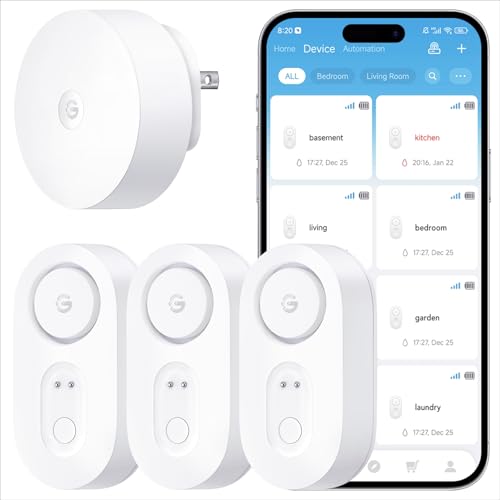
| GoveeLife Detector 1s 5 pack | Remote alerts across rooms | WiFi, SMS, email and app push, 5-year battery |
| GoveeLife Detector 2 6 pack | Larger homes | WiFi, 1968 ft range, sound alarm |
| RUIKORING 5 pack | Adjustable volume | 0-120dB adjustable, IP67, dual probes |
| Stechro 5 pack | Tiered volume control | 4 audio levels, IP66, leak and drip alert |
| BLIZONTE 3 pack | Low-maintenance local alarm | 5-year battery, 100dB, self-test, IP66 |
| Geevon 2 pack | Small budget coverage | 100dB alarm, basement and laundry |
| 5 pack 100dB detectors | Cheap local alarms | 100dB alarm, pipe and sink use |
How to Choose
Local alarm or smart alerts
A local alarm sounds a siren at the device, typically listed around 100 dB, so someone must be home to hear it. A WiFi sensor connects to a hub or your router and sends messages to your phone by app, email, or text. Smart models cost more per unit and require a compatible network, but they are the only type that helps when nobody is in the house.
Battery life and maintenance
Many sensors list a five year battery life, which suggests low maintenance, but the real number depends on how often the alarm sounds and the climate. Look for a low-battery chirp or self-check function. A sensor that dies silently is worse than none, and you may not discover it until the day you need it.
Probes, placement and ingress rating
Probes sit on the floor and detect water by conductivity. Dual-probe designs may catch both flat pooling and drips from above. Ingress ratings such as IP66 or IP67 indicate dust and water resistance, which matters in damp basements. Place sensors near the likely source: behind the toilet, under the sink, beside the washing machine, and next to the water heater.
What to ignore and where budgets cut corners
Ignore claims of long range unless you actually need it; a wireless range figure is measured in open air and drops sharply with walls. Budget alarms cut corners on volume control and battery quality, and sensor cables can be short. Confirm the cable length and whether a hub is required before you buy a smart set.
The 7 Best Options
GoveeLife Detector 1s 5 pack
This WiFi-based sensor set lists a high alarm, an ultra-long range figure, SMS, email, and app notifications, and a five year battery. Five units are enough to cover a kitchen, laundry room, bathroom, water heater, and basement. It is aimed at homeowners who travel, rent out a room, or want to know about a leak while at work, not just while at home. A vacation rental owner or someone with a second property would see the benefit most, because a message on the phone arrives long before a neighbor notices water coming through a ceiling.
- Phone alerts by app, SMS, or email work when you are away.
- Five units cover several high-risk spots.
- Trade-off: it relies on your network, and the exact connection setup should be confirmed on the listing.
Skip it if you want a fully offline alarm with no accounts or apps.
GoveeLife Detector 2 6 pack
The newer Govee model lists a 1968 foot range, WiFi sensing, SMS, email, and app alerts, a sound alarm, and a five year battery in a six pack. The extra unit and longer listed range appeal to a larger house or a duplex with several wet zones. Range figures reflect open air, so walls and floors will reduce them. A split-level house, a finished basement with a bathroom, or a duplex with shared plumbing is where an extra sensor or two pays off, and placing one in each wet zone gives you a clear picture of where an alert came from.
- Six units cover more rooms than the five-packs.
- Sound alarm adds a local warning on top of phone alerts.
- Trade-off: the larger pack costs more, and you may not need six sensors.
Skip it if your home has only two or three wet areas.
RUIKORING 5 pack
A five pack of leak alarms with adjustable volume from 0 to 120 dB, an IP67 rating, five-year battery life, and dual probes for leak and drip detection. The adjustable volume is an advantage in a small apartment where you may not want a maximum-volume siren. The IP67 rating suggests tolerance for damp basements. Dual probes sit close to the floor, so a drip from a pipe above and a puddle spreading from a washer both have a chance to trigger the alarm. Turn the volume down for a bedroom-adjacent closet and up for a distant utility room.
- Adjustable volume suits different home sizes.
- Dual probes aim to catch both leaks and drips.
- Trade-off: it is a local alarm only, so there are no phone notifications.
Skip it if you need alerts when you are away from the house.
Stechro 5 pack
This five pack lists four adjustable audio levels from 0 to 120 dB, an IP66 rating, and leak and drip alerts. The stepped volume controls are useful when different rooms need different loudness. It suits renters and homeowners who want basic local protection in several rooms without any app setup. Household members who are not comfortable with phone apps, such as older relatives, may prefer a simple siren they can hear from the next room, and the stepped volume makes it easier to tune for a thin-walled apartment versus a large basement.
- Four sound levels give you some control.
- No app or hub needed.
- Trade-off: local alarms only help if someone is home to hear them.
Skip it if you travel often and want remote notifications.
BLIZONTE 3 pack
Three leak alarms with a five year battery life, a low battery warning, 100 dB sound, a self-test function, and IP66 waterproofing. The self-test function is a handy way to confirm that the alarm still works. A three pack suits a modest apartment or townhouse with a kitchen, bathroom, and laundry area. Press the self-test on a calendar schedule, such as the first of the month, so a dead unit is found before it matters, and keep the sensors slightly raised off sealed concrete so the probes read water quickly.
- Self-test function helps confirm the unit is still active.
- Low battery warning prevents silent failure.
- Trade-off: three units may not cover a larger house.
Skip it if you need more than three coverage points or remote alerts.
Geevon 2 pack
A two pack of 100 dB sensor alarms intended for basements, bathrooms, laundry rooms, garages, and wine cellars, among other places. It is the lowest-commitment option here, which makes sense for a renter protecting just a washer and a water heater. Two units cover the highest-risk spots in a small space. A dorm, a studio, or a rented room with a single bathroom and a small kitchen is exactly the setting where two well-placed sensors do the job, and you can always add more later.
- Two units are enough for a small apartment.
- 100 dB sound is listed in the title.
- Trade-off: coverage ends quickly in a larger home.
Skip it if you want many sensors for a bigger house.
5 pack 100dB detectors
A generic five pack of 100 dB leak detectors for basement, pipes, drains, sinks, and faucets, with a flood leakage alert. It is a value-focused way to place alarms throughout a home. The title is long and partly cut off, so confirm the battery type and probe design on the listing. It suits a first-time buyer who wants to put a sensor under every sink, beside the dishwasher, and behind each toilet, then adjust placement after living with it for a few weeks and noticing which spots stay damp.
- Five units for broad coverage.
- Suited to pipes, sinks, and drains.
- Trade-off: an unnamed brand makes support and battery life harder to judge.
Skip it if you want a recognizable brand or phone notifications.
Which One Fits Your Situation
You are away from home often
The GoveeLife Detector 1s 5 pack or Detector 2 6 pack send alerts to your phone, which a local siren cannot do. Keep a spare router-friendly spot in mind, since a sensor too far from your network may drop out, and confirm any hub requirement before you order.
You want a simple siren with no setup
The RUIKORING or Stechro 5 pack provides local alarms with adjustable volume, and the lack of an app means nothing to set up or update later.
You live in a small apartment
The Geevon 2 pack or BLIZONTE 3 pack covers the washer, sink, and water heater without extra units.
You want maintenance reassurance
The BLIZONTE 3 pack lists a self-test function and a low battery warning.
Common Mistakes
- Placing a sensor where leaks rarely start, instead of next to the washing machine, water heater, or under a sink.
- Relying on a local siren while you are away from home.
- Ignoring the low battery chirp or never checking that the alarm still works.
- Assuming range figures work through walls; real-world range is much shorter than the listing claim.
- Treating a sensor as a shutoff; it only alerts, so you still need to know where your main valve is.
Related guides
- Battery Powered Floodlight Camera With Local Storage
- Cordless Drill Brush Attachment For Bathroom Grout
- Rechargeable Emergency Lantern For Power Outages
Frequently Asked Questions
Where should I place leak sensors?
Put them on the floor near likely sources: under sinks, behind toilets, beside washers and dishwashers, next to the water heater, and near a sump pump.
Do I need WiFi?
Only if you want phone alerts. A local alarm works without a network but depends on someone being home to hear it.
How long do the batteries last?
Many listings state five years, but real life depends on how often the alarm sounds and the conditions. Check them periodically, and replace the batteries or the unit if a low-battery chirp starts, since a silent dead sensor offers no protection.
Can a sensor stop a flood?
No. These sensors only alert you. Know where your main shutoff valve is so you can act quickly after an alert, and make sure every adult in the household knows the location as well.
More from Amazon
Programs that pair well with the guide above. Offers and eligibility are set by Amazon and may change.
A free business account with business pricing and bulk-buying tools for work, shop or home office.
Create a business accountFree shipping on eligible items, Prime Video and more. Eligible new members can start with a free trial.
Start a Prime free trialAudiobooks and podcasts to listen to on the go. Eligible new members can start with a free trial.
Try Audible freeAd-free music streaming. Eligible new subscribers can start with a free trial.
Try Music Unlimited freeAs an Amazon Associate we earn from qualifying purchases.