Key takeaways
- Shop vacuums are bought on tank size and horsepower, then regretted on noise, hose length, and how annoying they are to empty.
Shop vacuums are bought on tank size and horsepower, then regretted on noise, hose length, and how annoying they are to empty. That is the frame for the best shop vacuum under 150 dollars: you are choosing a drum, a motor, and a hose, and the three have to suit the mess you actually make. A garage that collects sawdust and the occasional puddle needs something different from a workbench that only sees drywall dust or a car that needs a weekly clean.
This guide is for homeowners, renters with a garage or basement, and weekend woodworkers who want a wet-dry vacuum without a large investment. Every spec below comes from the product titles, and where a title is cut off, the advice is to confirm on the listing. One thing worth knowing up front: horsepower numbers on shop vacs are usually marked “peak,” which describes the motor under ideal conditions, not what you will get at the nozzle. In 2026 listings, tank size, airflow, hose length, and filter type are better yardsticks than horsepower alone.
Quick Picks
Our top picks


 CRAFTSMAN CMXEVBE17595 16 Gallon 6.5 Peak HP
- Powerful 6.5 Peak HP provides extra power for…
- Rear blowing port on this wet dry shop…
- Built-in oversized drain on the wet/dry vac allows…

As an Amazon Associate we earn from qualifying purchases at no extra cost to you.
| Product | Best for | Key spec from the title |
|---|---|---|
| CRAFTSMAN 2.5 gallon | Small jobs and car cleanup | 2.5 gallon, 2.5 peak HP, portable |
| Stanley SL18116P | Everyday garage cleanup | 6 gallon, 4 horsepower |
| Stanley SL18115 | Cleanup plus blowing debris | 5 gallon, 4 HP, blower, 85 CFM, 15 ft reach |
| Basics 4 gallon | Basic stainless steel tank | 4 gallon, 3 HP, stainless steel |
| DEWALT DXV06P | Wheels and a poly tank | 6 gallon, 4 HP, blower, rubberized casters |
| CRAFTSMAN 9 gallon | Mid-size general use | 9 gallon, 4.25 peak HP |
| CRAFTSMAN 16 gallon | Large, heavy-duty jobs | 16 gallon, 6.5 peak HP |
How to Choose
Tank size: match it to the mess
A 2.5 gallon unit is a portable cleaner for a car or a workbench. Four to six gallons handles most garage tasks and stores easily on a shelf. Nine gallons and up suits renovation debris, wet spills, or a workshop that makes a lot of chips. Bigger tanks hold more, but they are bulkier, harder to carry upstairs, and take more room to store. Pick the smallest tank you will not outgrow, and think about where it will live between jobs, since a drum that does not fit its storage spot tends to end up in the middle of the garage.
Read horsepower as marketing, airflow as substance
Peak horsepower figures are nearly impossible to compare across brands. If a listing gives airflow in CFM, as the Stanley 5 gallon does with 85 CFM, use it. Look for hose diameter and length too: a 15 foot reach can save you from dragging the drum around a car, while a short hose turns every task into a two-handed wrestle. Wide hoses move bulky debris better than narrow ones, and a hose that is too short is the most common complaint that listings hint at but never state outright.
Filters, bags, and blowing
Dry fine dust like drywall powder clogs a standard filter quickly and can blow back out the exhaust. Listings that mention a filter bag or dust bag are better suited to fine debris. For wet pickup, remove the paper filter and use a foam sleeve if included. A blower function, named on a few listings, helps clear leaves and sawdust but is not a replacement for a proper dust collector.
Build, wheels, and noise
Steel tanks tolerate knocks and heat; poly tanks are lighter and do not dent. Casters make a bigger difference than most buyers expect, so look for rubberized wheels that do not scratch concrete or floors. Shop vacs are loud, and none of the listings give decibel figures, so wear hearing protection for long sessions. What to ignore: accessory counts that bury a few nozzles under a pile of extras.
The 7 Best Options
CRAFTSMAN 2.5 Gallon Wet Dry Vac
The compact choice. The title lists 2.5 gallons, 2.5 peak HP, a filter bag, a hose, and attachments, aimed at cleaning in the garage, in the car, or around the workbench. It is the kind of vacuum that lives on a shelf and comes out for ten-minute jobs rather than all-day projects.
- Strength: it is portable enough to carry with one hand and store on a shelf.
- Strength: attachments are included for detail work in a car or on a bench.
- Trade-off: a 2.5 gallon tank fills quickly with a woodworking session or a wet spill.
Skip it if you plan to clean up renovation debris or a damp basement, or if you want a long reach from the hose. A larger drum will save you repeated trips to the trash.
Stanley SL18116P 6 Gallon Wet/Dry Vacuum
A straightforward 6 gallon, 4 horsepower unit in black. The title is short, with no frills listed, which makes it the plain, mid-size option for a garage or basement where you just want a drum, a motor, and a hose.
- Strength: 6 gallons is a practical size for most garage cleanups before you need to empty it.
- Strength: the uncomplicated description points to a basic wet-dry design with little to learn.
- Trade-off: the title says nothing about hose length, filter type, or attachments.
Skip it if you want a blower function named on the listing, or if you need detailed accessory information before you buy. Confirm what ships in the box, since a short title leaves the question open.
STANLEY SL18115 5 Gallon Shop Vacuum with Blower
A stainless steel tank with 5 gallons, 4 HP, wet, dry, and blow functions, 85 CFM of airflow, and a 15 foot reach. It is the most spec-rich listing in the group, which makes comparing it to the others unusually easy.
- Strength: airflow is stated at 85 CFM, which gives you a real number to compare.
- Strength: the blower function can move leaves and shavings out of a corner or off a patio.
- Trade-off: a steel tank is durable but heavier than poly when you carry it up steps.
Skip it if weight matters to you, or if you want a lighter, smaller unit for the car. Anyone with a tiny storage closet should also measure first, since a stainless drum is not especially compact.
Basics 4 Gallon Stainless Steel Wet Dry Vac
A 4 gallon, 3 HP unit in grey and black with a stainless steel tank. The title is brief, which makes this a plain pick for buyers who want a small steel drum for the garage, the car, and the occasional spill.
- Strength: stainless steel suits wet pickup and resists rust better than bare metal.
- Strength: 4 gallons is easy to carry and store in a closet or under a bench.
- Trade-off: 3 HP is the lowest figure among the full-size models, and the title gives little else.
Skip it if you want a blower, a stated airflow figure, or a large tank. Because so few details are named, confirm hose length, filter type, and attachments on the listing before ordering.
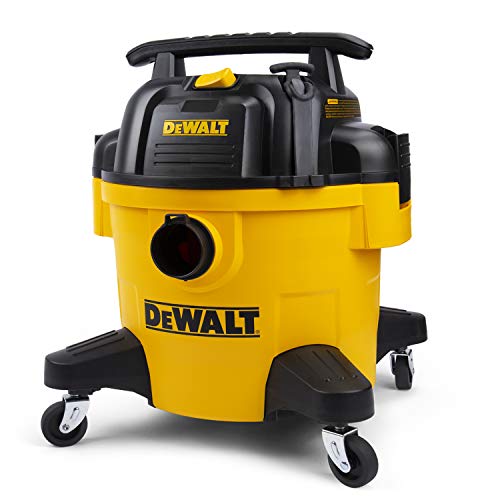
DEWALT DXV06P 6 Gallon Poly Shop Vacuum
A 6 gallon, 4 HP poly tank with a blower function and rubberized casters. The title calls it a 3-in-1 wet, dry, and blower design, pitched at people who move the unit around a garage or job site more than they carry it.
- Strength: rubberized casters make it easier to roll across a concrete floor without scarring it.
- Strength: a poly tank is lighter than steel and will not dent when it gets bumped.
- Trade-off: the title is cut off, so confirm hose length and filter details on the listing.
Skip it if you prefer a steel tank for heavy use, or if you need a bigger drum. Buyers who care about a wide set of included nozzles should also read the full page.
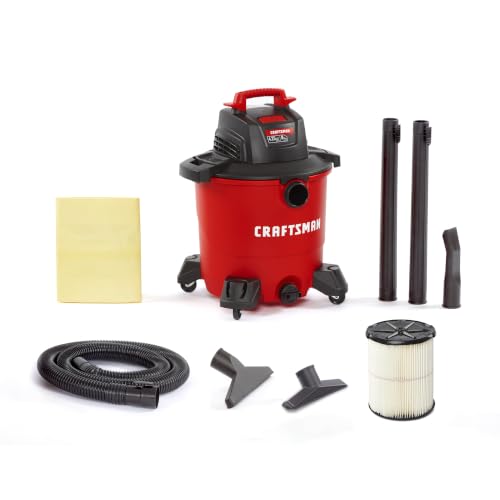
CRAFTSMAN 9 Gallon Wet Dry Shop Vacuum
A 9 gallon, 4.25 peak HP general-purpose unit, with a filter, dust bag, hose, and attachments listed for home projects. It sits at the step up from garage-corner size, where one emptying covers an afternoon of work.
- Strength: 9 gallons gives more room before you stop to empty the drum.
- Strength: the dust bag is named, which helps when the debris is fine and powdery.
- Trade-off: a bigger drum is bulkier to store and heavier to lift when it is full.
Skip it if you have little storage space, or if you only clean a small area now and then. A smaller unit will be easier to live with in that case, and it will still handle the odd spill or a pile of sawdust.
CRAFTSMAN 16 Gallon Heavy-Duty Wet Dry Shop Vacuum
The largest on the list: 16 gallons and 6.5 peak HP, with a filter, dust bag, hose, and attachments. It is meant for home projects that generate plenty of debris, such as sanding, demolition cleanup, or a larger workshop.
- Strength: 16 gallons holds the most before you have to empty it.
- Strength: the listing names a filter, dust bag, hose, and attachments.
- Trade-off: it is the biggest unit here, which means more space and more weight when full.
Skip it if you have limited storage or only plan occasional light cleanups. For a typical garage and a few spills, a mid-size drum will do the work with less hassle, and it will be far easier to carry around.
Which One Fits Your Situation
A one-car garage with sawdust and spills
The Stanley SL18116P or the DEWALT DXV06P at 6 gallons suit the job. The DEWALT adds casters and a blower, while the Stanley keeps things plain and simple. Either one fits beside a workbench, and neither is so large that it becomes a nuisance to store.
Car interiors and a small workbench
The CRAFTSMAN 2.5 gallon is the easy pick, with attachments for tight spots. It is small enough to carry to the driveway, and its modest tank is a fair match for a car interior or a bench top, where you rarely collect more than a few handfuls of debris.
A renovation with drywall dust
The CRAFTSMAN 9 or 16 gallon units name a dust bag, which is the detail that matters for powdery debris. Use a fine-dust filter, empty the drum often, and treat the larger unit as the better fit if the project will run for days.
Leaves, shavings, and a flat driveway
The Stanley SL18115 with blower and 15 foot reach handles both pickup and blowing. The long reach lets you work around a flat driveway or garage door without dragging the drum behind you, and the blower clears what the hose cannot reach.
Common Mistakes
- Choosing by peak horsepower alone.
- Vacuuming wet spills with a paper filter still installed.
- Buying a huge drum for a small apartment closet.
- Using the standard filter on fine drywall dust.
- Skipping hearing protection on long jobs.
Related guides
- Battery Powered Floodlight Camera With Local Storage
- Cordless Drill Brush Attachment For Bathroom Grout
- Rechargeable Emergency Lantern For Power Outages
Frequently Asked Questions
Is peak horsepower real?
It describes the motor under ideal conditions, not the suction you feel at the hose. Use airflow, hose size, and tank size to compare, and treat any figure without a standard behind it with caution.
Can I pick up water?
Wet-dry models can, but remove paper filters and empty the tank promptly.
What does a blower function do?
It lets you reverse the airflow to clear leaves or dust. It is handy but not essential.
How big a tank do I need?
Four to six gallons covers most garages, while nine gallons and up fits larger projects. If storage space is tight, lean smaller and empty it more often.
More from Amazon
Programs that pair well with the guide above. Offers and eligibility are set by Amazon and may change.
A free business account with business pricing and bulk-buying tools for work, shop or home office.
Create a business accountFree shipping on eligible items, Prime Video and more. Eligible new members can start with a free trial.
Start a Prime free trialAudiobooks and podcasts to listen to on the go. Eligible new members can start with a free trial.
Try Audible freeAd-free music streaming. Eligible new subscribers can start with a free trial.
Try Music Unlimited freeAs an Amazon Associate we earn from qualifying purchases.