Key takeaways
- Most people pick up their first multimeter because something small went wrong: a lamp that flickers, a doorbell that went silent.
Most people pick up their first multimeter because something small went wrong: a lamp that flickers, a doorbell that went silent, a car that will not crank on a cold morning. The meter is supposed to turn a shrug into an answer. For a beginner, that means the decision is not about chasing the longest feature list. It is about finding a meter that is forgiving when you hold the probes wrong, readable when you are crouched in a dim utility closet, and simple enough that you will actually reach for it.
This guide is written for the newcomer with a ceiling of under 100 dollars. At that tier you can realistically expect auto-ranging on many models, a decent display, and basic safety features, while true professional-grade durability and calibration paperwork mostly live higher up. The sections below explain what a first-timer should check on the spec sheet, then walk through six meters from the list in the order they were selected, with honest trade-offs for each. All judgments come from the listed titles, so confirm details on the listing before you buy.
Quick Picks
Our top picks


As an Amazon Associate we earn from qualifying purchases at no extra cost to you.
| Product | Best for | Key spec from the title |
|---|---|---|
| ANENG Digital Multimeter with Case | Cheap first meter with a carry case | Measures AC/DC voltage, current, resistance, capacitance, diodes |
| TM-510 Digital Multimeter | Hands that want less dial fiddling | 4000 counts, auto-ranging, non-contact voltage function |
| FS899L USB Rechargeable Multimeter | Readers who want a bright screen | 6000 counts, color screen, True RMS, USB rechargeable |
| Klein Tools MM320KIT | Household electrical checks | Kit with non-contact tester, receptacle tester, case |
| Klein Tools 80196 Kit | Learners who want a safety-minded kit | Manual-ranging, CAT III/IV caps, case, batteries |
| FNIRSI DMT-99 | Hobbyists who log readings | 9999 counts, TRMS, graph recording, anti-burn protection |
How to Choose
Auto-ranging versus manual-ranging
A manual-ranging meter makes you pick the measurement range before you touch the probes. Choose too low and you get an overload message; choose too high and you lose resolution. An auto-ranging meter figures this out for you, which removes a whole category of beginner confusion. If you are learning on your own, auto-ranging is the friendlier path. A manual meter is not wrong, though, and it can teach you what each range means if you are patient.
Counts and what they mean for readability
Counts describe how finely the display can divide a reading. A 2000-count meter is fine for checking a household battery or confirming a wall outlet has voltage. At 4000 to 6000 counts you start to see small differences in low-voltage electronics. Beyond that, extra counts matter mostly to hobbyists working on circuit boards. For a first purchase, anything from 2000 up is workable, so spend your attention on safety and layout instead.
Safety category and protection
This is the spec beginners skip and should not. Safety categories, shown as CAT II, III or IV, tell you what kind of electrical environment the meter was built to be connected to. Wall outlets and breaker panels sit in higher categories than a small appliance. If a title does not state a category, confirm on the listing before using it on mains wiring. Fuses on the current input, anti-burn protection and lead-alert displays are all useful extras for someone still learning which jack goes where.
Features worth paying for, and features to ignore
True RMS matters when you measure AC on equipment that does not produce a clean sine wave, such as dimmers and some electronics. A non-contact voltage function is a handy first-step check before you ever touch a wire. A backlight is worth it, because panels and basements are dark. Things to ignore at this level include capacitance or frequency modes you will not use for months, and gadget extras that crowd the dial. Budget models often cut corners on probe quality and case padding, so budget for a spare set of leads if you plan to use the meter often.
The 6 Best Options
ANENG Digital Multimeter with Case
This meter is aimed at the person who wants a straightforward tool and a case to keep it in. The title lists AC and DC voltage, current, resistance, capacitance and diode functions, which covers most of what a beginner would ever try: checking a battery, confirming continuity in a cord, or reading an adapter output. The included case also keeps the leads from tangling in a drawer.
- Strength: A wide set of measurement modes for a first-time buyer.
- Strength: A case is part of the package, which helps keep the leads organized.
- Trade-off: The title is truncated, so confirm the display size, safety category and whether it is auto-ranging on the listing.
Skip it if your plan involves regular work on household wiring and you want clearly stated category protection up front.
TM-510 Digital Multimeter
The TM-510 leans toward convenience. Its title mentions 4000 counts, auto-ranging and a non-contact voltage function, a combination that lets a beginner sweep a wall or cord for live voltage, then take a real reading with the probes once it is safe to do so. Auto-ranging removes the guessing around the dial, which is where most first-time frustration starts.
- Strength: Auto-ranging keeps the dial simple for newcomers.
- Strength: The non-contact function gives a quick first check before you handle conductors.
- Trade-off: Non-contact detection is a screening step, not a replacement for confirming with the probes.
Skip it if you want a stated safety category for panel work; the title does not make that clear, so confirm on the listing.
FS899L USB Rechargeable Digital Multimeter
This one is for the user who is tired of hunting for a coin-cell or square battery. The title describes USB charging, a large color screen with backlight, 6000 counts, auto-ranging and True RMS. For a beginner who works in dim spaces like a crawlspace or the back of a cabinet, a clear screen makes the numbers far easier to trust.
- Strength: A large color display with a backlight is easy to read in dark areas.
- Strength: True RMS and a high count make it a flexible learning tool.
- Trade-off: Several near-identical FS899L listings exist, so compare lead quality and safety wording carefully before choosing one.
Skip it if you would rather have a classic battery-powered meter with a long-established brand name behind it.
Klein Tools MM320KIT Electrical Test Kit
Think of this as a small starter bundle for household electrical curiosity. The title lists the digital multimeter with a non-contact voltage tester, a receptacle tester, a carrying case and batteries. That combination suits someone who wants to check outlets, switches and basic cords without buying each piece separately.
- Strength: Extra testers in the kit cover quick outlet checks the meter alone would not.
- Strength: Batteries and case are included, so it is ready to use out of the box.
- Trade-off: A kit approach means the meter itself may be simpler than stand-alone auto-ranging models.
Skip it if you want a screen with a high count or electronics-bench features such as graphing.
Klein Tools 80196 Digital Multimeter Kit
This kit leans into safety. The title names a manual-ranging meter, leads, CAT III/IV caps, batteries and a case, and notes functions such as battery checks and current. Those leads caps are the interesting part for a learner: they exist so you can expose only as much probe tip as a task requires.
- Strength: Category caps on the leads support safer habits from day one.
- Strength: A complete kit with case and batteries needs no extra shopping.
- Trade-off: Manual ranging asks you to learn the dial, which may slow an absolute beginner.
Skip it if you want the meter to choose the range for you with no learning curve.
FNIRSI DMT-99 Digital Multimeter
The DMT-99 is for the curious beginner who expects to grow. The title mentions 9999 counts, TRMS, a rechargeable battery, auto-ranging, graph recording, anti-burn protection and NCV. Graph recording is unusual in this tier and helps when you want to watch a voltage drift instead of catching one snapshot.
- Strength: High counts and graphing give room to grow into electronics projects.
- Strength: Anti-burn protection is a welcome cushion for a learner who might choose the wrong jack.
- Trade-off: More features mean a longer manual and more menus to learn.
Skip it if you only plan to check batteries and outlets a few times a year.
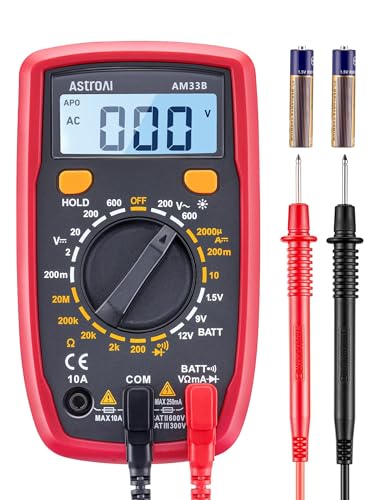
A note on the other listings in this price tier: several carry the same FS899L name and differ mainly in what ships in the box, such as extra silicone leads. The title wording is the only reliable guide, so read what is actually included before choosing one. The AstroAI model in the same list advertises 2000 counts and a similar function set, which makes it a reasonable fallback if the picks above are out of stock, though it was left out of the detailed reviews to keep the comparison focused on distinct designs.
Which One Fits Your Situation
You want to check outlets and switches around the house
The Klein Tools MM320KIT bundle fits this job because its receptacle tester and non-contact tester cover the routine checks, with the meter on hand for follow-up readings.
You are learning electronics and want room to grow
The FNIRSI DMT-99 gives you high counts, TRMS and recording, so it will not feel outgrown after a few months of projects.
You work in dark corners and hate squinting
The FS899L with its large color display and backlight is the easiest to read when you are working in a crawlspace or behind a cabinet.
You want to build safe habits from the start
The Klein Tools 80196 kit, with its CAT III/IV lead caps and a manual-ranging dial, teaches careful technique alongside the tool.
For a renter who only wants to answer small questions, the TM-510 is the quiet fallback: auto-ranging and a non-contact function are plenty for a dead battery, a suspect extension cord or checking whether a fixture has power before calling the landlord.
Common Mistakes
- Plugging the probe into the current jack and then measuring voltage, which can blow a fuse or damage a budget meter.
- Assuming a non-contact detector is proof that a wire is dead; always confirm with the probes.
- Ignoring the safety category and using a basic meter on panel wiring.
- Buying on feature count alone when the display, dial layout and lead quality matter more to a beginner.
- Leaving the meter set to a current or resistance mode, then touching a live source on the next use.
Related guides
- Battery Powered Floodlight Camera With Local Storage
- Cordless Drill Brush Attachment For Bathroom Grout
- Rechargeable Emergency Lantern For Power Outages
Frequently Asked Questions
Do beginners need True RMS?
Not for batteries or a plain household outlet. It matters more when measuring AC on dimmers, variable-speed tools and electronics. If you expect to branch out in 2026 or later, it is a cheap piece of future-proofing.
Is an auto-ranging meter always better?
For a beginner it is usually easier, since you do not choose a range. Some people prefer manual ranging because it teaches what the numbers represent. Either works once you understand your meter.
What does CAT III or CAT IV mean?
These are safety categories that describe the type of electrical environment a meter is built for. Higher numbers relate to installations closer to the power source. Confirm the category on the listing before you use any meter on panel or service wiring.
Should I buy a kit or a stand-alone meter?
A kit makes sense when it adds items you would buy anyway, such as a case, batteries or an outlet tester. A stand-alone meter makes sense when you want a better screen or more functions than a kit meter offers.
More from Amazon
Programs that pair well with the guide above. Offers and eligibility are set by Amazon and may change.
A free business account with business pricing and bulk-buying tools for work, shop or home office.
Create a business accountFree shipping on eligible items, Prime Video and more. Eligible new members can start with a free trial.
Start a Prime free trialAudiobooks and podcasts to listen to on the go. Eligible new members can start with a free trial.
Try Audible freeAd-free music streaming. Eligible new subscribers can start with a free trial.
Try Music Unlimited freeAs an Amazon Associate we earn from qualifying purchases.