Key takeaways
- A torque wrench is the tool that turns "tight enough" into a number. Wheel lug nuts, spark plugs, bike stems.
A torque wrench is the tool that turns “tight enough” into a number. Wheel lug nuts, spark plugs, bike stems, and engine accessories all have a specified tightness, and guessing with a breaker bar leads to stripped threads on one side and loose hardware on the other. The keyword sets a ceiling of under 100 dollars. That is comfortably above the entry tier and enough for a single click wrench, a multi-drive set with adapters, or a digital model, so the real work is matching the range and drive size to the jobs you actually do.
This guide is for home mechanics changing their own tires, cyclists tightening carbon parts, motorcycle owners, and anyone adding a precision tool to a garage in 2026. We compare six listings strictly on what their titles state. Accuracy percentages are manufacturer claims, and a torque wrench needs care to stay accurate, so we describe features and ranges only. Where a title is cut off or garbled, we flag it and send you to the listing.
Quick Picks
Our top picks




As an Amazon Associate we earn from qualifying purchases at no extra cost to you.
| Product | Best for | Key spec from the title |
|---|---|---|
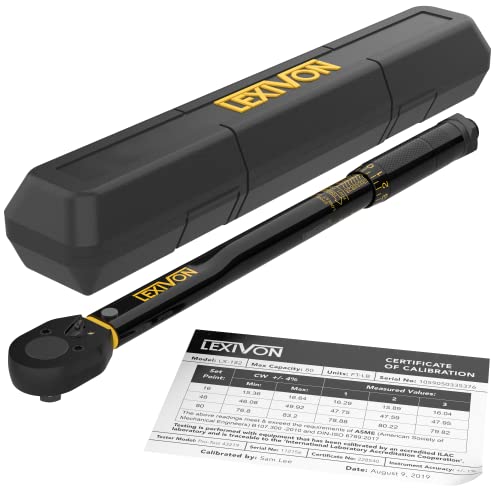
| LEXIVON LX-183 | Wheels and general auto work | 1/2-inch drive, 10-150 ft-lb click type |
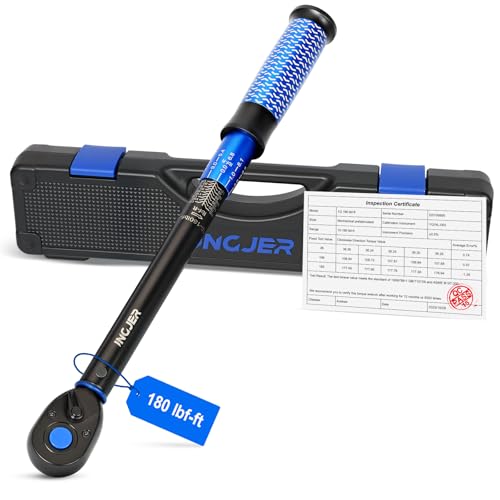
| INGJER 1/2 Inch | Higher torque jobs | 10-180 ft-lb, 3 percent claim, 72 tooth |
| DISEN 9PC Set | One box for several drives | 1/4, 3/8, and 1/2-inch drives, 6 adapters |
| CRAFTSMAN CMMT99434 | Heavy fasteners | 1/2-inch drive, 50-250 ft-lb |
| HERONIX 3/8 Inch | Bikes and motorcycles | 5-50 ft-lb, loud click, 72 tooth |
| Digital 3/8 Drive | Readout and spark plugs | 5.0-99.6 ft-lb, 1 percent claim, buzzer and LED |
How to Choose
Match the drive size and torque range to your jobs
A 1/2-inch drive wrench suits lug nuts and suspension hardware, with ranges that begin around 10 ft-lb and rise to 150 ft-lb or more. A 3/8-inch drive handles smaller fasteners such as spark plugs, valve covers, and many motorcycle and bicycle bolts. A 1/4-inch drive reads in inch-pounds and handles delicate parts. Look up the specification for your own fasteners first, then choose a wrench whose range covers them comfortably.
Keep your target torque in the middle of the range
Click wrenches are generally most reliable in the middle of their range, not at the bottom edge. A wrench rated from 10 to 150 ft-lb is a poor choice for a 12 ft-lb job and a stretch for one near 150. If you work on both large and small fasteners, a set with several wrenches or one with overlapping ranges may serve you better than a single wide-range tool.
Read what the accuracy language means
Titles often list an accuracy figure such as plus or minus 3 percent, and one digital listing claims 1 percent. These are manufacturer claims about a stated part of the range, and many have conditions. Look for any mention of calibration, a certificate, and what range the claim applies to. Remember that the wrench needs proper storage and handling to stay in tune, whatever the figure says. A cheap wrench used carefully can outlast an expensive one that gets thrown in a bin, and a claim of 1 percent is not meaningful if the tool is dropped or left wound up for months. Treat any figure as a starting point and plan to verify the tool if a job is critical.
Consider the mechanism and the extras
Click wrenches signal the set torque with a sound and feel. A 72-tooth ratchet allows a small swing angle in tight spaces. Dual-scale markings show both ft-lb and Nm. Digital models use a buzzer and light, which helps in noisy or dim places but requires batteries. Cases protect the tool, which matters, because dropping a torque wrench can upset it. A reversible ratchet and a lock on the handle are useful features to look for on the listing. Budget wrenches often economize on the grip knurling, the lock mechanism, and the case, so a clear description of each is worth more than a long list of marketing words. Prefer a design that makes the scale easy to read from the working position, and one that keeps the set value from drifting when you handle it.
The 6 Best Options
LEXIVON 1/2-Inch Click Torque Wrench LX-183
The title gives a 1/2-inch drive click wrench with a 10 to 150 ft-lb range, which is also written as 13.6 to 203.5 Nm. That range covers wheel lug nuts on many cars and a long list of other automotive fasteners, so it fits the home mechanic who wants one wrench for wheels and general repairs.
- Strength: the 1/2-inch drive and range fit the most common automotive jobs.
- Strength: both ft-lb and Nm ranges appear in the title.
- Trade-off: the title does not state an accuracy figure or a case, so confirm both.
Skip it if your fasteners sit below the 10 ft-lb floor or you need a handle lock. Check the listing for the accuracy statement and included accessories, and compare the printed range against the figure in your owner manual before you commit to a purchase.
INGJER 1/2-Inch Click Torque Wrench
This listing is a 1/2-inch drive wrench covering 10 to 180 ft-lb, or 13.6 to 244.1 Nm, with a stated plus or minus 3 percent dual-direction claim and a 72-tooth mechanism. The higher ceiling suits trucks, SUVs, and suspension work where fasteners call for more torque than a 150 ft-lb wrench can reach.
- Strength: the 180 ft-lb top end gives more headroom than the LEXIVON.
- Strength: a 72-tooth ratchet is helpful where swing room is limited.
- Trade-off: the 3 percent figure is a claim, and the title says upgrade without defining it.
Skip it if you mostly work on small fasteners, because the low end of a wide range is where click wrenches are least comfortable. Confirm whether it works in both directions and what the case contains, and read how the listing describes the scale markings, since small or shallow etching is hard to read in a dim garage.
DISEN 9-Piece Click Torque Wrench Set
The title describes a nine-piece set with 1/4, 3/8, and 1/2-inch wrenches, ranges of 20 to 220 in-lb, 5 to 45 ft-lb, and 10 to 170 ft-lb, plus six adapters, a storage box, a 72-tooth ratchet, and a 3 percent accuracy claim. It suits a garage that does both delicate and heavy work and wants one case for everything.
- Strength: three drive sizes cover small, medium, and large jobs in one box.
- Strength: six adapters and a storage box are listed.
- Trade-off: a set spreads a budget across three tools, so each wrench may be simpler than a single dedicated one.
Skip it if you only need one drive size and would rather put the budget into a single better wrench. Read the listing for the list of included pieces and any dual-direction details, and check that the adapters are described, because adapters can change the effective torque if they are used carelessly.
CRAFTSMAN 1/2-Inch Torque Wrench CMMT99434
The title shows a 1/2-inch drive wrench with a 50 to 250 ft-lb range. The range starts much higher than the others, which points to heavy hardware, such as large truck lug nuts, trailer axles, and big suspension bolts, and a named hardware brand appeals to buyers who value a familiar label.
- Strength: the 250 ft-lb upper limit is the highest in the group.
- Strength: a familiar tool brand is stated in the title.
- Trade-off: the 50 ft-lb floor makes it unsuitable for small fasteners.
Skip it if you work mostly on cars, bikes, or spark plugs, where the high floor leaves you without a tool for smaller jobs. Confirm the accuracy statement and warranty details on the listing, and check whether a case is included, because a heavy tool with no protection is easy to damage in a crowded toolbox.
HERONIX 3/8-Inch Click Torque Wrench
This listing is a 3/8-inch drive wrench covering 5 to 50 ft-lb, or 6.8 to 67.8 Nm, with a stated plus or minus 3 percent accuracy, a loud click, dual scale, and a 72-tooth mechanism. It is aimed at bikes, motorcycles, and engine bay work, where fasteners are smaller than a lug nut.
- Strength: the 5 ft-lb low end suits smaller fasteners than the 1/2-inch tools here.
- Strength: a loud click is helpful in a noisy garage.
- Trade-off: the 50 ft-lb ceiling is too low for lug nuts.
Skip it if you want one wrench for wheels, or if you only own metric fasteners and prefer a scale that shows Nm first. Check the listing for the case and calibration details, and for how the wrench sets and locks its value, since a bike frame or a carbon part is not a place for guesswork.
Digital 3/8-Inch Torque Wrench Set
The title describes a digital 3/8 drive electronic torque wrench set covering 5.0 to 99.6 ft-lb, with a 1 percent accuracy claim, a buzzer, an LED, inch-pound capability, and a spark plug accessory. The readout makes it easy to see the number, and the alerts help in dim or loud spaces.
- Strength: a digital display lets you read the value instead of counting clicks.
- Strength: the buzzer and LED give two kinds of warning.
- Trade-off: it needs batteries, and a 1 percent claim should be checked against the listing.
Skip it if you prefer a simple mechanical tool that works with no power at all. Confirm the battery type and the calibration instructions, and check whether the unit holds its zero after a drop, since electronic tools can be more sensitive to rough handling than a mechanical design.
Which One Fits Your Situation
You change your own wheels
The LEXIVON LX-183 covers the typical lug nut range at 1/2-inch drive. The INGJER adds headroom for trucks. Look up the figure in your owner manual, and tighten in a crisscross pattern in stages instead of all at once.
You work on bikes and motorcycles
The HERONIX 3/8-inch wrench starts at 5 ft-lb. The digital model also reads in inch-pounds with its spark plug accessory.
You want a complete starter box
The DISEN nine-piece set covers three drive sizes, with adapters and a case.
You work on heavy trucks and trailers
The CRAFTSMAN 50 to 250 ft-lb wrench fits big hardware.
Common Mistakes
- Choosing a wrench whose range barely includes the torque you need.
- Leaving the wrench set to a high value in storage instead of backing it off to the lowest setting.
- Using a torque wrench to loosen bolts, which can harm the mechanism.
- Dropping the tool or storing it loose in a toolbox.
- Ignoring the specified torque in the manual and using a number from memory.
Related guides
- Battery Powered Floodlight Camera With Local Storage
- Cordless Drill Brush Attachment For Bathroom Grout
- Rechargeable Emergency Lantern For Power Outages
Frequently Asked Questions
How often should a torque wrench be calibrated?
Follow the maker’s instructions. Heavy use or a drop is a reason to have it checked sooner.
Click or digital?
Click wrenches are simple and need no batteries. Digital ones show a readout and add alerts but depend on power.
Can I use one wrench for everything?
Rarely. A wide-range tool is less reliable at the extremes, so sets or two wrenches often serve better.
What is the difference between ft-lb and in-lb?
One foot-pound equals twelve inch-pounds, and small fasteners are usually specified in inch-pounds.
More from Amazon
Programs that pair well with the guide above. Offers and eligibility are set by Amazon and may change.
A free business account with business pricing and bulk-buying tools for work, shop or home office.
Create a business accountFree shipping on eligible items, Prime Video and more. Eligible new members can start with a free trial.
Start a Prime free trialAudiobooks and podcasts to listen to on the go. Eligible new members can start with a free trial.
Try Audible freeAd-free music streaming. Eligible new subscribers can start with a free trial.
Try Music Unlimited freeAs an Amazon Associate we earn from qualifying purchases.