Our Top Picks
 BESSEY GSCC4PK-C Clamp Set for Woodworking2 x 6 IN and 2 x 12 In.16 x 4 x 2 inches5.8 poundsCheck on Amazon

Clamp is a broad word in a workshop, and this roundup narrows it on purpose. The site already covers hose clamps for plumbing lines and pipe repair clamps for sealing leaks, and neither belongs anywhere near a glue joint. The five picks below are all clamps for woodworking and assembly work: tools that hold boards, frames and boxes steady while glue cures or while you drill, pin and fit parts together. They span five different mechanisms, because no single type does every job well. A one-hand bar clamp handles most flat work, an F-style set adds screw-driven pressure, spring clamps act as tireless extra fingers, a strap clamp pulls all four corners of a frame at once, and an angle clamp holds a true right angle while you fasten it.
Buying clamps is less about finding one winner and more about covering the gaps in your rack. Most woodworkers own several of one type and one or two of the rest. Match each pick to your work: panel glue-ups, small boxes, picture frames, cabinet carcasses or quick bench holds.
Disclosure: As an Amazon Associate, we earn from qualifying purchases made through links on this page, at no extra cost to you.
How to Choose Clamps for Woodworking
Separate opening capacity from throat depth. Opening capacity is how wide the jaws spread, and it decides the thickest stack of boards the clamp can grip. Throat depth is the distance from the bar to the center of the pressure pad, and it decides how far in from an edge the clamp can reach. A 12 inch clamp with a shallow throat still cannot reach the middle of a wide panel. For edge joints, opening matters most; for face frames and carcass work, throat depth is often the figure that limits you.
Read clamping force as a maker figure, not a promise. Makers publish force numbers measured under their own conditions, and the figures are not strictly comparable across brands. Use them as a rough guide to the class of clamp: light trigger clamps for positioning, screw-driven F-style and bar clamps for glue lines that need real squeeze, spring clamps for holding rather than crushing. A glue joint needs firm, even pressure along its length, which usually means more clamps at moderate force rather than one clamp wound down hard.
Protect the wood before you squeeze. Bare steel pads dent softwood and leave marks on finished faces. Look for clamps with fitted pads, and keep a strip of scrap wood or a caul under any pad that lacks one. Pads also spread the load, which helps on pine, cedar and other soft stock. On hard maple or oak the risk flips: the pad can slip on a polished face, so a dry fit matters more than raw force.
Do not over-tighten. Cranking a screw clamp past snug can bow a panel, squeeze a glue line dry and pull a frame out of square. The goal is a thin, even bead of glue along the joint, not maximum torque. Tighten in stages across several clamps, check diagonals on frames, and ease off any clamp that is bending the work. A bowed glue-up rarely flattens later.
Count clamps in pairs. One clamp almost never holds a panel flat. Budget for at least two of any bar or F-style clamp you plan to use on glue-ups, alternate them above and below the panel to balance the pull, and keep spring clamps within reach of the bench. Coverage beats one premium piece.
The 5 Best Clamps for Woodworking
1. IRWIN QUICK-GRIP Bar Clamp, 12-Inch (223112)

The one-hand bar clamp is the first clamp most people should own, and this 12 inch IRWIN is the pattern the type is known by. The trigger handle advances the sliding jaw with one hand while the other hand holds the work in place, which is exactly the situation you face when a board wants to wander during a glue-up. A quick-release button backs the jaw off just as fast, so repositioning mid-assembly does not turn into a wrestling match.
Twelve inches of opening covers drawer boxes, small panels, cutting boards and most furniture repairs, and the size stays light enough to hang on a wall rack. The jaws carry removable pads that cushion the work and spread pressure across a wider face than bare steel would. Used in pairs, one above and one below a panel, two of these keep an edge joint honest while the glue sets. Wider tabletops will want longer bars as well, but as the everyday reach-for-it clamp, this is the slot to fill first.
Specs
- Type: One-hand trigger bar clamp
- Opening capacity: 12 in
- Operation: Trigger advance with quick-release button
- Pads: Removable jaw pads
- Model: 223112
- UPC: 732454261309
2. BESSEY GSCC4PK-C Clamp Set, F-Style with Wood Handle
Where a trigger clamp trades force for speed, this Bessey set trades speed for force. The F-style layout puts a sliding jaw on a steel rail and drives the pressure pad with a screw and a classic wood handle, so the squeeze builds slowly and stays where you leave it. The set mixes two 6 inch and two 12 inch clamps: short ones for boxes and small panels, longer ones for cabinet sides and wider boards.
Bessey rates the set at 600 lb of clamping force, a maker figure that places these firmly in glue-line territory rather than light positioning duty. The pads are replaceable, which matters on a tool meant to serve for years, because pads are the part that wears and picks up dried glue. The wood handles give a sure grip with dusty hands and let you judge torque by feel. If you already own trigger clamps and want a step up in pressure for panel work, this set is the natural companion.
Specs
- Type: F-style screw bar clamps, set of 4
- Contents: Two 6 in and two 12 in clamps
- Clamping force: 600 lb (maker figure)
- Handle: Wood
- Pads: Replaceable
- Model: GSCC4PK-C
3. HORUSDY 6-Piece 6-Inch Spring Clamps (97867C)

Spring clamps are the extra hands of the shop. They carry no screw and no trigger; a strong steel spring holds the jaws shut, and you squeeze the handles to open them. That limits their force, but it also makes them instant, and instant is what you want when a part needs holding while you reach for a drill, a square or a second clamp. This HORUSDY set gives you six matching 6 inch clamps, each opening to 2.5 inches at the jaw.
The bodies are nickel-plated steel, so they shrug off knocks, glue drips and damp corners, and the jaw opening swallows common stock sizes: two-by lumber on edge, stacked plywood parts, a stop block against a fence. Keep a set clipped along the bench edge and they will earn their keep on every project, pinning a template to a workpiece or keeping a glue joint closed at the corners while the bar clamps do the heavy work in the middle.
Specs
- Type: Spring clamps, set of 6
- Clamp length: 6 in
- Jaw opening: 2.5 in
- Material: Nickel-plated steel
- Model: 97867C
- Best for: Quick holds and positioning
4. BESSEY VAS-23+2K-CB Variable Angle Strap Clamp, 23 ft
Frames defeat ordinary clamps: pressure on one corner pushes the opposite corner open, and four mitered joints all need closing at the same moment. A strap clamp solves it by wrapping the whole piece and pulling evenly from every side at once. This Bessey runs a woven polyester strap a full 23 feet long, enough to circle large frames, chair assemblies, drawer boxes and round or odd-shaped work.
Four pivoting corner clips ride on the strap and settle against each corner, and because they pivot they accommodate angles from 60 to 180 degrees rather than demanding a perfect right angle. That forgiveness saves mitered frames whose corners are a degree or two off: the clips find the angle instead of fighting it. A steel wire loop and the two-component handle draw the strap tight and hold tension while the glue cures. At a little over a pound, it stores in a drawer, yet replaces a whole strategy of corner blocks and crossed clamps.
Specs
- Type: Strap (band) clamp with corner clips
- Strap: Woven polyester, 23 ft
- Corner clips: 4 pivoting Vario clips
- Angle range: 60 to 180 degrees
- Weight: About 1.27 lb
- Model: VAS-23+2K-CB
5. BESSEY WS-3+2K 90-Degree Angle Clamp
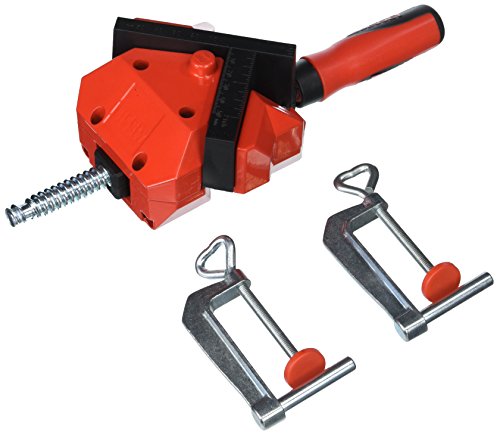
Some joints need holding at an exact right angle while both hands are busy driving screws or pins, and that is the whole brief of this Bessey angle clamp. The die-cast body holds two pieces at 90 degrees for corner joints and T joints alike, and a pivoting jaw lets it grip stock of different thicknesses on each side of the corner, the usual case when a shelf meets a cabinet side or a rail meets a leg.
Two TK-6 table clamps come in the box to pin the angle clamp itself to the bench, turning it into a fixed third hand: set the corner, lock it down, then fasten with both hands free. The throat depth is modest at about 1-1/8 inches, so this is a tool for frame members, box sides and face-frame stock rather than deep carcass work. Within that lane it removes the most awkward moment in small assembly, the half-second when a corner slips as the first screw bites.
Specs
- Type: 90-degree angle (corner) clamp
- Body: Die-cast
- Jaw: Pivoting, for stock of uneven thickness
- Throat depth: About 1-1/8 in
- Includes: Two TK-6 table clamps
- Model: WS-3+2K
Comparison Table
| Pick | Type | Capacity | Standout trait |
|---|---|---|---|
| IRWIN QUICK-GRIP 223112 | One-hand bar clamp | 12 in opening | Trigger advance, one hand free |
| BESSEY GSCC4PK-C | F-style screw clamps | 6 in and 12 in, set of 4 | 600 lb maker-rated force |
| HORUSDY 97867C | Spring clamps | 2.5 in jaw, set of 6 | Instant hold, nickel-plated steel |
| BESSEY VAS-23+2K-CB | Strap clamp | 23 ft strap | Pulls all four corners at once |
| BESSEY WS-3+2K | Angle clamp | 90-degree joints | Pivoting jaw, bench-mountable |
Frequently Asked Questions
How many clamps does a beginner actually need?
Enough to hold your typical glue-up without gaps: two bar or F-style clamps in a mid length, plus a handful of spring clamps, covers most small projects. Add length and count as your panels grow. A matched pair you use weekly beats a large set that never leaves the rack.
What is the difference between opening capacity and throat depth?
Opening capacity is the widest grip between the jaws; throat depth is how far that grip reaches in from the edge of the work. A clamp can have generous opening and still fail to reach the center of a wide panel if its throat is shallow. Check both figures against your typical work before buying.
Can a strap clamp replace bar clamps for frames?
For mitered frames and boxes, a strap clamp does the job bar clamps struggle with, because it pulls every corner closed together. It does not replace bar clamps for flat panel glue-ups, where pressure must land along a straight glue line. Most shops keep both, and reach for the strap when the work has corners on every side.
How do I keep clamps from denting soft wood?
Use the fitted pads the clamp ships with, and add scrap wood or a caul under any pad on pine, cedar or other soft stock. Tighten in stages across all clamps instead of winding one down fully, and stop when a thin bead of glue appears along the joint.
Why did my panel bow even though the clamps were tight?
Bowing usually comes from clamps pulling on one face only, or from force beyond what the joint needs. Alternate clamps above and below the panel so the pull balances, rest the panel on a flat surface while it cures, and ease off any clamp that visibly bends the boards.
Conclusion
A useful clamp rack is a small system, not a single tool. The IRWIN trigger clamp covers daily one-hand work, the Bessey F-style set brings screw-driven force to glue lines, the HORUSDY spring clamps handle the quick holds in between, the Bessey strap clamp closes frames from all four corners, and the Bessey angle clamp holds a true right angle while you fasten it. Buy in pairs where glue-ups demand it, and let even pressure do what brute force cannot.
More from Amazon
Programs that pair well with the guide above. Offers and eligibility are set by Amazon and may change.
A free business account with business pricing and bulk-buying tools for work, shop or home office.
Create a business accountFree shipping on eligible items, Prime Video and more. Eligible new members can start with a free trial.
Start a Prime free trialAudiobooks and podcasts to listen to on the go. Eligible new members can start with a free trial.
Try Audible freeAd-free music streaming. Eligible new subscribers can start with a free trial.
Try Music Unlimited freeAs an Amazon Associate we earn from qualifying purchases.