Key takeaways
- Compare five tubing benders by tube size, bend radius and handle type, from triple-head lever tools for brake lines to a ratchet kit for HVAC runs.
The real decision with a small tubing bender is not how strong your hands are. It is whether the bend comes out round and smooth, or flattened and kinked. That outcome is set by two things: the groove must match your tube diameter exactly, and the bend radius must suit the material and wall you are forming. These are hand tools for small metal tube, not conduit benders for large rigid electrical pipe, and not the loose spring helpers that only guide a bend by feel.
This guide is for drivers bending 3/16 and 1/4 inch brake and fuel lines, HVAC techs forming soft copper line sets, and home users working in copper, aluminum, brass, or thin-wall steel. Every pick was chosen from its Amazon product title and the details on its Amazon product page, including tube sizes, bend range, and listed model number.
Quick Picks
As an Amazon Associate we earn from qualifying purchases
| Product | Best for | Key spec from title |
|---|---|---|
| Imperial 470-FH Triple Head Tube Bender | Brake and fuel lines in four small sizes on one tool | Triple head, 3/16 to 3/8 in, 180 degree bends |
| Hilmor TB1412 Tri-Tube Bender 1839027 | Soft copper runs that include a 1/2 inch line | 1/4, 3/8 and 1/2 in grooves, up to 180 degrees |
| ARES 70240 3-in-1 Tubing Bender | A light first bender for occasional 1/4 to 3/8 inch work | 3-in-1, 1/4, 5/16 and 3/8 in, 180 degrees |
| Imperial 364-FHB06 Swivel Handle Bender | One repeated 3/8 inch size in thin-wall steel or stainless | Single size 3/8 in OD, swivel handle |
| Hilmor CBK Compact Bender Kit 1839032 | HVAC line sets from 1/4 to 7/8 inch in tight spaces | Ratchet kit, 7 mandrels, 1/4 to 7/8 in |
How to Choose
Match the Groove Sizes to the Lines You Actually Bend
List your tube sizes before you look at any tool, because groove coverage decides everything else. Brake work lives on 3/16 and 1/4 inch line. Fuel and transmission cooler lines add 5/16 and 3/8 inch. HVAC liquid and suction lines run from 1/4 inch up through 7/8 inch on larger line sets. A triple-head lever tool covers three or four small sizes in one body, which suits car work well. A ratchet kit with swap-in mandrels covers the wide HVAC spread. Buy for the sizes on your bench this month, and note which single size you bend most, because a dedicated tool for that size often forms it best.
Check the Bend Radius and the Angle Marks
Every groove forms one set radius, and that radius decides how tight a turn you can make and how much straight tube you need on each side of it. Small lever tools form radii from about 11/16 inch up to 1-1/2 inches depending on the groove, while ratchet mandrels run larger on the bigger sizes. A tight radius fits a line into a crowded engine bay, but it also works the wall harder, so thin or hard tube needs the gentler option. Angle marks matter just as much. Clear 0 to 180 degree markings let you stop at 45 or 90 degrees on purpose instead of bending, checking, and bending again.
Pick Lever Handles or a Ratchet for Your Material
A two-handle lever bender is the simple, durable default for soft copper and aluminum in the small sizes, and it gives direct feel as the tube forms. The limit shows up on 3/8 inch and larger soft copper, and on any thin-wall steel, where hand force climbs fast near the end of the bend. A ratchet kit trades that direct feel for mechanical help: short pumps walk the mandrel around, one hand can work the tool in a tight joist bay, and bigger sizes up to 7/8 inch become realistic by hand. If most of your work is 1/2 inch and above, the ratchet layout earns its bulk.
Confirm the Tool Suits Your Tube Material and Wall
Soft copper and aluminum forgive a lot, and nearly every tool here forms them well. Brass sits in the same easy group. Thin-wall steel asks more of the tool: look for a steel body or a model the maker names for steel, and keep the wall within the listed limit, since a bender built for soft tube only can flex or mark the line when the material fights back. Thin-wall stainless is the hardest case in this class. Only choose it with a single-size lever tool built for firm tube, bend slowly, and expect firm resistance all the way around the form.
The 5 Best Options
Imperial 470-FH Triple Head Tube Bender

Choose this one when brake and fuel line work is your main job and you want the most control in a hand lever tool. Three heads cover the small sizes car lines use, the markings are set up for left-hand, right-hand, and offset bends, and the indexing handle repositions midway through a deep bend so the handles never cross and fight you. That matters on a 180 degree return bend, where a plain lever tool runs out of handle travel. The die-cast body keeps weight sensible for a tool that lives in a top drawer and comes out on most jobs.
Specs
- Model: 470-FH
- Tube sizes: 1/4, 5/16 and 3/8 in OD, with 3/16 in formed in the 1/4 in groove
- Bend radii: 11/16, 1-1/8 and 1-1/2 in by groove
- Maximum bend: 180 degrees
- Tube materials: soft copper, aluminum and thin-walled steel, as listed
- Body: die-cast aluminum with cushion grips
Best for: Repeated brake, fuel and cooler lines in 3/16 to 3/8 inch tube, including offset and return bends.
Watch out for: There is no 1/2 inch groove, so larger copper work needs another tool, and the 3/16 inch size shares the 1/4 inch groove, so test on a scrap piece before forming a finished line.
ASIN: B007J9FWSA
Hilmor TB1412 Tri-Tube Bender 1839027

Pick the Hilmor when your small work includes a 1/2 inch line, because its three grooves jump from 1/4 and 3/8 straight to 1/2 inch instead of stopping at 3/8. That spread fits a mini-split install or a water line job where those three sizes cover the whole task. Color cues in the handles help you pick the right groove quickly, and the side markings carry bends up to 180 degrees for return bends on a line set. At 19 inches long it is a full-size lever tool, so it gives calm, steady leverage on soft copper rather than asking for a hard pull.
Specs
- Model: 1839027, TB1412
- Tube sizes: 1/4, 3/8 and 1/2 in OD
- Maximum bend: 180 degrees
- Tube materials: soft tubing only, copper, steel, aluminum and brass, as listed
- Assembled size: 19 x 3.5 x 4.25 in
- Item weight: 2.4 lb
Best for: Soft copper work across 1/4, 3/8 and 1/2 inch, such as line sets and supply lines.
Watch out for: There is no 5/16 inch groove, a common fuel line size, and the maker limits it to soft tubing, so thin-wall stainless is outside its brief.
ASIN: B00IPEJVJE
ARES 70240 3-in-1 Tubing Bender

This is the sensible first bender for a home garage: three grooves, a full 180 degree range, and just over a pound of weight, so it hangs on a pegboard and gets grabbed for the odd fuel line, vacuum line reroute, or copper repair without any setup. The marked form lets a beginner stop at a clean 90 degrees instead of guessing, and the long handles give enough leverage for soft copper and aluminum in these sizes. It will not replace a dedicated tool on a car you service every week, but for a few bends a month it covers the common small sizes honestly.
Specs
- Model: 70240
- Tube sizes: 1/4, 5/16 and 3/8 in OD
- Bend range: 0 to 180 degrees
- Item weight: 1.01 lb
- Package size: 10.59 x 3.03 x 2.64 in
- Body material: Not published
Best for: Occasional small bends in soft copper and aluminum, 1/4 to 3/8 inch, around the home garage.
Watch out for: The listing does not publish a body material or a wall limit, so keep it to soft tube and light walls, and move to a firmer tool for thin-wall steel.
ASIN: B06XPDJC9H
Imperial 364-FHB06 Swivel Handle Tube Bender

Buy a single-size tool when one size dominates your work, and this is that tool for 3/8 inch tube. A dedicated groove and form, sized only for 3/8 inch OD, holds the tube with full support all the way around the bend, which is what firmer thin-wall steel and stainless ask for. The alloy steel body and the tight 15/16 inch radius suit instrument lines, cooler lines, and chassis plumbing where the turn has to fit in a small space. The swivel handle repositions midway through the bend, so a full 180 degree return stays a one-tool job with no handle crossing and no regrip against a panel.
Specs
- Model: 364-FHB06
- Tube size: 3/8 in OD only
- Bend radius: 15/16 in to center of tube
- Maximum bend: 180 degrees
- Material: alloy steel, chrome finish, as listed
- Item weight: 1.75 lb
Best for: Repeated 3/8 inch bends in copper, aluminum, thin-wall steel or stainless, where one size rules the job.
Watch out for: It bends one size only, so a second size means a second tool, and the tight radius is demanding on harder tube, so bend in one slow pull rather than short jerks.
ASIN: B001HWBZFY
Hilmor CBK Compact Bender Kit 1839032
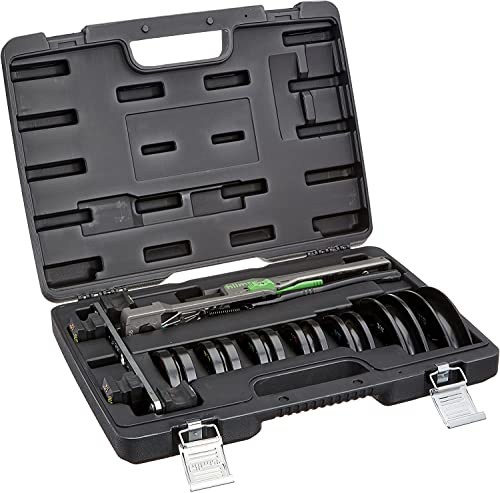
Choose the ratchet kit when your sizes run wide and your workspace runs tight. Seven color-coded mandrels cover 1/4 inch through 7/8 inch, the crossbar and mandrel swap by hand, and the spring-loaded ratchet lever forms a 90 degree bend with one hand while the other hand steadies the line set. That one-hand action is the real gain in a joist bay, above a ceiling, or inside an air handler cabinet, where a two-handle lever tool has no room to swing. A quick release frees the tube without dragging it across the form, which keeps soft copper clean on visible runs.
Specs
- Model: 1839032, CBK
- Tube sizes: 1/4, 5/16, 3/8, 1/2, 5/8, 3/4 and 7/8 in OD, 7 mandrels
- Maximum bend: 90 degrees
- Tube materials: soft tubing only, copper, steel, aluminum and brass, as listed
- Assembled size: 13.4 x 9.71 x 3.15 in
- Item weight: 7.8 lb
Best for: HVAC and refrigeration line sets from 1/4 to 7/8 inch, bent in place in tight spaces.
Watch out for: Bends stop at 90 degrees, so return bends need a lever tool instead, and this base kit has no reverse bend attachment, so check the kit contents if reverse bends are on your list.
ASIN: B00FPPDK70
Which One Fits Your Situation
You Are Replacing Brake Lines on One Car
Choose the Imperial 470-FH. Brake work mixes 3/16 and 1/4 inch tube with the odd 3/8 inch cooler line, and this one tool covers that spread with markings for the offset bends a chassis run needs. Its indexing handle also finishes the 180 degree return at the master cylinder without the handles crossing.
You Bend One 3/8 Inch Line Again and Again
Choose the Imperial 364-FHB06. A dedicated form supports 3/8 inch tube fully, the steel body suits firmer thin-wall steel and stainless, and the tight radius fits instrument and cooler lines into small spaces. One size done properly beats three sizes done loosely when the same bend repeats all week.
You Fit Mini-Splits and Line Sets for a Living
Choose the Hilmor CBK kit. Its mandrels run from 1/4 to 7/8 inch, which covers liquid and suction lines in one case, and the ratchet lever forms a 90 degree bend with one hand in a joist bay. For bench bends in just 1/4, 3/8 and 1/2 inch soft copper, the Hilmor TB1412 is the simpler companion.
You Need a Bender Twice a Year
Choose the ARES 70240. It covers 1/4, 5/16 and 3/8 inch tube, weighs about a pound, and forms a full 180 degree bend when a repair needs one. That is enough tool for the odd fuel line or copper fix, without paying for a kit whose larger mandrels would sit unused in the case.
Common Mistakes
- Using the nearest groove instead of the exact one, so the tube sits loose, shifts as the bend forms, and comes out flattened on one side.
- Reaching for a conduit bender or a bending spring on small metal line, then wondering why the bend is wide, uneven, or kinked at the ends.
- Forcing thin-wall stainless or hard steel through a tool the maker limits to soft tubing only, which can flex the form and scar the tube.
- Bending past the mark and pulling the tube back, which works the same spot twice and leaves a visible ripple in the wall.
- Skipping a scrap test bend, even though springback differs by material, so the first finished line lands a few degrees off the angle you needed.
Frequently Asked Questions
Can a tubing bender form stainless tube?
Some can, within limits. A firm single-size lever tool like the Imperial 364-FHB06 suits thin-wall stainless in its one size. Tools the maker limits to soft tubing only, including both Hilmor picks here, should stay on copper, aluminum, brass, and soft steel instead.
What is the difference between a tubing bender and a conduit bender?
Size and purpose. A tubing bender forms small metal tube, roughly 3/16 to 7/8 inch OD, with a groove matched to the tube and a set radius. A conduit bender forms large rigid electrical pipe with a long handle and foot pressure. The two tools do not swap jobs well.
Why did my bend kink even in the right groove?
Usually the tube moved or the pull was uneven. Seat the tube fully in the groove, keep it held against the form, and make the bend in one slow, steady pull. Very thin walls and hard tempers kink more easily, so a test bend on scrap tells you how your tube behaves.
Do I need a ratchet kit, or is a lever tool enough?
A lever tool is enough for small sizes in soft copper and aluminum, and it gives the best feel. Move to a ratchet kit when you bend 1/2 inch and larger sizes often, work in tight spaces with no swing room, or want one-hand control while the other hand holds the line.
More from Amazon
Programs that pair well with the guide above. Offers and eligibility are set by Amazon and may change.
A free business account with business pricing and bulk-buying tools for work, shop or home office.
Create a business accountFree shipping on eligible items, Prime Video and more. Eligible new members can start with a free trial.
Start a Prime free trialAudiobooks and podcasts to listen to on the go. Eligible new members can start with a free trial.
Try Audible freeAd-free music streaming. Eligible new subscribers can start with a free trial.
Try Music Unlimited freeAs an Amazon Associate we earn from qualifying purchases.