Key takeaways
- Compare five cable testers for home network wiring, from a simple Klein wiremap checker to a Fluke verifier with distance-to-fault and PoE detection.
A home office network usually fails at the cable, not at the router. One weak crimp, one pair on the wrong pins, or one run nicked inside a wall can leave a desk with a dead port or a link that quietly drops speed. A cable tester settles the question in seconds: plug in both ends and it reports whether every conductor lands where it should and, on stronger models, how long the run is and where the fault sits.
The five picks here all test copper Ethernet cabling, but they split into three tiers. The Klein LAN Scout Jr. 2 is a compact wiremap checker for patch cords and single runs. The Klein Scout Pro 3 and the two NOYAFA units add length measurement, cable tracing, and checks for power on the line, with the NF-8601S going furthest: true distance-to-fault readings and a ping test. The Fluke MicroScanner2 sits at the top as a verifier that also identifies what a live port is offering. None is a certification tool; they tell you whether your wiring is sound.
Disclosure: As an Amazon Associate, we earn from qualifying purchases made through links on this page, at no extra cost to you.
How to Choose a Cable Tester
Wiremap comes first. Every tester here maps all eight conductors pin to pin and flags the faults that matter: open circuits, shorts, miswires, and split pairs. The split pair is the one worth understanding. It passes a simple continuity check because every pin connects to something, yet the signals travel on wires that are not twisted together, so the run picks up interference and may fail at gigabit speed. Only a wiremap test catches it; a basic continuity buzzer cannot.
Length and fault location save wall surgery. Better testers also measure run length, confirming a run stays inside the 100 metre channel limit for Ethernet. The more valuable trick is distance to fault: using time domain reflectometry (TDR), the tester times a pulse sent down the cable and reports how far away the break or short sits. On an installed run, that reading is the difference between opening one section of wall and opening three.
Match the ports to the cables in your house. A pure Ethernet tester carries RJ45 ports only. If your walls also hold phone wiring or coax, a tester with RJ11 and F-connector ports checks those runs with the same tool. Shielded cable adds one more check: better testers report whether the shield is connected end to end, which matters near heavy electrical loads.
Live-network features are a separate tier. PoE detection tells you whether a port or run carries Power over Ethernet, and which pins supply it, before you plug in a camera or access point. Port flash and hub blink blink a switch port so you can find which run in a bundle lands on it. The Fluke below goes further and names the service on a live port. One caution applies to the whole group: most cable testers are built for unenergized cabling, so check the voltage limits before testing a line that might carry power.
Display and remotes decide how fast you work. A backlit LCD that draws the wiremap beats a row of blinking lights in a dark closet. Locator remotes earn their keep when several runs land in one place: plug a numbered remote into each room, and the tester names the run at the panel. Battery format is the last check; AAA and 9V cells are easy to keep spare, while the NOYAFA units recharge.
The 5 Best Cable Testers
1. Klein Tools LAN Scout Jr. 2 Cable Tester (VDV526-200)

The LAN Scout Jr. 2 does one job cleanly: it wiremaps RJ45-terminated data cable and names the fault. It handles shielded and unshielded Cat 3, Cat 5e, Cat 6/6A and Cat 7 cable up to 2,000 feet, and its backlit LCD shows opens, shorts, miswires, split pairs and shield faults in plain icons, not a light sequence to decode. A self-storing remote rides in the body, so testing an installed run alone is practical: remote in the room, tester at the panel. For a handful of runs and a drawer of self-crimped patch cords, this covers the real work.
Specs
- Model: VDV526-200
- Cable types: Cat 3, Cat 5e, Cat 6/6A, Cat 7; shielded or unshielded, RJ45
- Faults found: open, short, miswire, split pair, shield
- Maximum cable length: 2,000 ft (610 m)
- Power: 2 AAA alkaline batteries; active life 80 hours (maker figure)
- Dimensions: 5.3 x 2.4 x 1.2 in
2. Klein Tools Scout Pro 3 Cable Tester Kit (VDV501-851)
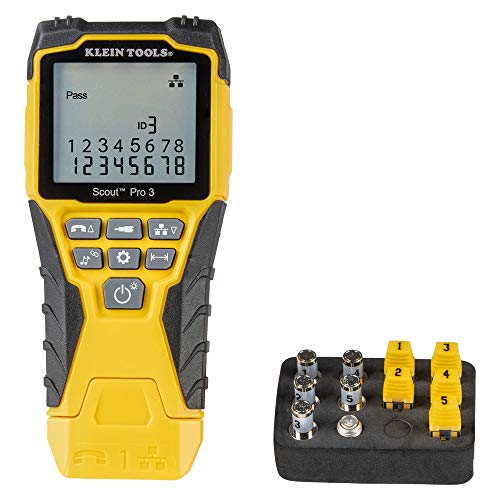
The Scout Pro 3 widens the brief to the whole low-voltage panel: it tests data cable on RJ45, voice cable on RJ11/12, and coax on an F-connector, all from one body. Beyond wiremap and the Jr. 2 fault set, it measures cable length by capacitance to 2,000 feet and reads result, wiremap, and cable ID on one backlit screen. The kit is built for labeling day: a self-storing Test+Map remote plus five LanMap and five CoaxMap locator remotes let you identify multiple runs in a single pass. Tone generation and hub blink cover tracing and port hunting, with the listening probe sold separately.
Specs
- Model: VDV501-851
- Ports: RJ11/12 (voice), RJ45 (data), F-connector (coax video)
- Length measurement: capacitance method, up to 2,000 ft (610 m)
- Display: backlit LCD showing length, wiremap, cable ID and results
- Remotes included: self-storing Test+Map remote, 5 LanMap RJ45 locator remotes, 5 CoaxMap F-connector locator remotes
- Power: 9V alkaline battery, included; active life 50 hours without backlight (maker figure)
3. NOYAFA NF-8209 Network Cable Tester

The NF-8209 is the step up for anyone whose runs feed powered devices. Alongside wiremap and continuity checks on Cat5 and Cat6 cable, it measures length from 2.5 to 200 metres, tests Power over Ethernet and reports supply details, and adds an NCV sensor that warns of AC voltage on a line. A port flash function blinks the matching switch port, and the digital scan mode traces a run through a bundle with the included receiver probe. The three-piece kit runs on a rechargeable lithium pack in the emitter. It skips coax and phone ports, but for Ethernet work it packs the longest feature list here under the Fluke.
Specs
- Model: NF-8209
- Cable types: Cat5, Cat6 UTP/STP (RJ45); telephone line
- Functions: wiremap and continuity, length test, cable tracing, PoE test, port flashing, crimp check, NCV voltage sensing
- Length range: 2.5 to 200 m
- Power: rechargeable lithium battery (emitter)
- Weight: 420 g
4. NOYAFA NF-8601S TDR Cable Tester

The NF-8601S is the diagnostician of the group. Its TDR length test does more than size a run: the graphical wiremap shows the distance to the fault, so a break inside a wall gets an address instead of a shrug. It covers RJ45, RJ11, BNC and metal cable from one transmitter, with a 2.8 inch color screen drawing the full pin map. Live-network tools are built in: PoE detection that names the powered pins and their voltage, a ping test that reports packet timing, and port flash for finding the far end at a switch. The receiver traces tone with an AC filter for work around powered switches, carries a 90 to 1000V voltage detector, and results export by TF card.
Specs
- Model: NF-8601S
- Cable types: STP/UTP Cat 5e, 6, 6A, 7; coaxial; telephone; metal cable (RJ45, RJ11, BNC ports)
- Length measurement: TDR, up to 1,000 m; accuracy up to 98% after calibration (maker figure)
- Display: 2.8 in color LCD, 320 x 240
- Functions: graphical wiremap with distance to fault, PoE detection, ping test, port flash, tone tracing with AC filter, NCV detector in receiver (90 to 1000V), TF card export
- Battery: 3.7V 1800mAh rechargeable lithium (transmitter and receiver)
- Dimensions: transmitter 173 x 92 x 34 mm; receiver 183 x 58 x 35 mm
5. Fluke Networks MicroScanner2 Cable Verifier (MS2-100)

The MicroScanner2 is the verifier professionals carry when a home network has grown into a small business one. Its screen shows four answers at once: a graphical wiremap, pair lengths, distance to fault, and cable ID or far-end device. It tests RJ45, RJ11 and coax, and it reads live services, detecting whether a port offers 10, 100 or 1000 Ethernet, plain telephone service, or PoE. Built-in IntelliTone toning works digitally for precise identification in a bundle, and in analog mode for common probes. The length test reaches 460 metres with 0.3 metre resolution, fine enough to place a fault within a single stud bay. It is the most capable tool here, and the right buy when the network supports income rather than hobbies.
Specs
- Model: MS2-100
- Ports: RJ45 (shielded 8-pin modular), RJ11, F-connector (coax)
- Service detection: 10/100/1000 Ethernet, POTS, PoE (802.3af)
- Length range: 460 m (1,500 ft); resolution 0.3 m (1 ft); typical accuracy ±4%
- Display: monochrome LCD with backlight
- Weight: 10.6 oz (300 g) with batteries and wiremap adapter
Comparison Table
| Product | Ports | Length measurement | PoE check | Display | Best for |
|---|---|---|---|---|---|
| Klein LAN Scout Jr. 2 (VDV526-200) | RJ45 | No | No | Backlit LCD | Patch cords and single runs |
| Klein Scout Pro 3 Kit (VDV501-851) | RJ45, RJ11/12, coax F | Yes, capacitance, to 2,000 ft | No | Backlit LCD | Mixed voice, data and video wiring |
| NOYAFA NF-8209 | RJ45 | Yes, 2.5 to 200 m | Yes | LCD | PoE cameras and access points |
| NOYAFA NF-8601S | RJ45, RJ11, BNC | Yes, TDR, to 1,000 m | Yes, plus ping test | 2.8 in color LCD | Finding faults inside walls |
| Fluke MicroScanner2 (MS2-100) | RJ45, RJ11, coax F | Yes, TDR, to 460 m | Yes, plus service detection | Backlit LCD | Verifying live office networks |
FAQ
Q: Can a cable tester find a fault hidden inside a wall?
A: Yes, if it measures distance to fault. The NOYAFA NF-8601S and the Fluke MicroScanner2 use TDR to report how far along the run a break or short sits, so you can measure from the jack and open the wall once, in the right place. Wiremap-only testers confirm a fault exists but cannot say where.
Q: What is a split pair, and why should I care?
A: A split pair happens when conductors from two different twisted pairs are mixed into one circuit at a plug or jack. Every pin still connects, so cheap continuity checkers pass it, but signals lose the noise protection of a proper twisted pair and the run may drop speed or fail under load. Every tester here detects split pairs.
Q: Do I need PoE testing in a home office?
A: Only if powered devices hang off your cabling: ceiling access points, security cameras, and desk phones are the common cases. A PoE check on the NOYAFA NF-8209, NF-8601S, or the Fluke confirms that a port or run delivers power, and on which pins, before you mount hardware that depends on it.
Q: Can these testers check coax and phone lines too?
A: Three of them can. The Klein Scout Pro 3 and the Fluke MicroScanner2 carry F-connector and RJ11 ports alongside RJ45, and the NOYAFA NF-8601S adds BNC and RJ11. The Klein LAN Scout Jr. 2 and the NOYAFA NF-8209 are Ethernet-focused, so choose by the wiring your walls hold.
Q: Will a cable tester tell me if a run supports gigabit speed?
A: Not directly. These are verification tools: they confirm correct wiring, sound pairs, shield continuity, and length inside the 100 metre limit, the physical conditions gigabit needs. The Fluke also reports the speed a live port advertises. Formal speed certification takes a different class of instrument, and no home office needs one.
Conclusion
Buy by the job in front of you. The Klein LAN Scout Jr. 2 is the honest minimum: a clear wiremap, split pair detection, and a remote that stores in the body. The Scout Pro 3 kit earns its place in houses wired for phone and coax as well as data, and its locator remotes speed labeling. Between the NOYAFA pair, the NF-8209 covers PoE checks and tracing for most powered setups, while the NF-8601S adds TDR fault distances and a ping test for stubborn installs. The Fluke MicroScanner2 closes the list as the verifier to grow into, the one that also tells you what a live port is serving.
More from Amazon
Programs that pair well with the guide above. Offers and eligibility are set by Amazon and may change.
A free business account with business pricing and bulk-buying tools for work, shop or home office.
Create a business accountFree shipping on eligible items, Prime Video and more. Eligible new members can start with a free trial.
Start a Prime free trialAudiobooks and podcasts to listen to on the go. Eligible new members can start with a free trial.
Try Audible freeAd-free music streaming. Eligible new subscribers can start with a free trial.
Try Music Unlimited freeAs an Amazon Associate we earn from qualifying purchases.