Key takeaways
- Compare the best angle finders for trim, crown molding and saw setup, from a pro Bosch tool to pocket magnetic gauges, with range and accuracy compared.
A corner that looks square on paper is often a degree or two off in the room, and that small error is exactly what leaves gaps in baseboard, crown molding and picture frames. An angle finder closes the gap between guessing and knowing. Press its arms or its magnetic base against the two surfaces, read the number on the screen, and set the saw to match. No squinting at a protractor scale, no test cuts on scrap.
The five picks below cover both families of this tool. Three are folding rulers with two arms: a pro Bosch unit that also computes miter and bevel settings, a 7-inch stainless GemRed for everyday trim work, and a compact General Tools model built for tight spots. The other two are magnetic gauges that sit on a blade or fence and report tilt: a Wixey cube made for saw setup, and a Klein gauge that doubles as a level. Every pick reads to a tenth of a degree, so the differences that matter are range, accuracy, arm length, and how each tool holds a reading.
Disclosure: As an Amazon Associate, we earn from qualifying purchases made through links on this page, at no extra cost to you.
How to Choose an Angle Finder
Pick the form that matches the job. A folding ruler measures the angle between two physical surfaces, which is what trim, flooring and framing work calls for. A magnetic gauge measures tilt against level, which is what you need when setting a saw blade bevel or checking a machine table. Many shops own one of each, because neither form does the other one’s work well.
Read accuracy and resolution as separate numbers. Resolution is the smallest step the screen can show, and on every pick here it is 0.1 degree. Accuracy is how close the reading sits to the true angle, and it is always the looser figure. A tenth-degree screen on a tool accurate to plus or minus 0.3 degree still leaves a visible seam on long crown runs. For trim and joinery, look for plus or minus 0.2 degree or better; for rough framing, plus or minus 0.3 degree is workable.
Check the measuring range before anything else. Ruler-style finders swing through a full 360 degrees, so they read inside corners, outside corners and reverse angles with the arms folded either way. The Bosch below tops out at 220 degrees, which still covers nearly every corner in a house. Magnetic gauges cover 180 degrees of tilt; the Klein splits that into a fine 0 to 90 range plus a full 0 to 180 range.
Look for a lock or a hold button. The whole point of the tool is carrying a number from the wall to the saw without losing it. A locking screw on the hinge, a HOLD key, or a memory function keeps the reading on screen while you walk.
Mind the power source. Two picks run on CR2032 coin cells, two on AAA cells, and the Bosch on four AA cells. Coin cells suit tools that live in a drawer and wake up a few times a month. Standard cells suit daily use, and they are easier to swap mid-job. Auto shut-off matters on both, because a forgotten tool with a lit screen drains its cell in days.
Consider build and sealing. Stainless arms shrug off drops and site dust, and etched scales stay legible after years of sliding across lumber. A sealed housing, IP54 on the Bosch and IP42 on the Klein, keeps fine dust out of the electronics. If the tool rides in a truck box rather than a desk drawer, those details decide how long it lasts.
The 5 Best Angle Finders
1. Bosch GAM 220 MF Digital Angle Finder
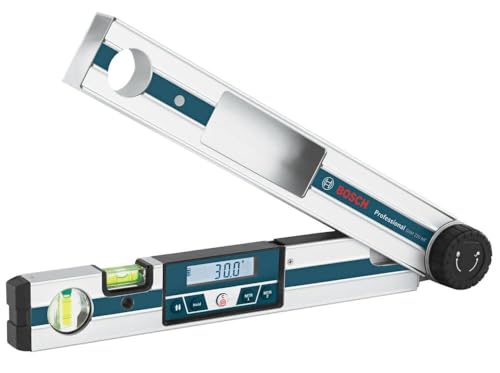
The GAM 220 MF is four tools in one housing: an angle finder, a protractor, a level, and a miter calculator that works out both simple and compound cuts. Measure a corner, press a button, and the screen hands you the miter and bevel settings for the saw, which removes the chart-and-calculator step. Accuracy is plus or minus 0.1 degree across the 0 to 220 degree range, the tightest figure in this group.
The 16-inch arm suits long trim runs, and a leg extension in the box reaches into deep or awkward corners. A HOLD key and a memory slot keep a reading parked while you move. The housing carries an IP54 seal, runs about 80 hours on four AA cells, and shuts itself off after roughly 30 idle minutes. At 2.4 pounds it is the heavyweight here; a hard case comes in the box.
Specs
- Model: GAM 220 MF
- Range: 0 to 220 degrees
- Accuracy: ±0.1 degree
- Resolution: 0.1 degree
- Arm length: 16 in / 40 cm
- Battery: 4 AA (included), about 80 hours
- Protection: IP54 seal against dust and splashes
- Weight: 2.4 lb
- Extras: Leg extension, hard case, HOLD and memory, simple and compound miter calculation
2. GemRed 82305 Digital Angle Finder

The 82305 is the classic two-arm ruler design in stainless steel, with laser-etched scales that will not rub off. Opened flat it spans 400 mm; folded, it shrinks to about 220 mm and rides in a tool belt or drawer. The hinge swings a full 360 degrees, and a locking screw pins the arms so the reading survives the walk to the saw.
Accuracy is plus or minus 0.3 degree with a 0.1 degree display step, which suits baseboard, flooring and general carpentry. One honest limitation: this model has no reverse display function, so on wide-open angles you read the screen from whichever side it faces. A CR2032 cell is included, and at 7 ounces it adds little belt weight.
Specs
- Model: 82305
- Range: 0 to 360 degrees
- Accuracy: ±0.3 degree
- Resolution: 0.1 degree
- Ruler length: 7 in / 200 mm per arm, stainless steel
- Folded length: About 220 mm
- Battery: CR2032 (included)
- Weight: 7 oz
- Extras: Locking screw; no reverse display function
3. General Tools 822 Digital Angle Finder

The 822, sold under the ANGLE-IZER name, is the compact pick: a 5-inch stainless ruler that fits inside cabinet carcasses, drawer boxes and other spots where a 7-inch arm will not sit flat. It reads through a full 360 degrees, zeroes at any point in the swing, and offers both a lock and a reverse angle function.
A center check notch in the blade helps line up ruler placement marks, a small touch that speeds up layout work. The large LCD reads easily at arm’s length, accuracy is plus or minus 0.3 degree, and the tool weighs 3.2 ounces. A CR2032 cell is included, and the maker backs it with a 1-year warranty.
Specs
- Model: 822
- Range: 0 to 360 degrees
- Accuracy: ±0.3 degree
- Resolution: 0.1 degree
- Ruler length: 5 in (7 in overall leg length), stainless steel
- Battery: CR2032 (included)
- Weight: 3.2 oz
- Extras: Lock and reverse angle functions, center check notch, 1-year warranty
4. Wixey WR300 Type 2 Digital Angle Gauge

The WR300 Type 2 leaves the ruler behind and measures tilt instead. Its magnetic base sticks to a saw blade, jointer fence or drill press table, and the screen reports the tilt to a tenth of a degree. Zero it on the machine table, stick it to the blade, crank the bevel to the number you want, and the cut matches the plan.
The range runs plus or minus 180 degrees, accuracy is plus or minus 0.2 degree, and the backlit screen stays readable under shop lights. It runs on a single AAA cell, shuts off on its own when idle, and weighs 3.2 ounces. What it cannot do is measure a room corner; pair it with a ruler-style finder if you also hang trim.
Specs
- Model: WR300 Type 2
- Range: ±180 degrees
- Accuracy: ±0.2 degree
- Resolution: 0.1 degree
- Battery: 1 AAA
- Weight: 3.2 oz
- Body: Alloy steel with magnetic base
- Extras: Backlit display, auto shut-off
5. Klein Tools 935DAG Digital Angle Gauge and Level
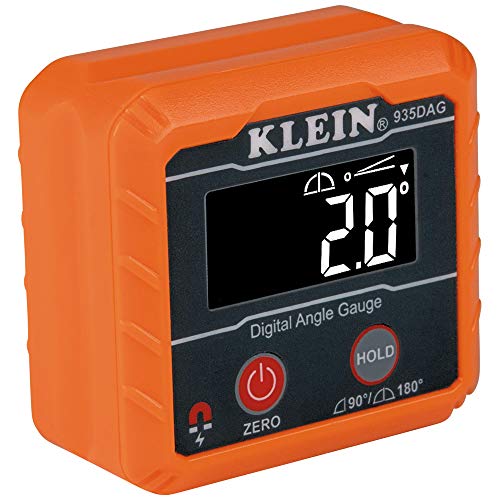
The 935DAG is a magnetic gauge built for installers. It offers two ranges, 0 to 90 degrees and 0 to 180 degrees, and its accuracy tightens to plus or minus 0.1 degree near the level and plumb points where precision matters most, relaxing to plus or minus 0.2 degree elsewhere. Rare earth magnets hold it to conduit, pipe and steel studs, and V-groove edges on all four sides seat it on round stock without rocking.
The reverse contrast screen flips on its own when the tool goes overhead, so readings stay upright. The housing is sealed to IP42 and survives drops from 6.6 feet. Two AAA cells and a soft carrying case come in the box, and at 3.5 ounces it rides in a pouch until needed.
Specs
- Model: 935DAG
- Range: 0 to 90 degrees and 0 to 180 degrees
- Accuracy: ±0.1 degree near level and plumb, ±0.2 degree elsewhere
- Resolution: 0.1 degree
- Battery: 2 AAA (included)
- Dimensions: 2.36 x 2.2 x 1.2 in
- Weight: 3.5 oz
- Protection: IP42 seal; drop protection to 6.6 ft
- Extras: Rare earth magnetic base, V-groove edges, soft case included
Comparison Table
| Pick | Form | Range | Accuracy | Battery |
|---|---|---|---|---|
| Bosch GAM 220 MF | Folding arm with miter calculator | 0 to 220 degrees | ±0.1 degree | 4 AA |
| GemRed 82305 | Folding ruler | 0 to 360 degrees | ±0.3 degree | CR2032 |
| General Tools 822 | Compact folding ruler | 0 to 360 degrees | ±0.3 degree | CR2032 |
| Wixey WR300 Type 2 | Magnetic gauge | ±180 degrees | ±0.2 degree | 1 AAA |
| Klein Tools 935DAG | Magnetic gauge and level | 0 to 90 and 0 to 180 degrees | ±0.1 to ±0.2 degree | 2 AAA |
Frequently Asked Questions
What is the difference between an angle finder and an inclinometer?
A folding angle finder measures the angle between two surfaces it touches. An inclinometer, also sold as a digital angle gauge, measures tilt against level and plumb, which suits blade and fence setup. The Wixey and Klein picks above are inclinometers; the Bosch, GemRed and General Tools picks are true two-surface finders.
How accurate does an angle finder need to be for crown molding?
Aim for plus or minus 0.2 degree or better. A miter joint doubles every error, because both halves of the joint carry it, so a finder off by 0.3 degree can leave a gap of 0.6 degree at the seam. The Bosch, at plus or minus 0.1 degree and with a built-in compound miter calculator, is the safest pick for crown work.
Can a magnetic angle gauge set a table saw blade bevel?
Yes, and it is the fastest way to do it. Zero the gauge on the saw table, stick its magnetic base to the blade, and tilt until the screen shows the target angle. The Wixey WR300 Type 2 is built for exactly this job, and its backlight helps inside a cabinet-style saw base.
Do digital angle finders work on inside and outside corners?
Ruler-style models do, because their arms swing a full 360 degrees and read the same corner from either side. The Bosch reaches 220 degrees, which still covers nearly every inside and outside corner in a house. Magnetic gauges measure tilt only, so they cannot read a corner directly.
How long do the batteries in a digital angle finder last?
Bosch publishes about 80 hours of runtime for the GAM 220 MF on four AA cells. The makers of the coin-cell and AAA picks do not publish a runtime figure, but auto shut-off stretches cell life by killing the screen when the tool sits idle. Keeping a spare CR2032 in the case is cheap insurance.
Conclusion
Match the form to the work and any of these five will serve well. Trim carpenters and serious remodelers should take the Bosch GAM 220 MF for its accuracy and built-in miter math. The GemRed 82305 is the all-round ruler for baseboard, flooring and general layout, while the General Tools 822 covers the same ground in a size that fits inside cabinets. On the machine side, the Wixey WR300 Type 2 owns blade and fence setup, and the Klein 935DAG adds level duty, a V-groove base and drop protection for install work. Measure the corner once, cut once, and the filler stays in the tube.
More from Amazon
Programs that pair well with the guide above. Offers and eligibility are set by Amazon and may change.
A free business account with business pricing and bulk-buying tools for work, shop or home office.
Create a business accountFree shipping on eligible items, Prime Video and more. Eligible new members can start with a free trial.
Start a Prime free trialAudiobooks and podcasts to listen to on the go. Eligible new members can start with a free trial.
Try Audible freeAd-free music streaming. Eligible new subscribers can start with a free trial.
Try Music Unlimited freeAs an Amazon Associate we earn from qualifying purchases.