Key takeaways
- Compare the best circuit finders for home panels, with digital and analog receivers, GFCI test functions, voltage ranges and sensitivity controls.
Every home has a breaker panel with faded pencil marks, missing labels, or labels that lie. The day you need to swap an outlet or cut power to one room for safe work, that panel turns into a guessing game of flipping breakers and shouting down the hallway. A circuit finder ends the game. You plug a small transmitter into the outlet in question, walk to the panel, and sweep a receiver across the breakers until it singles out the one feeding that outlet.
The five finders below all work on live household circuits, yet they differ in ways that matter. Some use a digital receiver that learns the panel and locks onto the strongest signal. Others keep a manual sensitivity dial, which helps in crowded panels. Most fold a ground fault outlet test into the transmitter, so the same tool checks the outlet once the breaker work is done.
Disclosure: As an Amazon Associate, we earn from qualifying purchases made through links on this page, at no extra cost to you.
How to Choose a Circuit Finder
Understand the two-part system. Every finder here is a pair: a transmitter that plugs into a receptacle and sends a signal along the wire, and a receiver you carry to the panel. The receiver reads signal strength at each breaker and signals, with light and sound, when it finds the strongest match. Nothing connects to the panel itself, and the circuit stays live during the search, so the rest of the house keeps its power.
Digital learning versus a manual dial. Digital receivers scan the panel twice. The first pass teaches the receiver the signal level at every breaker, and the second pass points to a single winner, which cuts down on false hits. Analog receivers with a sensitivity knob ask more of you: you sweep, turn the dial down, and sweep again until only one breaker still responds. The dial feels slower, yet in panels with tandem breakers packed tight together, that fine control can separate two breakers a digital unit keeps confusing.
Check the voltage window. Household finders are built for standard branch circuits, most often 90 to 125 volts AC. That covers normal outlets and lighting circuits in a home or small office. None of the tools here is meant for 240 volt appliance circuits, three-phase panels, or DC wiring, and each carries a safety category for the work it can touch.
Extra test functions earn their keep. A transmitter that also tests the outlet is more than a bonus. Wiring fault lights flag an open ground or swapped hot and neutral before you trust the outlet, and a ground fault trip test confirms that a protected outlet actually cuts power when it should. A non-contact voltage sensor in the receiver tip adds a quick way to confirm a wire is live before you touch it. If you only map breakers twice a year, a plain finder is fine; if you maintain a building, the added tests pay off on every visit.
The 5 Best Circuit Finders
1. Klein Tools ET310 AC Circuit Breaker Finder
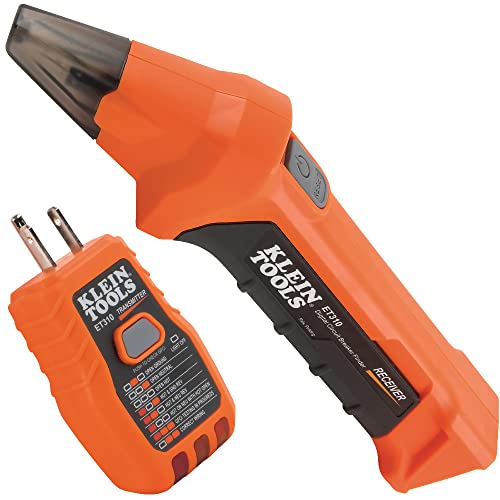
The ET310 is the finder most home users end up keeping, because its digital receiver removes the guesswork that puts people off analog tools. The transmitter plugs into the outlet and doubles as a ground fault outlet tester, with lights that report common wiring faults. You sweep the receiver down each row of breakers twice; on the second pass it gives a clear audible and visual signal at the single breaker feeding the transmitter.
Klein builds the pair for standard North American branch circuits, and the receiver runs on a single 9 volt battery. The two pieces store compactly in a kitchen drawer or a desk-side tool kit, within reach when a remodel or a faulty outlet comes up.
Specs
- Model: ET310
- Circuit voltage: 90 to 120 V AC
- Receiver type: Digital, two-pass learning scan
- Transmitter: Plug-in, with integrated GFCI outlet tester
- Indication: Audible tone and visual signal
- Receiver power: One 9 V battery
- Safety focus: Household branch circuits
2. IDEAL Electrical 61-534 Digital Circuit Breaker Finder
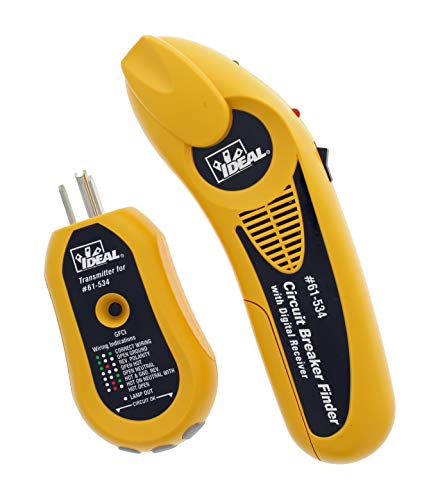
The 61-534 pairs a digital receiver with the most capable transmitter in this group. That transmitter does three jobs: it sends the locating signal, it tests the receptacle for correct wiring and polarity, and it trips a ground fault outlet to prove the protection works. The receiver adds a non-contact voltage sensor that detects 80 to 300 volts AC, so you can confirm a conductor is live without opening a box or touching bare copper.
IDEAL builds the set to a CAT II 300 V safety level with a UL 1436 listing, a step up in formal safety credentials from most household finders. The receiver shuts itself off after ten minutes of inactivity and uses an angled flat tip shaped to sit squarely on breaker faces during the scan. For a home workshop or small office where one person maintains the wiring, this is the most complete kit here.
Specs
- Model: 61-534
- Circuit voltage: 120 V AC
- Receiver type: Digital, with non-contact voltage sensor (80 to 300 V AC)
- Transmitter: Triple function signal sender, receptacle tester, GFCI trip test
- Safety: CAT II 300 V, UL 1436 listed
- Receiver power: One 9 V battery, auto power off after 10 minutes
- Pulse output: About 18 A at 120 V, per maker documentation
3. Extech CB10 AC Circuit Breaker Finder and Receptacle Tester

The CB10 takes the analog route and does it well. Its receiver carries a variable sensitivity adjustment, so in a dense panel you can sweep once at full sensitivity, note the cluster that responds, then dial down and sweep again until a single breaker remains. For panels where digital units sometimes hesitate between two adjacent breakers, that manual control is a genuine advantage rather than a chore.
Extech rates the finder for 110 to 125 volt AC circuits, and the transmitter works as a receptacle tester with a ground fault test, using LED patterns to report wiring conditions at the outlet. The receiver runs on a 9 volt battery, included in the box. It is a proven design suited to anyone who prefers a dial they control over a scan they trust.
Specs
- Model: CB10
- Circuit voltage: 110 to 125 V AC
- Receiver type: Analog, variable sensitivity adjustment
- Transmitter: Plug-in, with receptacle and GFCI test functions
- Indication: LED indicators and audible signal
- Receiver power: One 9 V battery, included
- Extra: Locates fuses as well as breakers
4. Sperry Instruments CS61200 Circuit Breaker Finder

The CS61200 is the compact classic of the group. Transmitter and receiver snap together into one tidy unit for storage, so nothing gets separated in a toolbox. The transmitter plugs into a standard outlet, works across a 90 to 120 volt AC range at 60 Hz, and includes a ground fault test function; the receiver answers with both audible and visual alerts as you pass the wand along the breaker row.
Sperry rates the set at CAT II 120 V, and the receiver runs on one 9 volt battery, included. With the maker’s separate accessory kit, the same transmitter can trace circuits feeding light fixtures and wall switches. On its own it covers the common household case: find the breaker, confirm it by switching it off, and watch the transmitter light go out.
Specs
- Model: CS61200
- Circuit voltage: 90 to 120 V AC, 60 Hz
- Receiver type: Analog wand, audible and visual alerts
- Transmitter: Plug-in, with GFCI test function
- Safety: CAT II 120 V
- Receiver power: One 9 V battery, included
- Weight: About 9.6 oz for the set
5. Amprobe BT-120 Circuit Breaker Tracer

The BT-120 leans on automation. Its receiver adjusts sensitivity on its own under microprocessor control, learning as you sweep and then pointing at the correct breaker with a large green arrow and a beep. There is no dial to manage and no second guessing about settings, which makes it friendly for a homeowner who maps a panel rarely and wants the tool to handle the judgement calls.
Amprobe specifies the tracer for powered systems from 90 to 120 volts AC at 50 to 60 Hz, aimed at homes and light commercial spaces. The transmitter shows a red light to confirm the receptacle is live before you head to the panel. The receiver runs on one 9 volt alkaline battery, included, and the set carries a UL 61010-1 listing at CAT II 120 V. Simple, direct, and hard to misuse.
Specs
- Model: BT-120
- Circuit voltage: 90 to 120 V AC, 50 to 60 Hz
- Receiver type: Automatic sensitivity, microprocessor controlled
- Indication: Green arrow light and audible beep
- Safety: CAT II 120 V, UL 61010-1
- Receiver power: One 9 V alkaline battery, included
- Auto power off: About 4 minutes
Comparison Table
| Model | Receiver style | Circuit voltage | Outlet test built in | Non-contact voltage | Safety level |
|---|---|---|---|---|---|
| Klein Tools ET310 | Digital learning scan | 90 to 120 V AC | Yes, with GFCI test | No | Household branch circuits |
| IDEAL 61-534 | Digital | 120 V AC | Yes, with GFCI trip test | Yes, 80 to 300 V AC | CAT II 300 V |
| Extech CB10 | Analog, sensitivity dial | 110 to 125 V AC | Yes, with GFCI test | No | Household branch circuits |
| Sperry CS61200 | Analog wand | 90 to 120 V AC | Yes, with GFCI test | No | CAT II 120 V |
| Amprobe BT-120 | Automatic sensitivity | 90 to 120 V AC | Live-circuit indication | No | CAT II 120 V |
Frequently Asked Questions
How does a circuit finder work without turning off the power?
The transmitter plugs into the outlet and sends a small signal along that circuit’s wiring. At the panel, the receiver senses the signal through each breaker’s face and reacts most strongly at the breaker carrying it. Because the signal rides the live circuit, the rest of the house keeps its power while you search, and you only switch a breaker off once you have found the right one.
Can a circuit finder locate the breaker for a light fixture or a wall switch?
Yes, with the right connection. Most transmitters plug into a receptacle, so a fixture needs an adapter that screws into the bulb socket, and a switch circuit needs clip leads on the wires. Some makers sell those adapters as a separate accessory kit. Once the transmitter is connected to the fixture or switch wiring, the panel sweep works exactly as it does for an outlet.
Why does the receiver react to more than one breaker?
Signals can bleed into neighbouring breakers, above all in panels with breakers packed tightly or circuits that share a neutral. The fix is a second pass. Digital receivers learn the panel on the first pass and name one breaker on the second. With an analog receiver, lower the sensitivity between passes and sweep again; false responses fade first, and the true breaker keeps answering longest.
Will these finders work on 240 volt circuits or in an old fuse box?
They are built for standard 90 to 125 volt branch circuits, so they do not cover 240 volt appliance circuits such as dryers, ranges, or large air conditioners. A fuse box is a different story: most of these tools locate fuses as happily as breakers, since the receiver only needs the signal at the protective device, whatever its form. Always confirm the voltage window in the maker’s documentation before use.
What should I do after the finder points to a breaker?
Treat the result as a strong lead, then prove it. Switch the chosen breaker off and confirm that the outlet or device has lost power; the transmitter light going out is the clearest sign. Only then label the panel in ink, with the room and outlets that breaker feeds, so the next job takes minutes.
Conclusion
For most homes, the Klein Tools ET310 is the easy recommendation: a digital receiver, a transmitter that tests the outlet, and a two-pass scan that names one breaker with confidence. The IDEAL 61-534 suits anyone who wants the deepest feature set, adding non-contact voltage detection and a higher safety level. The Extech CB10 rewards a patient hand with its sensitivity dial, the Sperry CS61200 wins on compact storage, and the Amprobe BT-120 asks the least of its user. Whichever you choose, finish properly: verify at the outlet, then label the panel.
More from Amazon
Programs that pair well with the guide above. Offers and eligibility are set by Amazon and may change.
A free business account with business pricing and bulk-buying tools for work, shop or home office.
Create a business accountFree shipping on eligible items, Prime Video and more. Eligible new members can start with a free trial.
Start a Prime free trialAudiobooks and podcasts to listen to on the go. Eligible new members can start with a free trial.
Try Audible freeAd-free music streaming. Eligible new subscribers can start with a free trial.
Try Music Unlimited freeAs an Amazon Associate we earn from qualifying purchases.