Key takeaways
- Compare window fans that exhaust hot attic air, with listed CFM, reversible airflow, sizes and fit checks to weigh before you order for your attic window.
An attic with a usable window opening gives you a way to move hot air out without cutting into the roof or hiring an electrician for a hardwired ventilator, but the fan only helps if it fits the opening and moves enough air for the space. The real decision is which style matches your window: a large whole-house window fan that fills a wide double-hung opening, or a compact shutter exhaust fan that sits in a small attic or dormer window and seals itself when it stops.

This guide serves attic owners with a wide gable-end or double-hung window, owners whose only opening is a small dormer window, and anyone who wants intake as well as exhaust from one unit. Every pick below mounts in a window and is positioned by its own listing for attic or general exhaust ventilation, and the picks were chosen from the name and specs on the Amazon product page.
Quick Picks
As an Amazon Associate we earn from qualifying purchases
| Product | Best for | Key spec |
|---|---|---|
| Air King 9166F 20″ Whole House Window Fan | A wide attic window where maximum airflow matters most | 3560 CFM on high |
| Air King 9155 16″ Window Fan | A standard double-hung window too small for the 20-inch model | 2470 CFM, reversible |
| HG Power Upgraded 10 Inch Shutter Exhaust Fan | A small dormer window where a sealing shutter matters | 647 CFM, automatic shutter |
| Hehou Window Shutter Exhaust Fan, 12″ | A compact window where intake and exhaust are both wanted | 470 CFM, pull-cord reversing |
| SAILFLO 10 Inch Window Shutter Exhaust Fan (SF-25DK) | A square cutout opening where a self-closing louver is wanted | 40 dB as listed, pull chain |
How to Choose
Measure the Opening Before Anything Else
Window fans fail more often on fit than on power. Measure the width and height of the opening with the sash raised, then compare those numbers against the fit range or panel dimensions in the listing, not against the fan size in the product name. A 20-inch whole-house fan needs a tall opening because the housing sits above the blade, while a shutter fan needs its full panel covered by the frame. If your opening falls between sizes, the smaller fan with a proper seal will usually ventilate better than a larger fan wedged in with gaps around the edges.
Match Listed CFM to Your Attic Size
CFM is the volume of air a fan moves per minute, and listings state it per speed, so compare high-speed figures across models. A small attic or dormer space can be served by a few hundred CFM, while a full attic under a hot roof needs the thousands of CFM that only the large whole-house window fans list. Treat the figure as a comparison tool rather than a promise, since real airflow depends on how freely air can enter the attic elsewhere. A fan exhausting into a sealed attic just stirs hot air, so an intake path matters as much as the number.
Decide Whether You Need Reversible Airflow
Exhaust-only fans push hot air out, which is the main job in summer. Reversible models can also pull cooler outside air in, useful in the evening after the roof has radiated its heat away, or for pressurising the attic slightly to push stale air out through vents. Reversing happens differently by model: some use an electrically reversible motor with separate intake speeds, others cycle through modes with a pull cord. If you only ever plan to exhaust, a simpler exhaust-only shutter fan is fine. If your attic has few vents, intake mode gives the fan a second job.
Check How the Fan Seals and How You Will Control It
An attic fan sits in an opening that stays in place for months, so what happens when it is off matters. Shutter and louver designs close automatically when the fan stops, limiting rain, dust and insect entry. Whole-house window fans with a guard housing let you close the window itself behind the fan. Controls matter too, because attic access is awkward: a front rotary switch, a pull chain, or a cord with an inline switch each beats controls on the back of the unit. Confirm the cord reaches an outlet without an extension lead.
The 5 Best Options
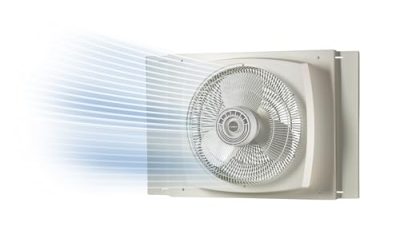
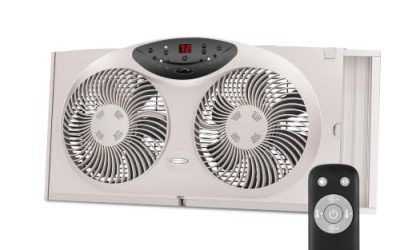
Air King 9166F 20″ Whole House Window Fan
If your attic has a wide double-hung or gable-end window and heat builds up fast on summer afternoons, this is the heavy lifter of the group. The 20-inch blade and three speeds move far more air than the compact shutter fans below, and the Storm Guard housing lets you close the window behind it when the weather turns. It suits larger attic spaces where a small exhaust fan would run all day and still fall behind. The trade-off is size: the opening has to be genuinely big, and the listed noise figure is the highest here.
Specs
- Blade: 20 inch
- Airflow: 3560 CFM high, 3120 CFM medium, 2510 CFM low
- Speeds: 3
- Motor: 1/6 HP, 120V, 1600 RPM on high
- Noise: 64 dB as listed
- Power: 170W on high
- Fits window openings: 27 to 38 in wide by 26.25 in tall
- Housing: Storm Guard, lets the window close behind the fan
- Control: front-mounted rotary
- Cord length: not stated
- Weight: not stated
Best for: a wide attic or gable-end window where maximum listed airflow matters most.
Watch out for: the opening must be at least 26.25 in tall, and confirm a current featured offer on the listing before ordering.
ASIN: B0007Q3RQ6
Air King 9155 16″ Window Fan
Choose this one when the attic window is a standard double-hung that cannot take the 20-inch model. It still moves a lot of air on its high setting, and the electrically reversible motor gives you three intake speeds as well as three exhaust speeds, so you can pull cooler evening air in after pushing the day’s heat out. The Storm Guard housing again lets the window close behind the fan. It fits buyers who want whole-house style airflow in a slightly smaller frame and prefer a simple rotary switch over extra electronics.
Specs
- Blade: 16 inch
- Airflow: 2470 CFM high, 1700 CFM medium, 1360 CFM low
- Speeds: 3 intake and 3 exhaust, electrically reversible
- Motor: 1/6 HP, 120V
- Power: 90W on high
- Fits windows: 26.5 to 34.5 in wide by 22 in high
- Housing: Storm Guard, lets the window close behind the fan
- Control: rotary switch
- Cord: 7 ft
- Noise: not stated
Best for: a standard double-hung attic window that is too small for the 20-inch model.
Watch out for: this fan is also sold under a sister brand’s badge, so check the model number 9155 and the ASIN on the live listing to be sure you are buying this unit.
ASIN: B002AGZUMA
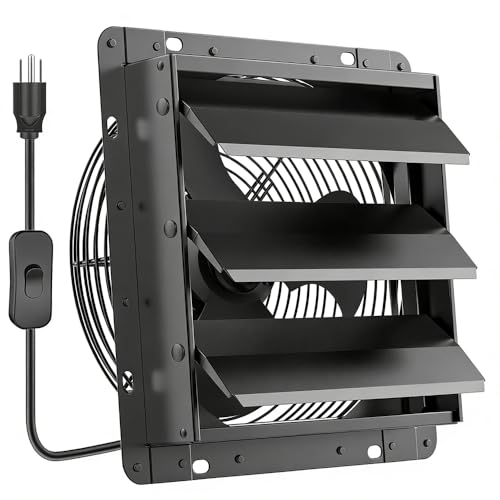
HG Power Upgraded 10 Inch Shutter Exhaust Fan
This compact shutter fan suits a small attic or dormer window where the big whole-house fans simply will not fit. Instead of raw airflow, its appeal is the automatic louver: the shutters open while the fan runs and seal shut when it stops, which helps keep rain, dust and insects out of an attic that sits empty most of the time. The long cord with an inline switch makes it easy to reach from the attic hatch. Pick it when the opening is small and a sealed-when-off fan matters more than maximum CFM.
Specs
- Size: 10 inch
- Airflow: 647 CFM as listed
- Shutter: automatic louver that seals shut when off
- Cord: 8 ft power cord with ON/OFF switch
- Power: plug-in, 100-120V US plug
- Noise: not stated
- Speeds: not stated
Best for: a small attic or dormer window where a shutter that seals when off matters more than raw CFM.
Watch out for: confirm a current offer on the listing, and check that the unit in the box is the corded plug-in version shown there.
ASIN: B0CNTQRML2
Hehou Window Shutter Exhaust Fan, 12″
Pick this one when you want both directions of airflow from a single compact unit. A pull cord cycles it through exhaust, then intake, then off, and the shutters close on their own when it stops, so there is nothing to adjust by hand after each use. Its listed noise figure is modest and the power draw is low, which suits an attic over bedrooms where a loud fan would carry through the ceiling. It is a single-speed design, so it fits steady background ventilation rather than fast heat purges.
Specs
- Size: 12 inch as titled
- Airflow: 470 CFM as listed
- Airflow direction: reversible by pull cord, shutters close automatically
- Speeds: 1 power level
- Speed: 1250 RPM
- Noise: 44 dB as listed
- Power: 35W, 110V
- Control: pull chain
- Dimensions: 5.35″D x 11.5″W x 13.6″H as listed
- Cord: included
Best for: a compact attic window where intake as well as exhaust is wanted from one small unit.
Watch out for: it is a single-speed pull-cord unit, so measure your opening against the listed dimensions rather than the title size alone.
ASIN: B0BL2G9FCG
SAILFLO 10 Inch Window Shutter Exhaust Fan (SF-25DK)
This shutter fan is built around a square cutout, so it suits an attic window opening you can measure and match to its panel rather than a sash you slide open. The airflow reverses for intake or exhaust, the pull chain keeps the controls simple with no electronics to fail in attic heat, and the louver closes when the fan stops. The listed noise figure is the lowest in this roundup. It fits a smaller attic or a gable-end window where a neat, sealed installation matters more than control options.
Specs
- Model: SF-25DK, 10 inch
- Cutout: 11.6 x 11.6 in
- Panel: 13.6 x 13.6 in
- Airflow: reversible, exhaust and intake
- Airflow capacity: not stated
- Control: pull chain switch
- Power: 35W, 120V
- Noise: 40 dB as listed
- Cable length: 39 inches as listed
- Blades: 5
Best for: a square attic window opening cut for a shutter fan, where a self-closing louver is wanted.
Watch out for: the listing’s own airflow figures conflict, so settle the CFM on the live page before relying on a number, and confirm the cutout size against your opening.
ASIN: B07TK98MVV
Which One Fits Your Situation
Your Attic Window Is Wide and the Heat Is Severe
Start with the Air King 9166F. Its 3560 CFM high setting is in a different league from the shutter fans, and a large attic under a sun-baked roof needs that volume to make a dent in afternoon temperatures. The Storm Guard housing means the window can still close behind it at night or during storms, so the installation does not leave the attic open to the weather between uses.
Your Only Opening Is a Small Dormer Window
The HG Power 10 inch shutter fan is the pick here. Whole-house fans need openings far bigger than a dormer provides, while this unit’s panel suits a compact window and its louver seals shut when off, which matters in a space you rarely enter. Its 647 CFM is modest, but for a small dormer attic it is matched to the volume it has to clear.
You Want Cooler Air Pulled In After Sunset
Choose a reversible model. The Air King 9155 gives you three intake speeds alongside three exhaust speeds, so the same unit that pushes hot air out all afternoon can draw cooler evening air in. If your window is smaller, the Hehou 12 inch reverses with its pull cord instead. Either way, intake mode only helps once outside air is cooler than the attic air, so timing matters more than speed.
The Attic Sits Directly Over Bedrooms
Noise carries through a ceiling, so look at the listed figures first. The SAILFLO lists 40 dB and the Hehou 44 dB, both far below the big Air King 9166F at 64 dB. Either shutter fan gives steady background ventilation without a drone overhead, and both seal when off. Pick the SAILFLO for a square cutout opening and the Hehou when you also want pull-cord reversing.
Common Mistakes
- Ordering by the fan size in the product name instead of the fit range or panel dimensions in the listing, then finding the housing will not sit in the opening.
- Comparing CFM figures across listings without checking the speed they were measured at, or trusting a figure the listing itself states inconsistently.
- Sealing the attic so well that the exhaust fan has no intake path, which leaves it stirring hot air instead of clearing it.
- Running a cord across the attic to a distant outlet with an extension lead instead of choosing a fan whose cord reaches properly.
- Leaving a fan without shutters or a closable window open to the weather all winter, inviting rain, dust and insects into the attic.
Frequently Asked Questions
Can a window fan really cool an attic without a roof vent?
It can lower attic temperatures by exchanging the air, provided cooler air has a way in. A window fan exhausting from one opening works best when another vent, window or soffit path lets replacement air enter. In a fully sealed attic the same fan mostly recirculates hot air, so check your intake path before blaming the fan’s CFM figure.
Should I run the fan on intake or exhaust during the day?
Exhaust is the daytime default, because attic air is usually hotter than outside air and you want it out. Intake makes sense in the evening, when outside air drops below attic temperature and a reversible fan can push the cooler air in. Running intake at midday just adds hot outside air to an already hot space.
How do I keep rain and insects out when the fan is off?
Choose a design that closes itself. Shutter and louver fans seal their blades shut when they stop, and whole-house window fans with a guard housing let you close the window behind them. If your fan does neither, plan to remove it or cover the opening outside the cooling season, and inspect the seal each spring.
Is it safe to leave an attic window fan running unattended?
Follow the maker’s instructions and basic electrical common sense: plug the fan directly into an outlet, keep the cord and outlet dry, unplug it before cleaning or servicing, and never run a unit with a damaged cord. Attics get extremely hot, so check on the fan periodically rather than treating it as fit-and-forget, and follow local electrical code for anything beyond a plug-in unit.
More from Amazon
Programs that pair well with the guide above. Offers and eligibility are set by Amazon and may change.
A free business account with business pricing and bulk-buying tools for work, shop or home office.
Create a business accountFree shipping on eligible items, Prime Video and more. Eligible new members can start with a free trial.
Start a Prime free trialAudiobooks and podcasts to listen to on the go. Eligible new members can start with a free trial.
Try Audible freeAd-free music streaming. Eligible new subscribers can start with a free trial.
Try Music Unlimited freeAs an Amazon Associate we earn from qualifying purchases.