Key takeaways
- Manual vs. power: Manual mechanisms use a lever and your own body weight — fewer failure points, nothing to plug in, and repairs usually mean a $30 cable. Power seats give you infinite stop positions and are far easier on bad knees and hips, but you’re trusting a motor and control board. If anyone in the house struggles to push a footrest closed, choose power.
- Frame material: Look for kiln-dried hardwood or plywood at the stress points where the mechanism bolts in. Particleboard strips out under repeated cycling, and once a bolt loses its bite you’re drilling and epoxying inserts. Product photos of the underside are worth more than any marketing copy.
- Wall and recline clearance: Standard mechanisms need 12 to 18 inches behind the seatback. Measure your actual wall-to-obstacle distance, then add four inches of margin. Wall-hugger designs recline in roughly 4 inches but sacrifice some seat depth.
- Upholstery honesty: Genuine leather patinas and can be conditioned back to life. Faux leather is easy to wipe down but eventually cracks at the seat-crease flex points, typically at the three to five year mark. Woven fabrics hide wear well but need a spray protectant applied before the sofa sees its first spill.
- Delivery and assembly reality: Most three-seaters arrive in two or three boxes weighing 80 to 120 pounds each. Confirm your doorway and stair turns first, and plan on a helper plus a socket wrench. Modular designs that bolt together in the room are dramatically easier to move later than one-piece units.
What's inside
Reclining sofas occupy a strange middle ground in furniture buying. They’re mechanical objects dressed up as upholstery, which means the things that determine whether you’ll still love yours in five years are mostly hidden: the gauge of the steel in the linkage, whether the frame rails are kiln-dried hardwood or stapled particleboard, how the motor is mounted. Showroom testing tells you almost nothing, and online listings tend to lead with cup holders while staying quiet about what’s underneath.
I’ve taken enough of these apart — reattaching pull handles, replacing a seized motor, shimming a frame that racked itself out of square — to know which construction details actually predict longevity. This guide walks through what to inspect before you buy, then reviews six current three-seat recliners across manual and power configurations, from budget fabric models to full genuine leather. Assembly difficulty and serviceability get equal weight alongside comfort, because a sofa you can’t fix is a sofa you’ll replace.
As an Amazon Associate we earn from qualifying purchases.


How to Choose a Sofa Recliners (2026)
- Manual vs. power: Manual mechanisms use a lever and your own body weight — fewer failure points, nothing to plug in, and repairs usually mean a $30 cable. Power seats give you infinite stop positions and are far easier on bad knees and hips, but you’re trusting a motor and control board. If anyone in the house struggles to push a footrest closed, choose power.
- Frame material: Look for kiln-dried hardwood or plywood at the stress points where the mechanism bolts in. Particleboard strips out under repeated cycling, and once a bolt loses its bite you’re drilling and epoxying inserts. Product photos of the underside are worth more than any marketing copy.
- Wall and recline clearance: Standard mechanisms need 12 to 18 inches behind the seatback. Measure your actual wall-to-obstacle distance, then add four inches of margin. Wall-hugger designs recline in roughly 4 inches but sacrifice some seat depth.
- Upholstery honesty: Genuine leather patinas and can be conditioned back to life. Faux leather is easy to wipe down but eventually cracks at the seat-crease flex points, typically at the three to five year mark. Woven fabrics hide wear well but need a spray protectant applied before the sofa sees its first spill.
- Delivery and assembly reality: Most three-seaters arrive in two or three boxes weighing 80 to 120 pounds each. Confirm your doorway and stair turns first, and plan on a helper plus a socket wrench. Modular designs that bolt together in the room are dramatically easier to move later than one-piece units.
The Best Sofa Recliners (2026)s Reviewed
Extra Wide Overstuffed 3 Seat Manual Recliner Sofa
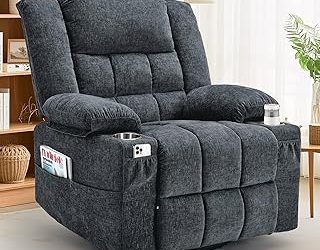
The overstuffed geometry here delivers genuinely deep seating with breathable fabric that stays comfortable through long sessions, and the manual mechanism keeps the parts count low. Extra-wide means extra footprint, so tape out the dimensions on your floor before ordering.
Genuine Leather Power Recliner Sofa
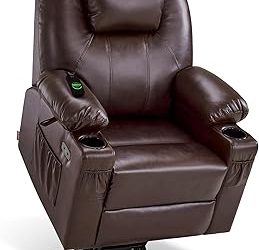
Real leather over a powered three-seat frame is the combination that ages gracefully rather than degrading, and the integrated USB ports and hidden cup holders are cleanly executed instead of bolted on as afterthoughts. Position it within reach of an outlet, or plan a cord route before final placement.
Dresegmt Loveseat Recliner with Flip Middle Backrest
The flip-down center backrest converts this from a three-seater to a loveseat with a console, and the storage drawer solves the remote-clutter problem better than most side pockets do. Its compact proportions make it one of the few options that genuinely works in an RV or a tight apartment.
HAOMARKETS 3-Piece Recliner Sofa Set with Massage & Heat
Buying the sofa and two power chairs together guarantees matching upholstery and consistent mechanism height across the room, which is hard to achieve piecemeal. The massage and lumbar heat functions are legitimately useful, though they add wiring you’ll want to secure and label during setup.
Faux Leather Manual Reclining Sofa
This is the pragmatic pick for high-traffic rooms and offices: wipe-clean surfaces, manual mechanisms, and no electronics to fail. Condition the seams occasionally and keep it out of direct sun, and you’ll significantly extend the life of the coating.
Frequently Asked Questions
How much space do I need behind a reclining sofa?
Budget 12 to 18 inches for standard mechanisms, measured from the wall to the back of the frame. Wall-hugger models cut that to about 4 inches. Always verify against the specific listing rather than assuming.
Can I repair a reclining sofa myself?
Frequently, yes. Broken pull cables, loose bolts, and detached handles are straightforward fixes with basic tools. Power units are trickier — motors and control boards are usually replaceable modules, so photograph the label and part number before ordering anything.
Is leather worth the extra cost over faux?
If the sofa sees daily use, yes. Genuine leather can be cleaned and conditioned indefinitely, while faux leather coatings eventually crack at flex creases. For light-use rooms, faux is a sound value.
Do power recliners work during a power outage?
Not without a backup. Many models accept an optional battery pack that holds enough charge for a handful of cycles. If outages are common where you live, a manual mechanism removes the concern entirely.
Final Thoughts
For most living rooms, the Genuine Leather Power Recliner Sofa is the one worth stretching for — real leather and powered positioning are the two upgrades you’ll still appreciate years in. The Dresegmt flip-backrest model is the smartest choice for tight spaces thanks to its storage drawer and convertible center seat, while the Extra Wide Overstuffed manual recliner delivers the deepest, most forgiving seating without any electronics to eventually service.