Key takeaways
- Weave structure: Flat, tightly woven surfaces beat anything with visible loops or nubs. Microfiber, canvas, denim, and short-pile flannel give claws nothing to catch. Run your thumbnail across a swatch before you commit.
- Rub count: Upholstery fabrics are rated in double rubs. Anything under 15,000 is decorative. Look for 25,000 and up for a household with a large dog, and treat that number as your baseline for reupholstery projects too.
- Moisture barrier: Water resistant means beads on the surface; waterproof means a laminated backing that stops liquid from reaching foam. For senior dogs or puppies still learning, insist on the backing, and check that it does not crinkle audibly.
- Anchoring system: Elastic straps, silicone-dotted undersides, and deep tuck flaps are what keep a cover honest. Pool noodles or foam tuck sticks pressed into the seat crease will hold a slipcover tighter than any strap alone.
- Wash and dry behavior: Measure your cushions, then buy for the shrink. Cotton quilts tighten in hot water, so wash cold and tumble low. Anything you cannot fit in a home machine will eventually stop getting cleaned.
What's inside
Anyone who has run a hand across a sofa arm after a summer of dog naps knows the real enemy isn’t dirt. It’s loop pull. Chenille, boucle, and loose linen weaves all share a fatal flaw: a single claw hooks a raised loop and drags it into a snag you cannot fix without a needle and a lot of patience. Add drool that wicks into the batting, hair that welds itself into the pile, and the occasional muddy sprint from the back door, and a nice couch becomes a project piece in under a year.
This guide takes the workshop approach. First, what actually makes a fabric dog-proof at the fiber level, borrowed from upholstery shop rules of thumb rather than marketing copy. Second, the practical shortcut most of us land on eventually: a well-fitted protective cover in the right material, tucked and anchored properly so it stays put. Below are the covers worth your money in 2026, plus the fitting tricks that separate a cover that looks intentional from one that looks like a bedsheet.
As an Amazon Associate we earn from qualifying purchases.


How to Choose a Sofa Fabrics For Dogs (2026)
- Weave structure: Flat, tightly woven surfaces beat anything with visible loops or nubs. Microfiber, canvas, denim, and short-pile flannel give claws nothing to catch. Run your thumbnail across a swatch before you commit.
- Rub count: Upholstery fabrics are rated in double rubs. Anything under 15,000 is decorative. Look for 25,000 and up for a household with a large dog, and treat that number as your baseline for reupholstery projects too.
- Moisture barrier: Water resistant means beads on the surface; waterproof means a laminated backing that stops liquid from reaching foam. For senior dogs or puppies still learning, insist on the backing, and check that it does not crinkle audibly.
- Anchoring system: Elastic straps, silicone-dotted undersides, and deep tuck flaps are what keep a cover honest. Pool noodles or foam tuck sticks pressed into the seat crease will hold a slipcover tighter than any strap alone.
- Wash and dry behavior: Measure your cushions, then buy for the shrink. Cotton quilts tighten in hot water, so wash cold and tumble low. Anything you cannot fit in a home machine will eventually stop getting cleaned.
The Best Sofa Fabrics For Dogs (2026) Reviewed
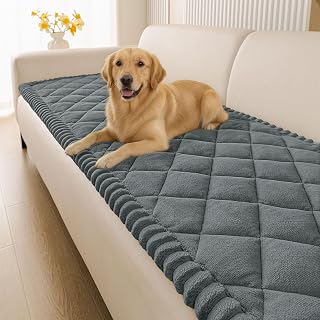
Smiry Waterproof Plush Flannel Protector
The flannel face is short enough to shed hair with a lint roller, and the laminated backing stops accidents before they hit the cushion. At 36″ x 71″ it covers a two-seater or one section of a sectional cleanly, and the non-slip underside holds well once you tuck the excess into the seat crease.
XINEAGE 4-Piece Stretch Couch Cover
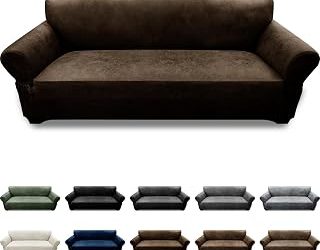
A four-way stretch knit is the closest you get to a tailored reupholstery job without touching a staple gun, and the separate cushion pieces mean no bunching where dogs pivot. Best for owners who want the sofa to look finished rather than draped, though it offers less liquid protection than a laminated option.
Leaf Floral Cotton Quilted Sofa Cover
Quilted cotton breathes better than synthetics, so it stays cooler for dogs that overheat, and the embroidered farmhouse pattern hides hair between washes. Treat it as a comfort layer rather than a moisture barrier, and size up slightly to allow for shrinkage.
Smiry Fuzzy Plush Pet Sofa Protector
The 27.6″ x 70.9″ cut suits a standard three-cushion couch, and the deeper plush pile is forgiving for dogs that dig before settling. Dark grey is the practical choice here since it hides both light and dark coats.
ZQFFB Non-Slip Sectional Cover
Available across enough sizes to actually match a sectional or loveseat instead of approximating it, which matters more than any other feature. The grip backing performs well on tight-weave upholstery, less so on leather, where a tuck stick is essential.
Frequently Asked Questions
Is leather a good choice for dog owners?
Real leather resists hair and wipes clean, but claws leave permanent scratches. Full-grain develops patina and hides light marks; bonded leather peels and should be avoided entirely.
What fabric should I never use?
Chenille, boucle, velvet with a long pile, and loose linen. All snag on contact. Silk and wool blends also trap odor.
Can I reupholster with performance fabric myself?
Yes, if the frame is sound. Order at least 20 percent extra yardage, keep the old panels as templates, and use a pneumatic stapler for anything larger than a chair.
How do I stop covers from sliding?
Combine three anchors: silicone backing, elastic straps, and foam tuck sticks in the seat crease. Any one alone will drift.
Final Thoughts
For most households, the Smiry Waterproof Flannel Protector is the sensible default because the laminated backing solves the problem that actually ruins cushions. If appearance matters as much as protection, the XINEAGE stretch set reads as tailored upholstery, and the ZQFFB is the one to reach for when you need a size that genuinely fits a sectional.