Key takeaways
- Frame material: Solid hardwood or kiln-dried wood beats engineered board every time. If a listing won’t name the frame material, assume it’s the cheap stuff. Boneless and modular sofas skip rigid frames entirely, relying on dense foam blocks — fine for comfort, but check the weight capacity before committing.
- Removable, washable covers: This is the single biggest predictor of how long you’ll keep a sofa. Zippered covers you can pull off and toss in the machine turn a permanent stain into a Tuesday chore. Check whether the covers come off the cushions and the base, since many only do the former.
- Seat depth versus room depth: A 40-inch deep seat is glorious for lounging and terrible for a 10-foot-wide room. Measure your walkways, then tape the sofa footprint on the floor before you order. Anything under 22 inches of seat depth reads as formal seating, not sink-in seating.
- Cushion construction: Pocket springs give you support that outlasts foam alone, which compresses and never fully recovers. High-density foam with a fiber wrap is the next best thing. Loose polyfill flattens within a season.
- Assembly reality: Modular sofas that connect via interlocking brackets or hook-and-loop straps require no tools and can be carried in through a standard doorway one piece at a time. Anything requiring bolt-together legs is still straightforward, but check whether hardware and a wrench are included.
What's inside
Shopping for a sofa online means judging a 300-pound object by a handful of staged photos. You can’t sit on it, can’t press the cushions, can’t check whether the frame flexes when you lean into the arm. And the specs that actually matter — seat depth, frame material, whether the covers come off — are often buried under marketing language about “cloud-like comfort.” I’ve assembled enough flat-pack furniture to know that the difference between a sofa you love in year five and one you drag to the curb usually comes down to three or four unglamorous details.
This guide covers the Amazon sofas worth your money in 2026, with an emphasis on what you can inspect, repair, and maintain yourself. I’ve focused on modular designs you can reconfigure without tools, removable covers you can actually wash, and frames built from something more substantial than particleboard. Each pick below is evaluated on construction, real-world livability, and how it holds up when kids, pets, and Saturday-night pizza enter the picture.
As an Amazon Associate we earn from qualifying purchases.


How to Choose a/an Amazon Sofa (2026)
- Frame material: Solid hardwood or kiln-dried wood beats engineered board every time. If a listing won’t name the frame material, assume it’s the cheap stuff. Boneless and modular sofas skip rigid frames entirely, relying on dense foam blocks — fine for comfort, but check the weight capacity before committing.
- Removable, washable covers: This is the single biggest predictor of how long you’ll keep a sofa. Zippered covers you can pull off and toss in the machine turn a permanent stain into a Tuesday chore. Check whether the covers come off the cushions and the base, since many only do the former.
- Seat depth versus room depth: A 40-inch deep seat is glorious for lounging and terrible for a 10-foot-wide room. Measure your walkways, then tape the sofa footprint on the floor before you order. Anything under 22 inches of seat depth reads as formal seating, not sink-in seating.
- Cushion construction: Pocket springs give you support that outlasts foam alone, which compresses and never fully recovers. High-density foam with a fiber wrap is the next best thing. Loose polyfill flattens within a season.
- Assembly reality: Modular sofas that connect via interlocking brackets or hook-and-loop straps require no tools and can be carried in through a standard doorway one piece at a time. Anything requiring bolt-together legs is still straightforward, but check whether hardware and a wrench are included.
The Best Amazon Sofa (2026)s Reviewed
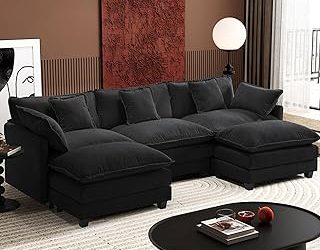
107″ Cloud Couch U-Shaped Modular Sectional
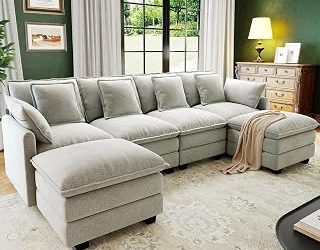
At 107 inches with a U-shaped footprint and two ottomans, this one is built for households that treat the living room as the default gathering spot. The six removable washable pillows are the practical win here — you’re not stuck spot-cleaning a permanent cover, and the modular pieces separate for moving day without a single screwdriver.
Acanva Mellow Curved Back Velvet Sofa
The tight curved back is doing structural work, not just styling: no loose back cushions means nothing to fluff, reshape, or fish out of the crevice. A hardwood frame under three seats of velvet makes this the pick for anyone who wants a sofa that looks intentional in a smaller apartment.
DOPEDIO 71.25″ Chenille Loveseat
Under six feet wide with pocket spring cushions and a solid wood frame, this is genuinely well-specced for a loveseat at this size. The removable washable cover plus straightforward assembly makes it a strong choice for first apartments, home offices, or any room where a full sectional would swallow the floor plan.
Mangodan Cloud L-Shaped Sectional
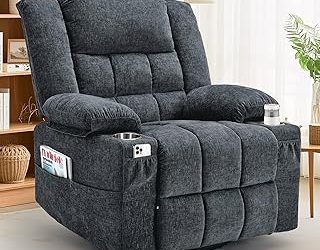
The deep seat and back support here is the boneless-couch formula done right — you get the sink-in feel without losing lumbar support entirely, which is where a lot of cloud sofas fail. Dark grey and explicitly kid- and pet-friendly, with a left-facing chaise that tucks neatly against a wall.
Korser 108″ Boneless Modular Sectional with Chaise
No assembly, flexible module combinations, and corduroy that hides wear better than most flat-woven fabrics. The side pockets sound like a gimmick until you stop losing remotes; combined with the 108-inch L-shape and deep seat, it’s the most reconfigurable option on this list.
Frequently Asked Questions
Will a large sectional fit through my doorway?
Modular and boneless sectionals ship in separate boxes and assemble in the room, so doorway width is rarely an issue. Traditional framed sofas are the ones to measure for — check the diagonal height of the sofa against your narrowest doorway and any stairwell turns.
How do I keep a light-colored sofa clean?
Buy one with removable covers and wash them on cold, air-dry only. Heat is what shrinks covers and ruins the fit. For chenille and corduroy, a stiff upholstery brush lifts embedded dirt that vacuuming misses.
Do boneless sofas sag over time?
The good ones use high-density foam blocks that recover overnight. Rotate and flip the seat modules every couple of months — same principle as a mattress — and you’ll even out the wear considerably.
Can I add or replace modules later?
Sometimes, but don’t count on it. Fabric dye lots shift between production runs, so a module bought two years later may not match. If you think you’ll expand, buy the larger configuration now.
Final Thoughts
For most households, the 107″ Cloud Couch U-Shaped Sectional offers the best combination of seating capacity and washable practicality, while the Korser 108″ Boneless Modular earns its spot for anyone who wants to rearrange the layout on a whim. If you’re working with limited square footage, the DOPEDIO Chenille Loveseat delivers pocket springs and a solid wood frame at a footprint that won’t overwhelm the room — a genuinely rare combination at that size.