Key takeaways
- Measure your wall gap first: Standard recliners need 12 to 18 inches behind them to fully extend. Wall huggers pull that down to three or four inches by moving the seat forward on its track instead of tilting back. Tape out your floor plan before you order anything.
- Manual versus power: A manual lever mechanism has fewer failure points and no cords to route, which matters in an RV or a room without a nearby outlet. Power units give you infinite recline positions and adjustable headrests, but you’re trusting a motor and a control board.
- Check the upholstery honestly: Faux leather is easy to wipe down but cracks at stress seams over time, especially in dry heat. Genuine leather costs more and ages better. Breathable woven fabric stays cooler in summer but shows spills.
- Look at the weight rating: A 250-pound-per-seat rating usually means a lighter gauge frame. Anything advertised at 350 pounds or higher tends to use heavier steel and better welds, which is a decent proxy for overall build quality.
- Decide if you need the console: A center console adds storage, cup holders, and often USB and USB-C ports, but it also adds five or six inches of width and eliminates the ability to stretch across both seats. Skip it if floor space is tight or you nap sideways.
What's inside
Anybody who has wrestled a reclining loveseat through a doorway knows the real problem isn’t picking a color. It’s that the spec sheet rarely tells you what you actually need to know: how far the footrest kicks out, whether the mechanism is a stamped steel frame or bent tin, and how much wall clearance the thing demands once both seats are laid flat. I’ve taken apart enough of these to know the difference between a unit built to last a decade and one that starts squeaking by month eight.
This guide breaks down six loveseat recliners worth considering in 2026, judged on frame construction, mechanism quality, and how well the extras actually work rather than how good they look in a product photo. You’ll find manual and power options, wall huggers for tight rooms, and a couple of home-theater models with consoles and charging built in. I’ve flagged where corners get cut and where the money is well spent.
As an Amazon Associate we earn from qualifying purchases.


How to Choose a Loveseat Recliner (2026)
- Measure your wall gap first: Standard recliners need 12 to 18 inches behind them to fully extend. Wall huggers pull that down to three or four inches by moving the seat forward on its track instead of tilting back. Tape out your floor plan before you order anything.
- Manual versus power: A manual lever mechanism has fewer failure points and no cords to route, which matters in an RV or a room without a nearby outlet. Power units give you infinite recline positions and adjustable headrests, but you’re trusting a motor and a control board.
- Check the upholstery honestly: Faux leather is easy to wipe down but cracks at stress seams over time, especially in dry heat. Genuine leather costs more and ages better. Breathable woven fabric stays cooler in summer but shows spills.
- Look at the weight rating: A 250-pound-per-seat rating usually means a lighter gauge frame. Anything advertised at 350 pounds or higher tends to use heavier steel and better welds, which is a decent proxy for overall build quality.
- Decide if you need the console: A center console adds storage, cup holders, and often USB and USB-C ports, but it also adds five or six inches of width and eliminates the ability to stretch across both seats. Skip it if floor space is tight or you nap sideways.
The Best Loveseat Recliner (2026)s Reviewed
Watson & Whitely Genuine Leather Wall Hugger Power Recliner Loveseat
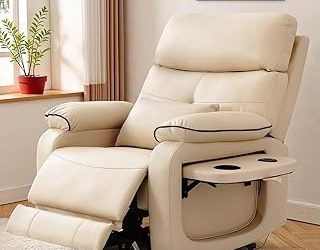
This is the one I’d buy for a room I plan to keep furnished for ten years. Real leather over a wall-hugger track, independent power headrests, and both USB-A and USB-C charging means you’re not adapting to it as the years go on, and the seams are stitched rather than glued at the high-wear corners.
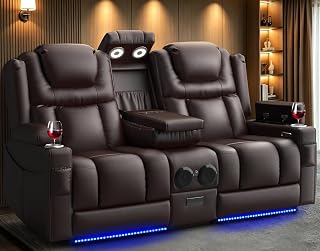
Faux Leather Manual Loveseat Recliner with Center Console
The manual lever setup is the practical choice here: no motor to burn out, no wiring to snake behind a wall, and the hidden storage under the console lid is genuinely useful for remotes and cables. Faux leather means easy cleanup, though I’d keep it out of direct afternoon sun to slow the inevitable surface wear.
Reclining Loveseat with Massage and Heavy Weight Capacity
The heavy weight rating is the headline feature and it’s backed up by a noticeably stouter frame than most units in this price range. Massage and heat are extras rather than reasons to buy, but the console with USB and USB-C ports plus a wall-hugger footprint makes this a strong fit for RVs and smaller living rooms.
Extra Wide Overstuffed Dual Manual Recliner Loveseat
The wide seat pans and breathable fabric make this the most comfortable option for long sitting sessions, especially in a warm room where faux leather gets sticky. It’s a simple dual manual design with no console, so you get more usable seat width and the option to stretch across both cushions.
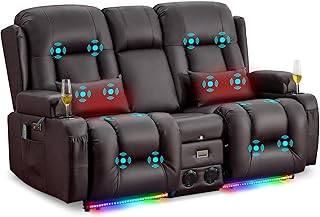
URRED Power Loveseat Recliner with Massage, Heat, and LED Lights
Built for a dedicated media room, with LED accent lighting, a console, and full power recline in a wall-hugger frame. The lighting is more subtle than the photos suggest, which is a good thing, and the assembly clips together without tools in about twenty minutes.
Frequently Asked Questions
How much clearance does a wall hugger recliner really need?
Typically three to five inches, though I’d give it six for safe measure since baseboards and outlet covers eat into that gap. Standard recliners need 12 to 18 inches.
Can I use a power recliner in an RV?
Yes, as long as you have a 120V outlet on inverter or shore power. Several models here are marketed for RV use specifically, but confirm the depth fits your slide-out when fully reclined.
Do these come assembled?
Most ship in two halves with the backs detached. They snap onto brackets on the seat base and take fifteen to thirty minutes with no tools. The backs are heavy, so plan on a second set of hands.
Is faux leather worth avoiding?
Not necessarily. Good faux leather holds up fine for five or six years with normal use and cleans up easily. It’s a reasonable tradeoff if the budget doesn’t stretch to genuine hide.
Final Thoughts
If you want something that will still feel solid in a decade, the Watson & Whitely genuine leather power loveseat is the pick, and its wall-hugger design keeps it practical in tighter rooms. For simplicity and fewer things to break, the manual faux leather model with the center console is hard to beat, while the heavy-capacity massage loveseat gives you the sturdiest frame of the group for RV and everyday living room duty.