Key takeaways
- Rear clearance: Standard recliners need 12 to 18 inches behind them. Wall huggers cut that to 3 or 4 by pushing the seat forward instead of tilting back — check the spec sheet for “wall hugger” or a stated clearance number, and don’t assume it.
- Console or no console: A center console adds 10 to 13 inches of width and gives you storage plus cup holders. Skip it if your wall is under 60 inches; a flip-up console is the compromise, letting you free the middle seat when you need three people on the sofa.
- Power versus manual: Manual mechanisms are cheaper and need no outlet, but the side handle needs arm clearance. Power units require a cord run and a nearby receptacle — plan that before you commit to a wall.
- Doorway and stair math: Most of these ship in two or three boxes and assemble on site, which solves the classic tight-turn problem. Confirm the box dimensions, not the assembled ones, if you’re carrying up a narrow staircase.
- Upholstery for the room’s traffic: Chenille reads warm and hides wear well. Flannel is the softest for the money. Leathaire and faux leather wipe clean fastest, which matters in a small room where the sofa doubles as the dining spot.
What's inside
Measure the wall, then measure the swing. That second number is where most small-space recliner projects fall apart. A loveseat that fits perfectly against the drywall on paper can still eat 14 inches of walkway when the footrest deploys, and nobody tells you that until the delivery guys are already gone. If you’ve ever pulled a tape measure across a 10×12 living room and done the math twice, you know the constraint isn’t width — it’s clearance, hinge geometry, and where the mechanism decides to travel.
This guide is built around that reality. I’ve broken down what actually matters when you’re fitting a reclining loveseat into an apartment, an RV, a bonus room, or a converted den: wall-hugger travel, real seat depth versus advertised depth, whether the console earns its footprint, and how power versus manual changes your placement options. Below you’ll find the picks worth your money, plus the selection criteria I’d use if I were building this out myself.
As an Amazon Associate we earn from qualifying purchases.


How to Choose a Reclining Sofa For Small Spaces (2026)
- Rear clearance: Standard recliners need 12 to 18 inches behind them. Wall huggers cut that to 3 or 4 by pushing the seat forward instead of tilting back — check the spec sheet for “wall hugger” or a stated clearance number, and don’t assume it.
- Console or no console: A center console adds 10 to 13 inches of width and gives you storage plus cup holders. Skip it if your wall is under 60 inches; a flip-up console is the compromise, letting you free the middle seat when you need three people on the sofa.
- Power versus manual: Manual mechanisms are cheaper and need no outlet, but the side handle needs arm clearance. Power units require a cord run and a nearby receptacle — plan that before you commit to a wall.
- Doorway and stair math: Most of these ship in two or three boxes and assemble on site, which solves the classic tight-turn problem. Confirm the box dimensions, not the assembled ones, if you’re carrying up a narrow staircase.
- Upholstery for the room’s traffic: Chenille reads warm and hides wear well. Flannel is the softest for the money. Leathaire and faux leather wipe clean fastest, which matters in a small room where the sofa doubles as the dining spot.
The Best Reclining Sofa For Small Spaces (2026)s Reviewed
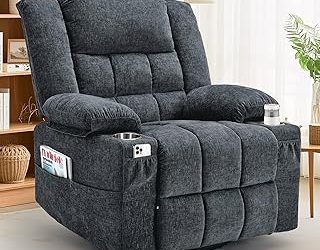
GUEAPY 55″ Loveseat Reclining Sofa with Cup Holders
At 55 inches, this is one of the narrowest true double recliners you’ll find, which makes it the default answer for studios and RV slide-outs. The chenille wears nicely, the wide armrests hold a laptop without a tray, and the side storage pocket keeps remotes off the floor in a room with no side table space.
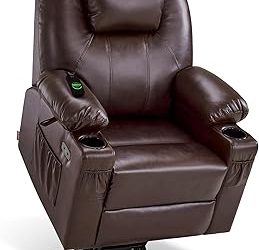
Redlife Power Loveseat Recliner with Heat and Massage
Electric dual recline means independent positioning with a button instead of a lever, so you lose the side-handle clearance problem entirely. The 8-point massage and heat are genuinely useful rather than novelty features, though budget a plan for the power cord before you pick a wall.
Loveseat Recliner with Flip-up Console (68″, Velvet Blue)
The flip-up console is the smartest design choice on this list — you get cup holders and storage when you want them, and a flat third seat when guests arrive. True wall-hugger travel means it lives 3 or 4 inches off the drywall, which is what makes 68 inches workable in a tight room.
Redlife Loveseat Recliner with Console and Bluetooth
This is the home theater build in a small footprint: USB, a standard outlet, Bluetooth speakers, a storage drawer, plus heat and massage on a manual pull mechanism. The Leathaire wipes down in seconds, which is the practical argument for it over fabric in a multipurpose room.
Massage Reclining Loveseat without Console (Wall Hugger)
Dropping the console reclaims roughly a foot of wall while keeping cup holders in the armrests and USB charging at the side. The wall-hugger mechanism plus the narrower profile makes this the most forgiving option for oddly shaped rooms and short wall runs.
Frequently Asked Questions
How much space do I really need behind a reclining loveseat?
A conventional recliner wants 12 to 18 inches. A wall hugger drops that to 3 or 4 because the seat slides forward as the back pivots. Always leave an inch of slack for baseboard and trim.
Do these arrive assembled?
Almost never, and that’s a feature. Multi-box shipping with bolt-together backs and slide-on cushions means you can get a 68-inch sofa through a 30-inch door and up a switchback stairwell. Expect 30 to 45 minutes with an included hex key.
Is power worth the extra cost in a small room?
Often yes, because power recliners don’t need side clearance for a handle, letting you tuck the sofa closer to an adjacent wall or bookcase. The tradeoff is planning a cord route to an outlet.
Will a reclining loveseat work in an RV?
Several here are marketed for RV use, and the wall-hugger models are the ones to prioritize. Verify assembled width against your slide-out and confirm the frame is bolted rather than glued for travel vibration.
Final Thoughts
If your wall is genuinely tight, the GUEAPY 55″ is the safest fit and the easiest to place. The 68″ flip-up console model is the best all-around pick for anyone who wants storage without permanently giving up a seat, and the Redlife Power Loveseat is where to spend if you want heat, massage, and button-controlled positioning without a lever eating your clearance.