Key takeaways
- Mounting system: Universal rails with quick-release brackets let you swap saws without drilling new holes. Brand-specific rails are faster to set up but lock you into one ecosystem, so check the bolt pattern of your saw’s base before you commit.
- Support length, not just capacity: A 500 lb rating means little if the arms only reach three feet. Look for stands that extend to eight feet or more so you can cut trim, treads, and decking without a helper holding the tail.
- Wheels versus legs: Pneumatic or 8-inch solid wheels roll over thresholds, extension cords, and job site rubble. Fixed-leg stands are lighter and cheaper, which suits a garage where the saw lives in one corner.
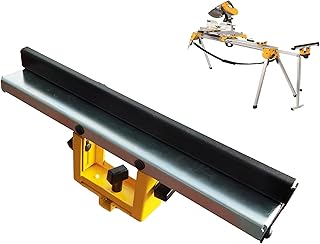
- Fence and stop quality: Repeatable cuts come from a solid flip stop that holds its zero. Flimsy stamped stops drift after a dozen bumps, so upgrade parts like the DEWALT DW7029-compatible support and stop are a smart small investment.
- Folded footprint: Measure your storage nook before ordering. Rolling stands stand upright at around 60 inches long, while compact models tuck against a wall at roughly half that depth.
What's inside
Every shop hits the same wall eventually: you clamp a 12-inch sliding compound saw to a pair of sawhorses, drop a 10-foot piece of poplar on it, and watch the whole rig tip like a seesaw. The cut wanders, the offcut binds, and you spend the next hour shimming scrap under the far end of the board. A miter saw is only as accurate as the plane it sits on, and a plywood-and-2×4 station bolted to the garage wall stops being charming the moment you need to trim baseboard on site.
This guide is written from the perspective of someone who has actually loaded and unloaded these stands out of a truck bed. I looked at how the mounting brackets handle saws they weren’t designed for, how the extensions behave under real crown molding weight, whether the wheels survive gravel driveways, and how fast each one folds when it’s raining. Below are the stands worth your money in 2026, plus the specs that actually matter once the sawdust starts flying.
As an Amazon Associate we earn from qualifying purchases.



🛒 Best Price Today on Amazon
Prime members get fast, free shipping on everything above, plus member-only deals. New members get a 30-day free trial — cancel anytime.
How to Choose a Miter Saw Stand (2026)
- Mounting system: Universal rails with quick-release brackets let you swap saws without drilling new holes. Brand-specific rails are faster to set up but lock you into one ecosystem, so check the bolt pattern of your saw’s base before you commit.
- Support length, not just capacity: A 500 lb rating means little if the arms only reach three feet. Look for stands that extend to eight feet or more so you can cut trim, treads, and decking without a helper holding the tail.
- Wheels versus legs: Pneumatic or 8-inch solid wheels roll over thresholds, extension cords, and job site rubble. Fixed-leg stands are lighter and cheaper, which suits a garage where the saw lives in one corner.
- Fence and stop quality: Repeatable cuts come from a solid flip stop that holds its zero. Flimsy stamped stops drift after a dozen bumps, so upgrade parts like the DEWALT DW7029-compatible support and stop are a smart small investment.
- Folded footprint: Measure your storage nook before ordering. Rolling stands stand upright at around 60 inches long, while compact models tuck against a wall at roughly half that depth.
The Best Miter Saw Stands Reviewed (2026)
DEWALT DWX724 Compact Miter Saw Stand
The DWX724 is the sweet spot for anyone who moves a saw occasionally rather than daily: the beam stretches to 40 inches, the brackets hold a 500 lb load, and it weighs little enough to carry one-handed. No wheels means you’re lifting it into the truck, but the trade-off is a stand that sets up in under a minute and stores flat against a stud wall.
BORA PM-4000 Portable Miter Saw Stand
BORA’s PM-4000 is the pick for shops running multiple saws or older tools with unusual bases, since the universal mounting brackets clamp almost anything down securely. It’s heavy-duty steel through and through, and the wide leg stance stays planted when you’re bearing down on a nested crown cut.
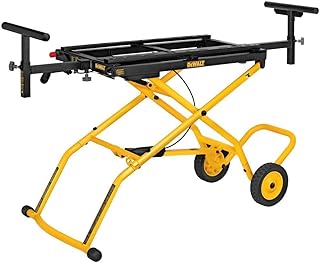
DEWALT DWX726 Rolling Miter Saw Stand
If you cut trim for a living, this is the one. The DWX726 rolls like a hand truck, adjusts for height so you can dial in a comfortable working plane, and supports material out to a full eight feet with stops on both wings, which is what separates a real production stand from a glorified sawhorse.
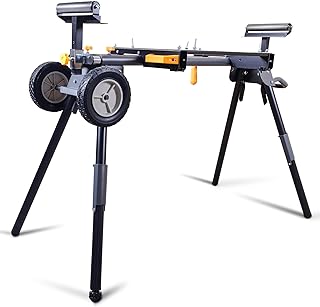
POWERTEC MT4000V Portable Miter Saw Stand
The MT4000V punches above its price with quick-release brackets, 8-inch wheels, and built-in triple outlets so your saw, vacuum, and work light run off one cord. A 330 lb capacity covers any 12-inch slider, and the folding action is genuinely one-handed once you’ve done it a few times.
Deluxe Heavy Duty Rolling Stand (WK-MS029E-2)
This rolling stand delivers the wheels-and-fold convenience of premium models for noticeably less, with a 330 lb rating and the same 8-inch tires that make curbs a non-event. Fit and finish is a step below DEWALT, but for a weekend shop or a second stand it’s hard to argue with.
Frequently Asked Questions
Will a universal stand fit my saw?
Most 10- and 12-inch saws bolt to universal rails without issue, but measure the distance between the mounting holes in your saw’s base first. Some compact cordless models have narrow footprints that need the brackets pulled closer than the default setting.
Do I need wheels?
Only if the saw leaves the shop. Wheels add weight and cost, and a fixed-leg stand is more rigid dollar for dollar. Buy the rolling version if you load a truck weekly or cross a gravel drive.
Are aftermarket supports and stops worth buying?
Yes, especially on brand-specific stands. A wide auxiliary support like the deawater unit for the DEWALT DW7029 gives short offcuts something to land on and turns a single-point support into a proper outfeed table.
How do I keep everything coplanar?
Set the saw’s table as your reference, then adjust each extension arm with a straightedge laid across both until you feel no rock. Recheck after transport; brackets loosen with vibration.
Final Thoughts
For most workshops, the DEWALT DWX724 is the practical choice: light, accurate, and cheap enough to leave bolted to your saw permanently. Step up to the DWX726 if you cut long stock daily and want wheels plus eight feet of supported material, or grab the POWERTEC MT4000V if you want rolling convenience and onboard outlets without the flagship price.