Key takeaways
- Swing and throat depth: Swing is twice the distance from the chuck center to the column, so a 12-inch press reaches the middle of a 12-inch board. For furniture panels and chair parts, 10 to 12 inches gives you real breathing room; 8-inch models handle rails, stiles, and small stock fine.
- Speed range and how you change it: Large Forstner bits and hole saws need low RPM to avoid scorching; small twist bits in hardwood want speed. Belt-and-pulley presses are cheaper and dead reliable but mean opening the head cover. Variable-speed dials let you dial it in mid-cut.
- Cast iron mass: Weight is not a downside here. A cast-iron head, table, and base soak up vibration that would otherwise chatter the bit and leave ragged holes. Skip anything with a stamped-steel table if you care about hole quality.
- Table tilt and travel: A table that tilts 0 to 45 degrees lets you drill angled leg mortises and splayed stretchers without shop-built jigs. Rack-and-pinion height adjustment beats loosening a clamp and wrestling the table up the column.
- Benchtop or magnetic: Benchtop presses are for bringing work to the tool. Mag drills clamp themselves to steel and bring the tool to the work, which is what you want for weld-up bed frames, structural brackets, and shop fixtures.
What's inside
A hand drill can only take you so far. The moment you start cutting mortises for a bench, drilling dowel holes in a headboard, or boring shelf-pin rows that need to line up across four panels, the wobble in a freehand hole stops being a small annoyance and starts showing up in the finished piece. Doors hang crooked, dowels bind, joints gap. A drill press fixes the underlying problem: it holds the bit perfectly perpendicular, every time, at a depth you set once.
The trouble is that “drill press” covers everything from a 20-pound benchtop unit for pilot holes to a 40-pound magnetic drill built for punching through steel plate. Below are six machines worth the bench space, spanning cast-iron benchtop models for furniture work and portable mag drills for metalwork. I’ve noted where each one earns its keep, what it gives up, and the specs that actually matter once the machine is bolted down.
As an Amazon Associate we earn from qualifying purchases.


🛒 Best Price Today on Amazon
Prime members get fast, free shipping on everything above, plus member-only deals. New members get a 30-day free trial — cancel anytime.
How to Choose a/an Drill Press Best (2026)
- Swing and throat depth: Swing is twice the distance from the chuck center to the column, so a 12-inch press reaches the middle of a 12-inch board. For furniture panels and chair parts, 10 to 12 inches gives you real breathing room; 8-inch models handle rails, stiles, and small stock fine.
- Speed range and how you change it: Large Forstner bits and hole saws need low RPM to avoid scorching; small twist bits in hardwood want speed. Belt-and-pulley presses are cheaper and dead reliable but mean opening the head cover. Variable-speed dials let you dial it in mid-cut.
- Cast iron mass: Weight is not a downside here. A cast-iron head, table, and base soak up vibration that would otherwise chatter the bit and leave ragged holes. Skip anything with a stamped-steel table if you care about hole quality.
- Table tilt and travel: A table that tilts 0 to 45 degrees lets you drill angled leg mortises and splayed stretchers without shop-built jigs. Rack-and-pinion height adjustment beats loosening a clamp and wrestling the table up the column.
- Benchtop or magnetic: Benchtop presses are for bringing work to the tool. Mag drills clamp themselves to steel and bring the tool to the work, which is what you want for weld-up bed frames, structural brackets, and shop fixtures.
The Best Drill Press Best (2026)s Reviewed
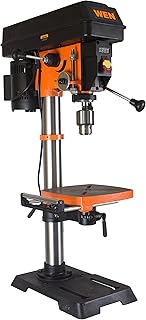
WEN 12-Inch Variable Speed Benchtop Drill Press (DP1263V)
The 6.2-amp motor and infinitely variable speed dial make this the most capable benchtop press here for mixed furniture work, letting you drop into the low hundreds of RPM for a 2-inch Forstner without touching a belt. The laser crosshair and LED light are genuinely useful on dark walnut, where pencil marks disappear under the chuck.
SKIL 10 In. 5-Speed Benchtop Drill Press (DP9505-00)
SKIL’s laser alignment system is the best-executed of the bunch, projecting two intersecting lines that stay accurate through table height changes. Ten inches of swing and a well-damped cast-iron head make it a smart middle ground if a 12-inch press feels like more machine than your bench can hold.
WEN 8-Inch 5-Speed Cast Iron Benchtop Drill Press (4206T)
This is the workhorse I’d hand a first-time buyer: 2.3 amps, five belt speeds, all-cast-iron construction, and a footprint that fits on a crowded bench. It won’t swing wide panels or hog out 2-inch holes, but for dowels, shelf pins, and hardware pilots it’s accurate and nearly indestructible.
ZELCAN 1550W Portable Magnetic Drill Press
With 2,922 lbf of magnetic hold, a 2-inch boring capacity, and stepless 0–580 RPM with reversible rotation, this is the pick for anyone building steel bases, brackets, or welded frames. Reverse is more valuable than it sounds when you’re backing a tap or a stuck annular cutter out of thick plate.
VEVOR 1300W Magnetic Drill Press
The VEVOR delivers the same 2,922 lbf clamping force at a friendlier price, and the titanium-magnesium alloy guide rail keeps the slide tight under load. The included 11-piece bit set gets you drilling the day it arrives, though the single 810 RPM speed limits you to smaller diameters than the ZELCAN handles.
Frequently Asked Questions
Do I need a drill press for furniture building?
You can build furniture without one, but hole accuracy is where hand-drilled joinery fails. Any dowel joint, shelf-pin system, or through-bolted knockdown fitting benefits immediately from a perpendicular hole and a repeatable depth stop.
What speed should I use in hardwood?
As a rule, bigger bit means slower speed. Small twist bits under 1/4 inch run happily above 2,000 RPM, while a 2-inch Forstner in maple wants roughly 250 to 500 RPM. If you see smoke or smell burning, you’re too fast or feeding too hard.
Is 8 inches of swing enough?
For rails, legs, aprons, and small parts, yes. If you regularly drill into the middle of wide panels or tabletops, step up to 10 or 12 inches, or plan on shop-made extension jigs.
Can a magnetic drill replace a benchtop press?
No. Mag drills only hold on ferrous metal and are built for steel, not wood. Think of them as a complement for hardware fabrication rather than a substitute.
Final Thoughts
For most furniture makers, the WEN DP1263V is the one to buy: variable speed, 12 inches of swing, and enough cast iron to keep holes clean. Tight on bench space or budget, the WEN 4206T covers the fundamentals without compromise, and if your projects involve steel frames or brackets, add the ZELCAN mag drill for work the benchtop press simply can’t reach.