Key takeaways
- Map your clearance first: Sketch the room to scale, then add 4 to 18 inches behind each reclining seat depending on whether the model is a wall hugger. Also measure doorways, stair turns, and ceiling height at the landing — box dimensions matter more than assembled dimensions on delivery day.
- Manual versus power: Manual levers are mechanically simple, cost less, and never leave you stranded during an outage. Power recline gives infinite positioning and easier operation for anyone with shoulder or wrist limitations, but it needs an outlet and adds a motor and transformer to the failure list.
- Interrogate the frame: Look for kiln-dried hardwood or heavy-gauge steel at the recline points, sinuous spring or webbing suspension, and metal-to-metal connector brackets between modules. Plastic clips and pure engineered wood at stress points are where sag starts.
- Upholstery for your household: Faux and bonded leather wipes clean in seconds but can crack under direct sun and heavy use. Chenille and linen breathe better and feel warmer, and removable washable covers are worth real money if you have kids or pets.
- Plan for repairs: Before buying, confirm the brand sells replacement motors, cable-pull handles, and connector hardware. A sectional you can rebuild with a socket wrench and a $40 part will outlive one that becomes landfill when a single mechanism fails.
What's inside
Anyone who has hauled a sectional up a stairwell knows the real test happens before you ever sit down. These things arrive as four or five boxes of bolted steel, and the difference between a sofa you love and one you resent usually comes down to details you can’t see in a listing photo: whether the frame is kiln-dried hardwood or stapled particleboard, whether the recline mechanism is riveted or screwed, whether the seat boxes actually clamp together or just rest against each other and drift apart by month three. Add in power motors, USB ports, and LED strips, and you’re not just buying furniture — you’re installing a small piece of hardware into your living room.
This guide approaches sectional recliners the way you’d approach any build: measure twice, inspect the joinery, and check what happens when a part wears out. Below are six of the strongest options for 2026, spanning manual and power recline, leather and chenille upholstery, and layouts from compact L-shapes to a 134-inch modular monster. I’ve focused on assembly reality, frame construction, and long-term serviceability rather than showroom gloss.
As an Amazon Associate we earn from qualifying purchases.



How to Choose a Sectional Recliner Sofa (2026)
- Map your clearance first: Sketch the room to scale, then add 4 to 18 inches behind each reclining seat depending on whether the model is a wall hugger. Also measure doorways, stair turns, and ceiling height at the landing — box dimensions matter more than assembled dimensions on delivery day.
- Manual versus power: Manual levers are mechanically simple, cost less, and never leave you stranded during an outage. Power recline gives infinite positioning and easier operation for anyone with shoulder or wrist limitations, but it needs an outlet and adds a motor and transformer to the failure list.
- Interrogate the frame: Look for kiln-dried hardwood or heavy-gauge steel at the recline points, sinuous spring or webbing suspension, and metal-to-metal connector brackets between modules. Plastic clips and pure engineered wood at stress points are where sag starts.
- Upholstery for your household: Faux and bonded leather wipes clean in seconds but can crack under direct sun and heavy use. Chenille and linen breathe better and feel warmer, and removable washable covers are worth real money if you have kids or pets.
- Plan for repairs: Before buying, confirm the brand sells replacement motors, cable-pull handles, and connector hardware. A sectional you can rebuild with a socket wrench and a $40 part will outlive one that becomes landfill when a single mechanism fails.
The Best Sectional Recliner Sofas (2026) Reviewed
Dresegmt Manual Recliner Sectional, 5 Seater
The flip middle backrest is genuinely clever engineering — it converts to a console with cup holders without adding a separate module, which saves you both footprint and one more connection point to worry about. Manual mechanisms keep the parts count low, and the mixed grey linen and chocolate leather-look upholstery hides scuffs better than a single-tone finish.
L-Shaped Reclining Sectional with Storage Console, Brown
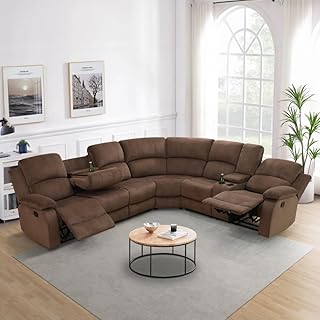
This is the straightforward, no-electronics choice: two reclining seats, a lidded storage console, and a chaise, assembled with basic hardware in well under an hour. Without motors or LEDs in the mix, there’s simply less that can fail, which makes it a sensible pick for a den or basement setup.
FUOROLA Power Reclining Sectional with LED
The breathing leather is the standout here — perforation makes a real difference during long viewing sessions compared to sealed vinyl. Power recline, USB charging, and ambient LED lighting land it firmly in home theater territory, so budget an accessible outlet and route the transformer cable where you can reach it later.
Power Reclining Sectional, Net Design, Black
The stitched net paneling gives this one more visual structure than most black leather sets, which tend to read as a dark mass in a small room. Power recline plus integrated cup holders and console storage covers the essentials, and black upholstery is forgiving about the inevitable popcorn incident.
134″ Modular Power Reclining Sectional, Chenille, White
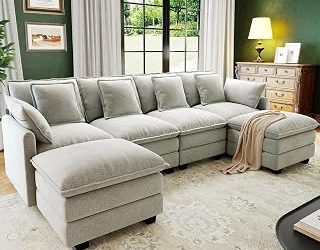
Wall-hugger mechanisms are the technical highlight: you get full recline with minimal rear clearance, which is what makes a 134-inch footprint workable in a normal room. Adjustable headrests, machine-washable covers, and true modularity mean you can reconfigure it after a move rather than replace it.
Frequently Asked Questions
How much wall clearance does a reclining sectional need?
Standard mechanisms want 12 to 18 inches behind the seat back. Wall huggers reduce that to roughly 3 to 6 inches by sliding the seat forward as it reclines. Always verify against the specific listing rather than assuming.
Can I assemble one of these alone?
Mostly yes — most modules snap or bolt together with included hardware and take 45 to 90 minutes. Lifting the boxes and aligning the connector brackets is much easier with a second person, and a rubber mallet plus a socket set beats the bundled folding wrench every time.
Do power recliners work during a power outage?
Not unless you add a battery pack, which many brands sell as an accessory. If outages are common where you live, or if a seat getting stuck reclined would be a real problem, a manual model is the safer bet.
Is faux leather or fabric better long term?
Fabric like chenille typically outlasts budget faux leather, which can peel after a few years of heavy use. Faux leather wins on spill cleanup, so decide based on whether your household generates more messes or more mileage.
Final Thoughts
For most living rooms, the Dresegmt manual sectional is the smartest buy — the flip-down backrest earns its keep and there’s very little to break. If you’re building a dedicated theater space, the FUOROLA power set delivers perforated leather and proper ambient lighting without overcomplicating things, while the 134-inch modular chenille sectional is the one to choose if you have the square footage and want washable covers and wall-hugger clearance you can reconfigure for years.