Key takeaways
- Panels vs. shelves: Slatwall wins for hand tools, cords, ladders, and anything you hang. Wall shelves win for bins, paint cans, coolers, and bulk items that need a flat surface. Most well-organized garages end up running both on different walls.
- Stud spacing and real capacity: A 1,400 lb rating assumes correct lag placement into solid framing. Locate your studs before you buy — 16-inch centers are standard, but older builds and metal framing change the math. Never anchor a loaded shelf to drywall alone.
- Panel material: PVC slatwall resists moisture, road salt, and humidity swings that swell MDF panels. If your garage is unheated or you park a wet vehicle inside, PVC is the only sensible choice.
- Depth and clearance: Measure from the wall to your car door at full swing. A 24-inch shelf is generous for storage but brutal on a tight driveway approach, so check the walk-through gap before committing.
- Included hardware: Hook counts vary wildly between kits. Systems bundling 8 to 16 accessories save you a separate order and a second trip to the hardware store.
What's inside
Every garage starts the same way: a few bins in the corner, a leaf blower leaning against the drywall, and a promise that you’ll deal with it this weekend. Then the floor disappears. The real culprit isn’t clutter, it’s that a standard two-car garage has roughly 400 square feet of unused vertical surface doing absolutely nothing. Most homeowners fight for floor space they don’t need while ignoring the walls that could carry everything.
Wall storage solves this, but the market splits into two very different camps that get lumped together in search results. Slatwall panels give you infinite reconfigurability with hooks and baskets you can slide anywhere. Heavy-duty wall shelves give you deep, load-rated platforms for bins and cases. This guide breaks down which one matches your stuff, what load ratings actually mean once you factor in your wall framing, and the six systems worth your money in 2026.
As an Amazon Associate we earn from qualifying purchases.


🛒 Best Price Today on Amazon
Prime members get fast, free shipping on everything above, plus member-only deals. New members get a 30-day free trial — cancel anytime.
How to Choose a Garage Wall Storage System (2026)
- Panels vs. shelves: Slatwall wins for hand tools, cords, ladders, and anything you hang. Wall shelves win for bins, paint cans, coolers, and bulk items that need a flat surface. Most well-organized garages end up running both on different walls.
- Stud spacing and real capacity: A 1,400 lb rating assumes correct lag placement into solid framing. Locate your studs before you buy — 16-inch centers are standard, but older builds and metal framing change the math. Never anchor a loaded shelf to drywall alone.
- Panel material: PVC slatwall resists moisture, road salt, and humidity swings that swell MDF panels. If your garage is unheated or you park a wet vehicle inside, PVC is the only sensible choice.
- Depth and clearance: Measure from the wall to your car door at full swing. A 24-inch shelf is generous for storage but brutal on a tight driveway approach, so check the walk-through gap before committing.
- Included hardware: Hook counts vary wildly between kits. Systems bundling 8 to 16 accessories save you a separate order and a second trip to the hardware store.
The Best Garage Wall Storage Systems Reviewed
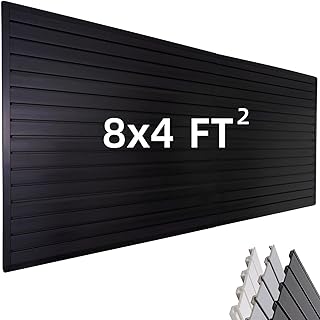
FRAYSCENT Slat Wall Paneling (8ft x 4ft, Black)
The 8-foot horizontal run is the smart detail here — fewer seams across a long wall means a cleaner install and no awkward butt joints landing mid-stud. The black PVC hides scuffs well and wipes clean, which matters more than you’d think on a wall that lives behind a lawnmower.
FLEXIMOUNTS 2x6ft Wall Shelving with 8 Hooks (Lite Series)
A genuinely versatile combo: two 6-foot shelves plus eight hooks covers a full wall in one purchase. The 1,200 lb rating and rustproof finish handle power tool cases and garden supplies without flex, and the bundled hooks let you use the space under each shelf instead of wasting it.
Jusgym 4-Pack Wall Mounted Garage Shelving (2x3ft, 1,400 lbs)
The seamless one-piece grid is the standout feature — no spliced sections to work loose over time, which is where cheaper shelves eventually fail. Four smaller 2×3 units give you far more layout freedom than two long ones, especially around windows, outlets, and door openings.
FLEXIMOUNTS 2x6ft Garage Shelving (Classic Series, 1,400 lbs)
The Classic Series steps up to a 1,400 lb capacity with a beefier bracket design, making it the pick for genuinely heavy loads like bulk paint, batteries, or full tool chests. Installation is well-documented and the templates are accurate, which saves real time on a two-shelf run.
Yuzzy Slat Wall Paneling (4 x 8ft, Black)
A straightforward heavy-duty PVC panel that trims cleanly with a circular blade — useful when you’re fitting around a service door or panel box. Groove tolerances are tight enough that standard slatwall accessories seat firmly without rattling.
Frequently Asked Questions
Can I install these on drywall without hitting studs?
No. Both slatwall and shelving must anchor into wood studs, masonry, or metal framing with appropriate lags. Drywall anchors will not hold rated loads and will fail progressively, usually while you’re standing underneath.
How much weight can slatwall actually hold?
Capacity is per-hook rather than per-panel, typically 50 to 100 lbs for standard hooks when the panel is fastened at every stud. Spread heavy items across multiple grooves instead of concentrating load on a single hook.
What height should I mount wall shelving?
Set the bottom shelf at 60 to 72 inches so you preserve wall space for hanging items underneath and keep the shelf above vehicle door clearance. Above 84 inches, you’ll need a step stool for daily access.
Do PVC panels warp in an unheated garage?
Quality PVC slatwall handles freeze-thaw cycles and humidity far better than MDF or wood composite. Leave a small expansion gap at the ends of long runs and you won’t see buckling.
Final Thoughts
For most garages, the FLEXIMOUNTS Classic Series 2x6ft shelving is the strongest all-around buy, pairing a real 1,400 lb capacity with an install process that doesn’t fight you. If you’d rather hang than stack, the FRAYSCENT 8ft x 4ft slatwall gives you the cleanest long-wall run with the fewest seams, while the Jusgym 4-pack seamless shelves are the best choice for working around obstacles with maximum layout flexibility.