Anyone who has ever hauled a flat-pack sectional into a second-floor apartment knows the value of a well-equipped garage, and the same logic applies to the vehicle that gets your projects home. A soft tire on the truck you use for lumber runs and thrift-store scores is more than an inconvenience — it wrecks your fuel economy, chews through rubber unevenly, and leaves you stranded on a gravel shoulder with a bed full of reclaimed oak. Yet most people still rely on a gas station pump with a broken gauge and a hose that barely reaches the rear axle.
A 12 volt air compressor plugs into your vehicle’s power and gives you full control over pressure, wherever you happen to be. The catch is that the category spans everything from glovebox-sized inflators meant for topping off a bike tire to tank-fed dual-cylinder rigs that can seat a bead on a 35-inch mud terrain. This guide breaks down what actually matters when you’re comparing models, then walks through five units that earn their storage space — from compact digital inflators for weekend errands to heavy-duty setups for anyone who airs down on the trail and back up at the pavement.
Our top picks



As an Amazon Associate we earn from qualifying purchases at no extra cost to you.
🛒 Best Price Today on Amazon
Prime members get fast, free shipping on everything above, plus member-only deals. New members get a 30-day free trial — cancel anytime.
How to Choose a 12 Volt Air Compressor (2026)
- Airflow (CFM) over PSI: Nearly every model claims 150 PSI, which tells you almost nothing. CFM is what determines whether a 33-inch tire takes two minutes or twelve. Under 2 CFM suits passenger cars and air mattresses; 6 CFM and up handles truck and off-road rubber without a coffee break.
- Power connection type: Cigarette-lighter plugs cap out around 10–15 amps, which physically limits how much compressor you can run. Anything genuinely heavy duty needs direct battery clamps or a hardwired circuit, so check what your vehicle can actually supply before you commit.
- Duty cycle and cooling: A unit that runs 15 minutes then needs 20 to cool off is fine for one flat, frustrating for four corners. Dual cylinders and metal housings shed heat far better than single-piston plastic bodies, and that difference shows up the moment you use it in July.
- Tank or no tank: An onboard tank stores pressure so you get instant bursts for seating beads, running air tools, or blasting sawdust off a workbench. It costs you cargo space and weight, so decide whether you need reserve air or just steady inflation.
- Gauge accuracy and auto shut-off: A backlit digital gauge with preset shut-off means you can set 35 PSI, walk away, and come back to exactly that. Analog dials drift, and holding a trigger while squinting at a needle in a dark driveway gets old fast.
The Best 12 Volt Air Compressor (2026)s Reviewed
AstroAI Dual Power Tire Inflator (12V/120V)
The dual-power design is the standout here — run it off your car socket on the road or plug it into a wall outlet in the shop, which makes it genuinely useful for inflating air mattresses and sports gear between road trips. Twin metal motors keep temperatures reasonable during longer runs, and the digital preset gauge shuts the pump off on its own so you’re not babysitting it.
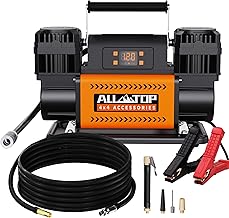
ALL-TOP 12V Dual Cylinder with LCD Panel
At 12.35 CFM, this is overland-grade airflow, and the LCD control panel lets you dial in a target pressure and let the unit manage the rest across all four tires. It demands a direct battery connection and proper storage space, but if you regularly air down for sand or rock, nothing in the plug-in class comes close on speed.
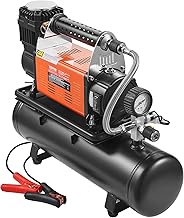
VEVOR 12V Heavy Duty with 6L Tank
The 6-liter tank is what separates this kit from a plain inflator — you get stored pressure for seating beads, running small air tools, or blowing debris out of joinery before glue-up. At 6.35 CFM it inflates truck and RV tires quickly, and the digital gauge keeps guesswork out of it.
Uharbour 12V 10.6 CFM Offroad Compressor
A serious dual-cylinder unit that trades the tank for raw airflow, and the included carry bag means it lives in the truck rather than cluttering a shelf. Best suited to 4×4 owners who want fast recovery times on oversized tires without a permanent under-hood install.
GSPSCN 12V Heavy Duty Metal Twin Cylinder
Full metal construction and twin cylinders give this pump a durability edge over plastic-shelled competitors, and it moves air fast enough for pickups, vans, and campers. A solid middle-ground pick if you want real capability without stepping up to a tank-equipped kit.
Frequently Asked Questions
Can a 12 volt compressor run air tools?
Only tank-equipped models can, and even then, expect to work in short bursts. Impact wrenches and nailers draw far more air than a portable pump refills, so plan on pausing while the tank recovers rather than working continuously.
Should I run it with the engine on or off?
Engine on, in almost every case. High-draw compressors can pull a resting battery down quickly, and a running alternator keeps voltage stable, which also helps the pump hit its rated performance.
How long can I run it before it overheats?
Check the stated duty cycle, typically 15 to 40 minutes depending on the build. Metal housings and dual cylinders extend that window, and letting the unit rest between tires costs you a couple of minutes but adds years of life.
Are these useful for anything besides tires?
Plenty. Air mattresses, inflatable kayaks, sports balls, and pool floats all work with the right nozzle adapter, and a tank-fed model doubles as a blow gun for clearing sanding dust out of corners and hardware.
Final Thoughts
For most drivers, the AstroAI dual-power inflator covers everything from tire top-offs to guest air mattresses in one compact package. If your truck sees dirt and oversized tires, the ALL-TOP dual cylinder delivers the airflow to air back up fast, while the VEVOR tank kit is the pick for anyone who wants stored pressure for bead seating and shop duty alongside tire inflation.