Key takeaways
- Seat width over overall width: Exterior dimensions include armrest padding and side panels, which tell you nothing about hip room. Look for a stated seat width of 24 inches minimum, 26 inches or better if you’re broad through the hips or want room to shift. Measure your favorite current chair with a tape before you shop so you have a real number to compare against.
- Weight capacity with margin: Treat the rated capacity as a ceiling, not a target. If a chair is rated to 400 pounds, plan to stay comfortably under that, because the rating assumes static load — not the shock loading that happens every time you drop into the seat. Heavy-duty motion mechanisms with steel channel and welded joints handle repeated cycling far better than thin stamped brackets.
- Lift motor quality: A single-motor lift raises the whole chair as one unit and is fine for most users. Dual-motor systems let you position back and footrest independently, which matters if you have hip or knee limitations. Either way, check that the motor is a sealed unit with an accessible connector — that’s the part most likely to need replacing, and you want it swappable without disassembling the frame.
- Frame and foam construction: Kiln-dried hardwood or steel beats particleboard and pine every time. For cushions, high-density foam over sinuous steel springs holds shape; pure polyfill collapses. If a listing won’t specify foam density or spring type, assume the worst.
- Footrest extension and total length: Tall users routinely end up with calves supported and heels dangling, which cuts circulation. Look for chairs advertising extended footrests, ideally four inches or more beyond standard, and check the fully reclined length against your height.
What's inside
Anyone who has ever flipped a recliner on its back to look at the guts knows the truth: most chairs sold as “oversized” are standard frames wrapped in extra foam. The seat box is still 20 inches wide, the mechanism is still rated for 250 pounds, and the frame is still stapled poplar. Sit in it daily at 300-plus pounds and you’ll feel the failure points arrive in order — foam compresses to a pancake in six months, the scissor mechanism develops a sideways wobble, then a weld or a joint gives out entirely. Buyers end up replacing chairs every couple of years and blaming themselves rather than the build.
This guide approaches the problem the way you’d size a workbench: start with the load, work backward to the structure. Below are six recliners built specifically for bigger and taller bodies, with real seat widths, reinforced steel motion hardware, and lift motors that actually help you stand instead of straining against your weight. I’ve flagged what to inspect before you commit, which specs are marketing fluff, and where each chair earns its keep.
As an Amazon Associate we earn from qualifying purchases.


How to Choose a/an Recliner For Large People (2026)
- Seat width over overall width: Exterior dimensions include armrest padding and side panels, which tell you nothing about hip room. Look for a stated seat width of 24 inches minimum, 26 inches or better if you’re broad through the hips or want room to shift. Measure your favorite current chair with a tape before you shop so you have a real number to compare against.
- Weight capacity with margin: Treat the rated capacity as a ceiling, not a target. If a chair is rated to 400 pounds, plan to stay comfortably under that, because the rating assumes static load — not the shock loading that happens every time you drop into the seat. Heavy-duty motion mechanisms with steel channel and welded joints handle repeated cycling far better than thin stamped brackets.
- Lift motor quality: A single-motor lift raises the whole chair as one unit and is fine for most users. Dual-motor systems let you position back and footrest independently, which matters if you have hip or knee limitations. Either way, check that the motor is a sealed unit with an accessible connector — that’s the part most likely to need replacing, and you want it swappable without disassembling the frame.
- Frame and foam construction: Kiln-dried hardwood or steel beats particleboard and pine every time. For cushions, high-density foam over sinuous steel springs holds shape; pure polyfill collapses. If a listing won’t specify foam density or spring type, assume the worst.
- Footrest extension and total length: Tall users routinely end up with calves supported and heels dangling, which cuts circulation. Look for chairs advertising extended footrests, ideally four inches or more beyond standard, and check the fully reclined length against your height.
The Best Recliner For Large People (2026)s Reviewed
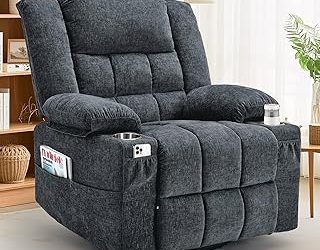
Large Power Lift Recliner with Massage and Heat
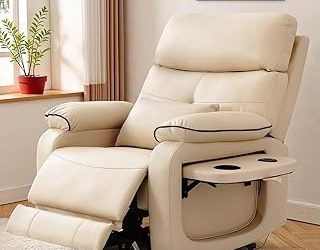
This is the well-rounded pick: overstuffed cushioning, a genuine lift motor, and heat plus vibration massage zones that earn their place for anyone dealing with lower back stiffness. Two cup holders, a side pocket, and a USB port mean you’re not running an extension cord across the floor.
MCombo Oversized Power Lift Recliner R7289
The spec sheet here is honest, which is rare — 26-inch seat width, 150 degrees of recline, and a 4.7-inch extended footrest that finally supports tall users’ heels. FSC-certified frame materials and straightforward assembly make this the pick if you want to know exactly what you’re getting.
Faux Leather Manual Recliner Chair
No motors, no wiring, no failure points beyond the mechanism itself — a sensible choice if you want simplicity or a chair for a room without a nearby outlet. The tradeoff is that manual recline requires core strength and leverage, so skip it if standing assistance matters.
Electric Power Recliner with Hidden Arm Storage
Built for media rooms, with breathable leather that doesn’t turn clammy over a three-hour movie and hidden arm compartments for remotes and chargers. Power recline is smooth and quiet, though this is a comfort chair rather than a lift chair.
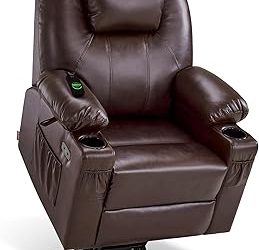
Large Power Lift Recliner with Heavy Duty Mechanism
The heavy-duty motion mechanism is the headline: thicker steel and better-supported pivots than typical lift chairs, which is what you want for daily heavy use. Anti-skid fabric keeps you from sliding forward during the lift cycle, a small detail that makes a real difference.
Frequently Asked Questions
What weight capacity do I actually need?
Add roughly 20 percent to your body weight and shop for that number. A 300-pound user should look at 375 to 400 pounds rated capacity, which accounts for dynamic loading and gives the mechanism headroom to last years rather than months.
Is a lift recliner worth the extra cost?
If standing from a seated position is difficult, or you anticipate it becoming difficult, yes. The lift function reduces knee and hip strain dramatically and is far cheaper than the alternative of a chair you can’t get out of unassisted.
How much clearance do I need behind the chair?
Most standard recliners need six to twelve inches of wall clearance. Wall-hugger designs cut that to about four inches, but always confirm the manufacturer’s stated requirement rather than guessing, and account for the power cord routing.
Can I assemble one of these myself?
Usually, though not solo. Most arrive in two or three sections that click together, but the back section on an oversized chair can run 60 pounds or more. Have a second person on hand and clear a path before the box arrives.
Final Thoughts
For most buyers, the MCombo Oversized Power Lift Recliner is the safest bet — the published 26-inch seat width and extended footrest mean fewer surprises after delivery. If therapeutic features matter more, the Large Power Lift Recliner with Massage and Heat delivers real comfort value, while the version with the heavy-duty motion mechanism is the one to choose for the highest daily loads and longest expected service life.