Key takeaways
- Map the full recline footprint: Chalk the outline on your floor before ordering. Add the manufacturer’s recline depth to the closed depth, then leave a hand’s width behind wall-hugger models and roughly 18 inches behind conventional mechanisms.
- Audit your power situation: Powered bases, heat, and massage draw modest wattage individually but share one cord. Confirm you have a grounded outlet within reach and skip the daisy-chained power strip.
- Inspect the frame and mechanism: Kiln-dried hardwood or steel-reinforced plywood with bolted brackets outlasts stapled softwood. Look for sinuous spring or steel-band suspension rather than webbing alone.
- Match upholstery to actual use: Bonded and faux leather wipe clean and suit theater rooms; chenille and performance woven fabrics breathe better and hide pet hair. Both benefit from a seam-brush every few weeks.
- Plan the assembly and the exit: Most units ship in two halves that click together with a hook bracket. Verify your narrowest doorway, and note whether the backs detach for future moves.
What's inside
Anyone who has hauled a reclining loveseat up a stairwell knows the real problem isn’t picking a color. It’s the tape-measure math nobody does until the box is already in the driveway: the extra 12 inches a footrest eats when it deploys, the wall clearance the spec sheet buries in a footnote, the console lid that won’t open because you parked the frame too close to an end table. Add powered features to the mix and you inherit a second layer of planning, since every motor, massage node, and LED strip has to trace back to a real outlet on a circuit that isn’t already carrying a space heater.
This guide approaches the category the way you’d approach any build: measure the envelope, check the fasteners, understand what’s serviceable later. Below you’ll find the models worth your bench time in 2026, plus the spec details that separate a loveseat you’ll still like in year five from one that develops a squeak by spring.
As an Amazon Associate we earn from qualifying purchases.


How to Choose a Reclining Loveseat With Console (2026)
- Map the full recline footprint: Chalk the outline on your floor before ordering. Add the manufacturer’s recline depth to the closed depth, then leave a hand’s width behind wall-hugger models and roughly 18 inches behind conventional mechanisms.
- Audit your power situation: Powered bases, heat, and massage draw modest wattage individually but share one cord. Confirm you have a grounded outlet within reach and skip the daisy-chained power strip.
- Inspect the frame and mechanism: Kiln-dried hardwood or steel-reinforced plywood with bolted brackets outlasts stapled softwood. Look for sinuous spring or steel-band suspension rather than webbing alone.
- Match upholstery to actual use: Bonded and faux leather wipe clean and suit theater rooms; chenille and performance woven fabrics breathe better and hide pet hair. Both benefit from a seam-brush every few weeks.
- Plan the assembly and the exit: Most units ship in two halves that click together with a hook bracket. Verify your narrowest doorway, and note whether the backs detach for future moves.
The Best Reclining Loveseats With Console (2026) Reviewed
Power Reclining Loveseat with Console, Wall Hugger RV Recliner
This one packs the deepest feature list here: heat, massage, Bluetooth audio, LED accents, and both USB-A and Type-C in the console. The wall-hugger geometry is the practical win, letting you set it close to a wall in a narrow room without sacrificing recline travel.
Ashley Boyington Power Reclining Loveseat with Console
Ashley’s build quality shows in the frame and the stitch lines, and the zero-gravity recline genuinely takes pressure off the lower back in a way basic two-position mechanisms can’t. The leather-and-faux-leather blend puts real hide where your skin lands and vinyl where wear matters less.
Redlife Power Loveseat Recliner with Blue LED Lights
A tidy media-room pick with PU leather, integrated speakers, dual phone cradles, and LED strips along the base. It’s the most straightforward of the powered group, which also means fewer components to troubleshoot later.
TUNYI Wall Hugger Loveseat Recliner with Massage & Heat
The standout detail is the console’s household outlet alongside the USB ports, so a laptop or lamp runs without a cord snaking across the floor. Beige upholstery and a compact wall-hugger footprint make it a sensible fit for finished basements and RVs alike.
URRED Wall Hugger Power Reclining Loveseat, 77.3″
At 77 inches with three seating positions plus a console, this is the pick when you have wall to spare and want room to sprawl. Faux leather, cup holders, hidden storage, and LED lighting round out a well-equipped theater setup.
Frequently Asked Questions
How much clearance does a wall-hugger loveseat really need?
Typically three to six inches, versus 12 to 18 for a standard mechanism. Wall huggers slide the seat forward as the back tilts, so measure from the wall to the rear-most point at full recline rather than trusting the closed dimension.
Can I run one of these on an RV or off-grid inverter?
Usually yes. The recline motors draw the most, generally in the 60 to 100 watt range while moving, and far less at rest. Heat and massage add a modest continuous load, so size your inverter with headroom and check the label on your specific unit.
What maintenance keeps the mechanism quiet?
Twice a year, tip the unit forward, vacuum the linkage, and apply a small amount of white lithium grease to the pivot points. Retorque the connecting bolts at the same time; that’s where most developing creaks originate.
Manual or power for a small apartment?
Manual saves cost, weight, and cord management, and there’s no motor to fail. Power wins if you want incremental positioning, heat, or massage, or if standing from a deep recline is difficult.
Final Thoughts
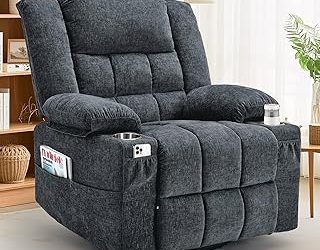
For the most complete feature set in the tightest footprint, the wall-hugger power loveseat with heating and massage is the one to beat. Choose the Ashley Boyington if long-term frame quality and real leather contact surfaces matter most, or the GUEAPY 55″ chenille model if you want a compact, motor-free option that fits a small living room without a single cord to route.