Key takeaways
- Motor count over feature count: A single motor swings back and footrest together on one fixed arc, so you can’t open your hip angle without also dropping your legs. Dual motors separate the two. Triple motors add headrest control, which matters if you have cervical issues stacked on top of lumbar ones.
- Real lumbar hardware, not just a pillow: A strap-on cushion is a decent stopgap, but built-in inflatable or contoured lumbar support tracks your spine as the chair reclines. Check whether the support moves with the backrest or stays put while your body shifts away from it.
- Seat height and depth against your own measurements: Measure floor-to-knee-crease while seated and subtract nothing. If the seat sits higher, your feet dangle and your pelvis rolls back. If the seat is too deep, the front edge cuts your thighs and pulls you into a slouch.
- Frame and deck construction: Kiln-dried hardwood with corner blocking beats particleboard every time. Ask about spring type — 8-gauge sinuous springs or a webbed deck hold shape far longer than thin steel bands, which is what causes that hammock sag after a year.
- Heat placement, not just heat presence: Plenty of chairs advertise heat but bury the element in the seat cushion. For lower back pain you want it in the lumbar panel, sitting directly against the muscles that spasm.
What's inside
I’ve torn down enough recliners to know the difference between a chair that supports your spine and one that just looks like it does. Pull the upholstery off a cheap frame and you’ll usually find a flat slab of 1.2-density foam over a sagging sinuous spring deck — nothing that fills the hollow of your lumbar curve. When that gap goes unsupported, your lower back flattens, the discs load unevenly, and forty minutes in the chair leaves you stiffer than when you sat down. That’s why so many people with lower back pain end up disappointed by a recliner that felt fine in the showroom.
What actually fixes it is geometry plus adjustability: a genuine lumbar shelf that meets your spine where it curves, a recline range that opens the hip angle past 120 degrees, and enough independent motor control that you can dial the position instead of settling for two preset stops. This guide covers the chairs I’d actually recommend after looking at frame construction, motor counts, lumbar hardware, and how well they hold up under daily use. Lift mechanisms, zero-gravity tilt, heat placement — all of it factors in below.
As an Amazon Associate we earn from qualifying purchases.


How to Choose a Recliner Lower Back Pain (2026)
- Motor count over feature count: A single motor swings back and footrest together on one fixed arc, so you can’t open your hip angle without also dropping your legs. Dual motors separate the two. Triple motors add headrest control, which matters if you have cervical issues stacked on top of lumbar ones.
- Real lumbar hardware, not just a pillow: A strap-on cushion is a decent stopgap, but built-in inflatable or contoured lumbar support tracks your spine as the chair reclines. Check whether the support moves with the backrest or stays put while your body shifts away from it.
- Seat height and depth against your own measurements: Measure floor-to-knee-crease while seated and subtract nothing. If the seat sits higher, your feet dangle and your pelvis rolls back. If the seat is too deep, the front edge cuts your thighs and pulls you into a slouch.
- Frame and deck construction: Kiln-dried hardwood with corner blocking beats particleboard every time. Ask about spring type — 8-gauge sinuous springs or a webbed deck hold shape far longer than thin steel bands, which is what causes that hammock sag after a year.
- Heat placement, not just heat presence: Plenty of chairs advertise heat but bury the element in the seat cushion. For lower back pain you want it in the lumbar panel, sitting directly against the muscles that spasm.
The Best Recliner Lower Back Pain (2026)s Reviewed
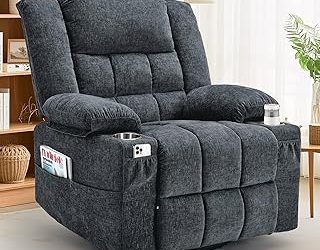
EONIX Triple Motor Zero Gravity Power Recliner
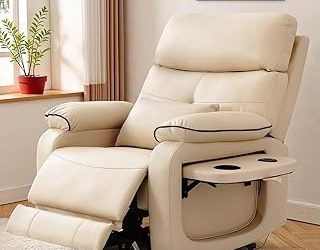
Three independent motors let you set backrest, footrest, and headrest separately, which is the closest you’ll get to a custom fit without a therapy chair — and the zero-gravity position genuinely unloads the lumbar spine by raising your knees above your heart. The 8-zone massage and lumbar heat are well placed, and USB-C means you’re not hunting for an old cable.
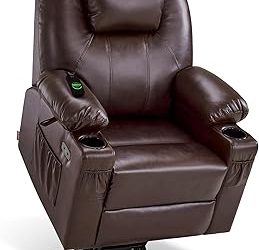
EDILLY Genuine Leather Power Lift Recliner
The double lumbar cushion is the standout here: two stacked support points instead of one, so you can adjust for where your curve actually sits rather than where the factory guessed. Genuine leather over a large-scale frame makes this the pick for taller or heavier users who bottom out smaller chairs.
Dual Motor Power Lift Recliner with Wireless Charger
Infinite-position dual motors mean you can recline the back without launching the footrest, letting you fine-tune hip angle for whatever your back tolerates that day. The lift function is smooth and slow enough to be genuinely useful for anyone who struggles to rise from a seated position.
Infinite Position Lay Flat Lift Recliner, Brown
The extended footrest closes the gap that leaves calves dangling on shorter chairs — a small detail that changes how evenly your weight distributes across the seat. Lay-flat capability makes it viable for sleeping if your pain flares at night and stairs are a problem.
MAHOMICO Power Lift Recliner with Lumbar Heating
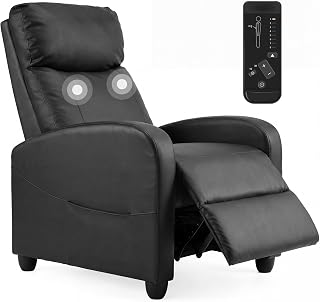
This is the value play: lumbar heating and vibration massage in a compact footprint that fits apartments and smaller living rooms without dominating the space. The side pocket and dual cup holders keep you from twisting to reach a side table, which is a real consideration during a flare-up.
Frequently Asked Questions
Can a recliner make lower back pain worse?
Yes, if the lumbar gap goes unsupported. A chair that lets your low back flatten into a C-curve loads the discs unevenly and tightens the hip flexors. Fill that gap and the same chair becomes therapeutic.
Is zero gravity actually better for back pain?
The position raises your knees above your heart, which reduces compressive load on the lumbar discs and takes tension off the psoas. It’s not marketing fluff, though the benefit depends on the chair holding the angle without letting you slide forward.
How long should I sit in a recliner at a time?
Change position every 45 to 60 minutes regardless of how good the chair is. Static loading is the underlying problem — a recliner that’s easy to adjust encourages the small shifts that keep tissue from stiffening.
Do I need a lift chair if I’m not elderly?
If standing up from a low seat triggers pain, a lift mechanism removes that entire movement. Plenty of people in their forties with disc issues find it more useful than the massage features.
Final Thoughts
For the most control over your spine’s position, the EONIX triple-motor is the chair I’d build my recommendation around — independent headrest adjustment plus true zero gravity is a combination you rarely see at this level. Larger or taller users should look hard at the EDILLY genuine leather model for its double lumbar cushion and extended footrest, while the MAHOMICO delivers targeted lumbar heat and a lift mechanism in a footprint that works for smaller rooms.