Key takeaways
- Color temperature: Aim for 3000K if you want a soft, flattering warmth that plays well with warm-toned tile and brass hardware. Go 5000K daylight if grooming accuracy is the priority — it reads closest to natural window light, which is what you’ll be seen in.
- CRI matters more than you think: Anything below CRI 80 will flatten skin tones and make foundation matching a guessing game. CRI 85+ is the sweet spot for vanity work and costs almost nothing extra.
- Lumens per bulb, not total: A three-bulb fixture with 450lm bulbs gives you roughly 1350 lumens, which is fine for a powder room. A larger bathroom wants closer to 2000, so either step up to 500lm+ globes or choose a fixture with more sockets.
- Wet or damp rating: Bulbs sitting inside an enclosed shade near a shower take real humidity abuse. A wet-rated bulb is cheap insurance against premature failure and flickering.
- Dimmable or not: If your wall switch is a dimmer, non-dimmable LEDs will buzz, flicker, or die early. Check the box. If you don’t have a dimmer, non-dimmable bulbs are typically brighter per watt and cheaper.
What's inside
Anyone who has stood at a bathroom mirror at 6 a.m. squinting at their own reflection knows the frustration: shadows under the eyes, muddy skin tones, and a shave or makeup job that looks completely different once you step outside. The culprit usually isn’t the mirror or the fixture — it’s the bulb. Too warm and orange, too dim, or too low in color rendering, and no amount of leaning closer will fix it. I’ve swapped bulbs in a dozen bathrooms over the years, mine and friends’, and the difference between a bargain-bin globe and a properly spec’d one is genuinely startling.
This guide walks through the bulbs and fixtures I’d actually install today, based on what matters in a small, humid, mirror-facing room: color temperature, CRI, lumen output, and whether the thing can survive steam. I’ve also included a few complete vanity fixtures worth considering if you’re replacing the whole assembly rather than just the glass. Everything here uses a standard E26 medium base or is a fixture designed around it, so you’re not locked into proprietary parts down the road.
As an Amazon Associate we earn from qualifying purchases.





How to Choose a Light Bulb For Bathroom Vanity (2026)
- Color temperature: Aim for 3000K if you want a soft, flattering warmth that plays well with warm-toned tile and brass hardware. Go 5000K daylight if grooming accuracy is the priority — it reads closest to natural window light, which is what you’ll be seen in.
- CRI matters more than you think: Anything below CRI 80 will flatten skin tones and make foundation matching a guessing game. CRI 85+ is the sweet spot for vanity work and costs almost nothing extra.
- Lumens per bulb, not total: A three-bulb fixture with 450lm bulbs gives you roughly 1350 lumens, which is fine for a powder room. A larger bathroom wants closer to 2000, so either step up to 500lm+ globes or choose a fixture with more sockets.
- Wet or damp rating: Bulbs sitting inside an enclosed shade near a shower take real humidity abuse. A wet-rated bulb is cheap insurance against premature failure and flickering.
- Dimmable or not: If your wall switch is a dimmer, non-dimmable LEDs will buzz, flicker, or die early. Check the box. If you don’t have a dimmer, non-dimmable bulbs are typically brighter per watt and cheaper.
The Best Light Bulb For Bathroom Vanity (2026)s Reviewed
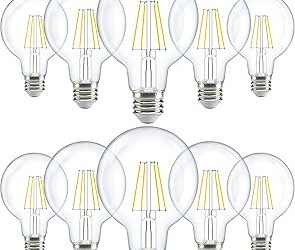
Sunco 10 Pack G25 LED Globe, 3000K Warm White
These are my default recommendation for anyone with an exposed-socket fixture, since the vintage filament look means you don’t need shades to hide anything. At 500 lumens each and wet rated, a set of three or four hits a comfortable brightness without the clinical edge, and buying ten at once means you’ve got spares in the drawer for years.
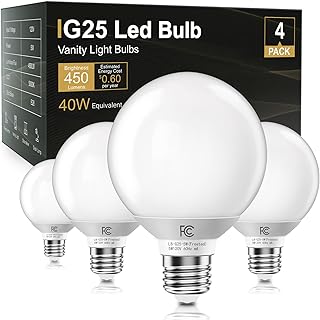
G25 LED Globe Bulbs, 5000K Daylight, CRI85+ 4-Pack
If you do makeup or color-match anything at your mirror, this is the bulb to buy — CRI85+ at 5000K renders skin and fabric honestly, and what you see at the vanity is what you’ll see in daylight. They’re non-dimmable, so confirm your switch is a plain on/off before ordering.
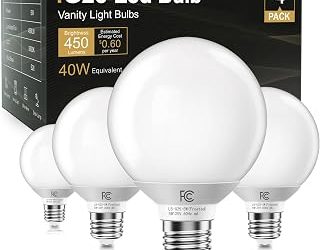
TJOY G25 LED Globe Vanity Bulbs, 5000K, 4-Pack
A slightly softer 450-lumen output makes these a better fit for fixtures with four or six sockets, where full-brightness bulbs across the board can get overwhelming in a small room. UL listed with CRI85+, and the frosted globe diffuses well enough that you’re not staring into a hot spot.
Kichler 6-Light Bathroom Vanity Bar, Brushed Nickel
At 36 inches with six sockets, this linear bar is the right answer for a wide double-vanity mirror where a single centered fixture leaves the edges in shadow. The brushed nickel finish is forgiving of water spots, and installation is straightforward if you’ve got a standard junction box centered above the mirror.
Ralbay 4-Light Crystal Vanity Light, Brushed Nickel
This one splits the difference between decorative and practical — the crystal accents throw a bit of sparkle without tipping into chandelier territory, and four sockets give you real usable light. Pair it with 3000K globes if you want the crystal to glow warm rather than look icy.
Frequently Asked Questions
Should vanity bulbs point up or down?
Up-facing shades bounce light off the ceiling for softer, more even fill, which is generally kinder to faces. Down-facing shades put more light on the counter but can cast shadows under your brow and nose.
Is 5000K too harsh for a bathroom?
It depends on the room’s job. In a guest powder room, yes — 3000K feels more welcoming. In a primary bathroom where you’re getting ready for work, 5000K accuracy wins over ambiance.
Can I mix bulb color temperatures in one fixture?
Don’t. Mixed Kelvin values in adjacent sockets create visibly uneven, slightly greenish light and it’s immediately noticeable in a mirror. Replace all bulbs in a fixture at the same time with the same spec.
Do I need wet-rated bulbs if my vanity is across from the shower?
Damp-rated is usually sufficient at that distance, but wet-rated costs so little more that I default to it in any bathroom without an exhaust fan running reliably.
Final Thoughts
For most bathrooms, the Sunco 10-Pack G25 in 3000K is the easiest win — wet rated, warm, plenty bright, and cheap enough to bulk-buy. If mirror accuracy is your priority, switch to the 5000K CRI85+ G25 globes instead, and if you’re replacing a whole fixture over a wide double vanity, the Kichler 6-Light bar solves the shadow problem that single centered fixtures never quite manage.