Key takeaways
- Measure the doorway, not the room: Compact sectionals ship in two or three cartons, so the individual box dimensions matter more than the assembled width. Check the largest carton against your narrowest turn — hallway corners and stair landings sink more deliveries than front doors do.
- Reversible vs. fixed chaise: A reversible ottoman lets you flip the L to either side, which is worth real money if you plan to rearrange or move within a year. Fixed-orientation sectionals are usually a bit sturdier but lock you into one wall.
- Seat depth over total length: A 72-inch sofa with 22 inches of usable depth feels roomier than an 83-inch one with a shallow 19-inch deck. If you nap on your couch, prioritize deep-seat models and accept the extra footprint.
- Frame and leg hardware: Look for solid wood or steel frames with metal-threaded inserts rather than screws driven straight into particleboard. Plastic legs are the first failure point on budget sectionals — swapping them for tapered hardwood legs is a 20-minute upgrade.
- Fabric that survives real life: Chenille hides wear and feels warmer underfoot; linen-look polyester cleans easier and resists pilling; velvet looks sharp but shows every pet hair. Match the material to whoever actually shares the room with you.
What's inside
If you’ve ever tried to wrestle a full-size sectional through a stairwell landing, you already know the real constraint isn’t your living room square footage — it’s the path to get there. Most compact sectionals solve this with knock-down construction, but the trade-off shows up later: wobbly legs, sagging deck springs, and ottomans that slide out from under you every time you shift your weight. The honest problem for small-space buyers is finding a sofa that ships flat, assembles without a shop full of tools, and still feels solid two years in.
I put this guide together the way I’d approach any build: looking at joinery, frame material, seat depth, and how the pieces actually lock together. Below you’ll find compact L-shaped and modular sectionals sized for apartments, studios, and bonus rooms, along with the specs that matter when the footprint is tight. I’ve flagged which ones reverse for left- or right-hand layouts, which ones use chenille versus linen-look polyester, and where the assembly is genuinely tool-free versus “one Allen key included.”
As an Amazon Associate we earn from qualifying purchases.


How to Choose a/an Sectional Sofa For Small Spaces (2026)
- Measure the doorway, not the room: Compact sectionals ship in two or three cartons, so the individual box dimensions matter more than the assembled width. Check the largest carton against your narrowest turn — hallway corners and stair landings sink more deliveries than front doors do.
- Reversible vs. fixed chaise: A reversible ottoman lets you flip the L to either side, which is worth real money if you plan to rearrange or move within a year. Fixed-orientation sectionals are usually a bit sturdier but lock you into one wall.
- Seat depth over total length: A 72-inch sofa with 22 inches of usable depth feels roomier than an 83-inch one with a shallow 19-inch deck. If you nap on your couch, prioritize deep-seat models and accept the extra footprint.
- Frame and leg hardware: Look for solid wood or steel frames with metal-threaded inserts rather than screws driven straight into particleboard. Plastic legs are the first failure point on budget sectionals — swapping them for tapered hardwood legs is a 20-minute upgrade.
- Fabric that survives real life: Chenille hides wear and feels warmer underfoot; linen-look polyester cleans easier and resists pilling; velvet looks sharp but shows every pet hair. Match the material to whoever actually shares the room with you.
The Best Sectional Sofa For Small Spaces (2026)s Reviewed
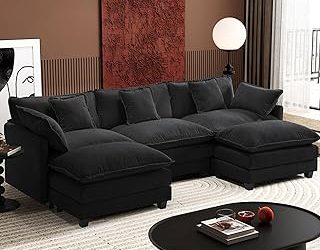
73.6″ Convertible Sectional with Reversible Ottoman
This is the one I’d hand to a first-time apartment dweller: 73.6 inches wide, a reversible ottoman that works on either side, and assembly that genuinely takes under half an hour. The fabric is a tight-weave gray that hides scuffs well, though the seat cushions benefit from a firmer insert if you sit in the same spot daily.
Flamaker 72″ L-Shaped Convertible Sectional
At 72 inches, the Flamaker is the tightest footprint here without feeling like a loveseat, and the removable ottoman doubles as a spare seat when guests show up. The linen-look upholstery in dark grey is the practical choice for rentals — it takes a spot-clean without water-ringing the way some polyesters do.
76.7″ Small Modular Cloud Couch (Beige)
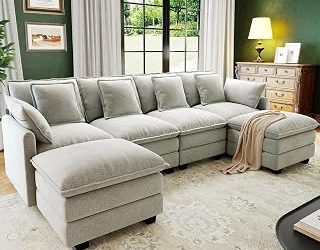
Chenille deep-seat construction is what separates this from the flat-pack crowd; at 76.7 inches you get genuine lounging depth in a modular format you can reconfigure later. Beige shows dirt faster than the darker options, so pair it with a washable throw if you have kids or dogs.
76.7″ Camel Cloud Couch Loveseat with Ottoman
Same well-executed modular platform as the beige version, but the camel chenille reads warmer and disguises everyday wear noticeably better. Deep seats and a detachable ottoman make it a strong studio pick where the sofa also serves as the bed-adjacent lounge.
3-Seat Reversible Sectional with Convertible Ottoman
The ribbed fabric gives this one a more designed look than its price suggests, and the tool-free assembly is legitimately tool-free — the sections cam-lock together by hand. Grey ribbing does trap crumbs in the channels, so keep a brush attachment handy.
Frequently Asked Questions
What’s the smallest sectional that still seats three?
Roughly 72 inches is the practical floor. Below that you’re dividing the deck into two adult-width seats plus a perch. The Flamaker at 72 inches and the 73.6-inch convertible both hit that threshold honestly.
Can I reverse the chaise after assembly?
On reversible-ottoman models, yes — the ottoman is a separate piece that simply butts against either end, so reconfiguring takes a minute with no tools. Fixed-chaise designs require full disassembly, if they allow it at all.
Is chenille or linen better for pets?
Linen-look polyester wins for cleanup and resists snagging from claws. Chenille is more comfortable and hides wear better long-term, but its looped pile can pull if a cat treats it as a scratching post.
Do these need a wall behind them?
Most compact sectionals have finished backs, so they float fine as room dividers in studios. Check that the ottoman and main body sit at matching heights first — a mismatch is obvious when viewed from the open side.
Final Thoughts
For most small-space buyers, the 73.6″ Convertible Sectional with Reversible Ottoman is the sensible default: right size, easy build, forgiving fabric. If you want a genuinely comfortable deep seat and can spare a few extra inches, the 76.7″ Camel Cloud Couch is the upgrade worth making, and the Flamaker 72″ remains the best answer when your floor plan simply won’t give you more room.