Key takeaways
- Measure the real footprint, twice: Note the seated depth and the folded-flat depth, then chalk both on your floor. A 70″ loveseat that extends to 40″ deep can block a closet door you didn’t think about. Also measure your dorm’s door width and any stair landing turns.
- Check the frame material honestly: Solid wood or steel tube rails outlast particleboard every time. If the listing says engineered wood, look for metal-reinforced hinge plates at the backrest, since that joint takes the most abuse from repeated folding.
- Foam density beats foam thickness: A 3-inch high-density pad supports better than a 6-inch soft one. For floor futons, multi-layer construction with a firm core and softer top layer gives you sit-comfort without bottoming out on tile.
- Plan for teardown, not just setup: Favor designs with bolt-together modules, removable armrests, or zip-off covers. Anything glued or stapled shut is a one-way trip. Keep the hardware bag taped to the underside of the frame all year.
- Verify the fabric can be cleaned in place: Chenille and corduroy hide wear well but need a removable or spot-cleanable cover. Faux leather wipes down in seconds, which matters when someone spills ramen at 1 a.m.
What's inside
Dorm rooms punish furniture that can’t multitask. You get maybe 80 square feet of floor, a bed frame bolted to a wall you can’t touch, a roommate with their own pile of stuff, and a move-out date that means whatever you buy has to come apart and fit in a sedan trunk in May. A futon is the obvious answer, but the category is a minefield: half of them arrive as a flat-pack puzzle with a hex key that strips on the second bolt, and the other half are foam slabs that pancake by October.
I’ve assembled, disassembled, re-tightened, and hauled a lot of convertible seating over the years, and the tells are consistent. This guide breaks down what actually holds up in a dorm: frame construction you can service with basic tools, foam density that survives daily sitting, and floor-mattress options for anyone whose room simply has no wall space left. Below are six picks spanning frame sofas and Japanese-style floor futons, plus the checklist I use before clicking buy.
As an Amazon Associate we earn from qualifying purchases.


How to Choose a Futon For Dorm (2026)
- Measure the real footprint, twice: Note the seated depth and the folded-flat depth, then chalk both on your floor. A 70″ loveseat that extends to 40″ deep can block a closet door you didn’t think about. Also measure your dorm’s door width and any stair landing turns.
- Check the frame material honestly: Solid wood or steel tube rails outlast particleboard every time. If the listing says engineered wood, look for metal-reinforced hinge plates at the backrest, since that joint takes the most abuse from repeated folding.
- Foam density beats foam thickness: A 3-inch high-density pad supports better than a 6-inch soft one. For floor futons, multi-layer construction with a firm core and softer top layer gives you sit-comfort without bottoming out on tile.
- Plan for teardown, not just setup: Favor designs with bolt-together modules, removable armrests, or zip-off covers. Anything glued or stapled shut is a one-way trip. Keep the hardware bag taped to the underside of the frame all year.
- Verify the fabric can be cleaned in place: Chenille and corduroy hide wear well but need a removable or spot-cleanable cover. Faux leather wipes down in seconds, which matters when someone spills ramen at 1 a.m.
The Best Futon For Dorm (2026)s Reviewed
Flamaker Futon Sofa Bed
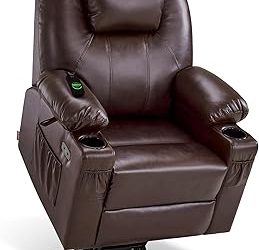
The removable armrests are the smart detail here: pull them and the assembly becomes narrow enough to clear a standard dorm doorway without pivoting, then bolt them back on inside the room. Faux leather makes cleanup trivial, and the built-in cup holders keep drinks off a frame that doesn’t love moisture.
6th Generation Japanese Floor Futon Mattress
If your room has zero wall space for a frame, this nine-layer twin pad is the workaround, giving you a legitimate sleeping surface that rolls up into a closet during the day. The high-density foam core resists the flattening that kills cheap floor mattresses by midterms.
LINSY HOME 70″ Chenille Futon Sofa Bed
The three-position backrest and adjustable armrest mean it works as a couch, a lounger, and a bed without moving the frame off the wall, which is exactly what you want when the wall is your only anchor. Chenille wears better than it looks like it should, and the light green reads warmer than the standard gray everyone else buys.
Ribilake 70″ Futon Sofa Bed
Four configurations from one frame, and the backrest ratchets independently so two people can sit at different angles. Assembly is genuinely tool-light, which matters when your only workspace is a hallway floor.
Convertible Folding Modular Floor Sofa
This is the most flexible pick for oddly shaped rooms: the backrest lifts off and the sections reconfigure into a corner unit, a three-seater, or a king-size flat sleeping platform. Corduroy over foam keeps the weight low enough to reposition solo.
Frequently Asked Questions
Will a futon fit through a standard dorm door?
Most 70″ models arrive flat-packed in two or three boxes, so the door clearance question applies to the assembled unit, not the shipment. Assemble inside the room whenever possible, and prioritize models with detachable armrests if your hallway has tight turns.
Do dorms allow floor futons?
Generally yes, since they involve no modifications and no lofting. Check your housing agreement for rules about blocking egress paths, and use a breathable mat or slatted riser underneath to prevent moisture buildup against the floor.
How do I keep the foam from flattening?
Rotate the mattress or seat cushions monthly, end to end and top to bottom. For floor futons, air them out weekly rather than leaving them rolled up damp, which is what actually degrades foam cell structure.
What tools should I have on hand?
A short-handle Phillips screwdriver, a small adjustable wrench, and a set of hex keys that aren’t the flimsy stamped one in the box. A cordless driver with a clutch set low speeds assembly without stripping threads.
Final Thoughts
For most dorm setups, the LINSY HOME chenille futon is the best balance of comfort, adjustability, and serviceability, while the Flamaker earns its spot for anyone facing a tight doorway thanks to those removable armrests. If a frame simply won’t fit your floor plan, the 6th Generation Japanese floor futon delivers real sleep quality and disappears into a closet by 9 a.m.