Key takeaways
- Real output, not marketing lumens: A 1800-lumen uplight can light a bedroom corner; filling a 250-square-foot living room with usable ambient light takes 3000 lumens or more. Match the number to the ceiling height too, since every extra foot of throw costs you brightness at the floor.
- Dimming quality: Stepless dimming is the feature to hunt for. Stepped dimmers jump between fixed levels and often flicker at the bottom of their range, which you’ll notice most on a white ceiling acting as a giant reflector.
- Base footprint and mass: Look for a base at least 10 inches across with real weight in it. A tall lamp with a light base is a tipping hazard around pets, toddlers, and vacuum cords — and no amount of felt padding fixes bad physics.
- Bulb strategy: Integrated LEDs run cooler, thinner, and brighter, but when the array dies the lamp is scrap. Socketed models let you swap bulbs and tune color yourself, which is the repairable choice if that matters to you.
- Color temperature control: Adjustable CCT between roughly 2700K and 6500K lets one lamp handle warm evening light and cool task light. Fixed-temperature fixtures are fine if you already know what you want the room to feel like.
What's inside
Bounce light off a ceiling and a room stops feeling like a dentist’s office. That’s the whole trick behind a torchiere, and it’s why anyone who has ever rewired a thrift-store lamp or built a plywood console knows the value of indirect light. The trouble is that the category has split in two: cheap uplights that hum, flicker on low, and topple if you brush past them, and heirloom-grade fixtures that cost more than the sofa they sit beside. Somewhere in the middle sits the lamp you actually want, and finding it means reading past the lumen claims on the box.
I spent a stretch of evenings with a light meter, a stud finder (for the record, torchieres don’t need one), and a stack of these lamps in a room with 9-foot ceilings and no overhead fixture. What follows is a practical buying framework plus honest notes on the models worth your money in 2026 — including which ones hold a dim setting without stepping, which bases stay planted on hardwood, and which are worth the extra money for a glass shade you’ll still like in a decade.
As an Amazon Associate we earn from qualifying purchases.


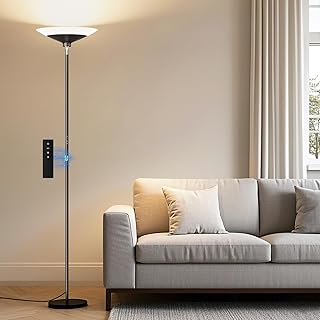

How to Choose a Torchiere Floor Lamp (2026)
- Real output, not marketing lumens: A 1800-lumen uplight can light a bedroom corner; filling a 250-square-foot living room with usable ambient light takes 3000 lumens or more. Match the number to the ceiling height too, since every extra foot of throw costs you brightness at the floor.
- Dimming quality: Stepless dimming is the feature to hunt for. Stepped dimmers jump between fixed levels and often flicker at the bottom of their range, which you’ll notice most on a white ceiling acting as a giant reflector.
- Base footprint and mass: Look for a base at least 10 inches across with real weight in it. A tall lamp with a light base is a tipping hazard around pets, toddlers, and vacuum cords — and no amount of felt padding fixes bad physics.
- Bulb strategy: Integrated LEDs run cooler, thinner, and brighter, but when the array dies the lamp is scrap. Socketed models let you swap bulbs and tune color yourself, which is the repairable choice if that matters to you.
- Color temperature control: Adjustable CCT between roughly 2700K and 6500K lets one lamp handle warm evening light and cool task light. Fixed-temperature fixtures are fine if you already know what you want the room to feel like.
The Best Torchiere Floor Lamp (2026)s Reviewed
SUNMORY 69″ LED Standing Lamp with Remote
At 32W and roughly 3000 lumens, this is the lamp that genuinely replaced a ceiling fixture in my test room, and the stepless dimmer rides all the way down to a candle-glow level without stuttering. The 69-inch height keeps the light source above eye level from a standing position, so you get zero glare from across the room.
Upgraded 40W 4000LM Torchiere with Remote & Touch
The brightest of the group and the one I’d pick for a great room or a space with vaulted ceilings, with a 2700K–6500K range that covers everything from evening reading to daylight-balanced work. Dual remote and touch control is the small practical win here — you’re not hunting for a dropped remote at midnight.
72″ Torchiere with Glass Lampshade
This is the one that reads as furniture rather than a light fixture, thanks to a real glass shade and a socketed bulb you can replace or upgrade on your own terms. At 72 inches it’s the tallest here, which suits high ceilings but makes it worth measuring your corner before ordering.
Uttermost Stowe 66″ Satin Black
Uttermost builds this like a piece of decor, with a weighted base and a satin black finish that holds up next to darker wood tones without looking sprayed on. There’s no remote and no integrated LED, which is exactly the point for anyone who prefers choosing their own bulb and expects the lamp to outlast three of them.
72″ LED with Remote/Button Control, 1800Lm
A tidy compromise for bedrooms and home offices: 1800 lumens is plenty for a modest room, and the 3000–6500K range plus onboard button means it still works when the batteries die. Skip it if you’re lighting a large open plan, where you’ll want closer to double the output.
Frequently Asked Questions
Can a torchiere really replace a ceiling light?
In rooms under about 200 square feet with light-colored ceilings, yes — a 3000-lumen-plus model gets you there. Dark or textured ceilings absorb far more light, so budget extra output or plan on a second lamp.
Are modern torchieres a fire risk?
The old halogen models that scorched ceilings are long gone. LED torchieres run warm at most, and integrated units typically stay under temperatures that would concern you even after hours of use.
How do I keep one from tipping over?
Choose a wide, heavy base and place the lamp in a corner or behind furniture so it can’t be walked into. Route the cord along the baseboard rather than across traffic paths, and if you have small kids, a discreet strap anchoring the pole to a wall stud is cheap insurance.
Is stepless dimming worth paying extra for?
If you use the lamp as your main light source, absolutely. Indirect light magnifies any inconsistency in the dimmer, so smooth control is the difference between a room that feels calm and one that feels slightly off.
Final Thoughts
For most rooms, the SUNMORY 69″ hits the sweet spot of brightness, genuinely smooth dimming, and a price that doesn’t sting. Step up to the 40W 4000LM model if you have tall ceilings or a large open space to fill, and choose the Uttermost Stowe if you’d rather buy a serviceable, well-built fixture once and swap bulbs for the next ten years.