Key takeaways
- Match the system to the job: Suspension airbag kits need steady low-volume pressure and a leveling gauge; horn and seat-inflation setups need a tank; tire work needs sustained flow. Pick the architecture first, brand second.
- Duty cycle over peak PSI: A 150 PSI rating means nothing if the pump overheats after four minutes. Look for stated duty cycle percentages, dual cylinders, or thermal cutoffs — those numbers tell you whether you can air up four 35s in one session.
- Wiring and fusing quality: Check for a proper inline fuse, a relay, and ring terminals sized for the draw. Cheap kits ship with undersized 14-gauge leads that sag voltage and cook the motor. Budget for upgraded wire if the kit skimps.
- Mounting reality check: Measure your frame rail or bed clearance before ordering. Tank-fed systems need real estate plus vibration isolation; compact suspension pumps tuck behind a wheel well but still need a dry, splash-free spot.
- Control method: Wireless app and remote control gets you out from under the dash and is genuinely useful for solo leveling. Hardwired switch panels are more durable long-term. Decide which failure mode you can live with.
What's inside
Anyone who has crawled under a truck at dusk trying to level a sagging airbag with a gas station hose knows the appeal of onboard air. The problem is that “onboard air compressor” covers wildly different hardware — a bolt-in suspension pump that lives permanently on the frame rail, a tank-fed system built to feed a train horn, or a battery-powered inflator that rides in the toolbox. Buy the wrong category and you end up with a unit that either can’t hold pressure for a suspension circuit or is far too much plumbing for topping off tires before a trip.
This guide breaks down the units worth your bench time in 2026, from hardwired airbag kits with wireless control to cordless inflators that skip installation entirely. I’ve weighted duty cycle, real CFM behavior under load, wiring quality, and how forgiving each kit is when you’re mounting it yourself with hand tools instead of a lift.
As an Amazon Associate we earn from qualifying purchases.



🛒 Best Price Today on Amazon
Prime members get fast, free shipping on everything above, plus member-only deals. New members get a 30-day free trial — cancel anytime.
How to Choose a/an Onboard Air Compressor (2026)
- Match the system to the job: Suspension airbag kits need steady low-volume pressure and a leveling gauge; horn and seat-inflation setups need a tank; tire work needs sustained flow. Pick the architecture first, brand second.
- Duty cycle over peak PSI: A 150 PSI rating means nothing if the pump overheats after four minutes. Look for stated duty cycle percentages, dual cylinders, or thermal cutoffs — those numbers tell you whether you can air up four 35s in one session.
- Wiring and fusing quality: Check for a proper inline fuse, a relay, and ring terminals sized for the draw. Cheap kits ship with undersized 14-gauge leads that sag voltage and cook the motor. Budget for upgraded wire if the kit skimps.
- Mounting reality check: Measure your frame rail or bed clearance before ordering. Tank-fed systems need real estate plus vibration isolation; compact suspension pumps tuck behind a wheel well but still need a dry, splash-free spot.
- Control method: Wireless app and remote control gets you out from under the dash and is genuinely useful for solo leveling. Hardwired switch panels are more durable long-term. Decide which failure mode you can live with.
The Best Onboard Air Compressor (2026)s Reviewed
RETRUE Onboard Air Compressor System for Truck Airbag Suspension
This is the straightforward choice if your goal is leveling airbags on an F-150, Silverado, Sierra, or Ram without engineering the plumbing yourself — the kit arrives with the manifold, lines, and fittings mapped out. Installation is genuinely doable in an afternoon with a drill, a wrench set, and patience for routing air line away from exhaust heat.
Medium Duty 150 PSI Onboard Air System with 2.5 Gallon Tank
The 2.5-gallon (9.5 liter) reservoir is what separates this from bag-only kits: stored air means instant horn blasts and enough reserve to seat a tire bead or run a small air tool. Plan your mounting carefully, because a full tank plus compressor is real weight that needs solid frame anchoring, not sheet metal.
maXpeedingrods 120 PSI On Board Air Compressor with App Control
Wireless app and remote control is the standout feature here — adjusting bag pressure from outside the truck while watching the stance settle is a legitimate quality-of-life upgrade for trailers and loaded pickups. The 120 PSI ceiling is lower than tank systems, which is fine for suspension duty but not your pick for high-pressure work.
OlarHike 12000mAh Heavy Duty Tire Inflator
Dual power is the smart play: run it cordless in a parking lot or plug into 12V when the battery’s flat. The 150 PSI rating and digital gauge handle truck, Jeep, SUV, and RV tires without the slow crawl typical of cheap plug-in units, and there’s zero installation involved.
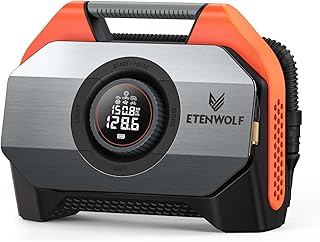
ETENWOLF VORTEX S6 Cordless Tire Inflator
The 19200mAh pack and dual-cylinder design deliver a 100% duty cycle, which means you can work through a full set of heavy-duty tires without waiting for the motor to cool. The LED backlight earns its keep during roadside repairs, and it doubles competently as a bike pump.
Frequently Asked Questions
Do I need a tank with my onboard compressor?
Only if you want instant air delivery for horns, air tools, or bead seating. Pure airbag leveling works fine tank-free, since the bags themselves act as the reservoir.
Can I install one of these myself?
Yes, with basic tools. Suspension kits require drilling mounts, routing air line, and tapping a fused 12V source. Budget three to five hours for your first install and use zip ties liberally.
What PSI rating do I actually need?
Airbag suspension typically runs 5 to 100 PSI. Tire inflation on trucks and RVs wants a 150 PSI capable unit so the pump isn’t working at its absolute limit.
Will a cordless inflator replace a hardwired system?
For tires, absolutely. For airbag suspension or a train horn, no — those need a permanently plumbed compressor.
Final Thoughts
For airbag suspension on a daily-driven truck, the RETRUE kit is the most complete bolt-in package, while the maXpeedingrods system wins if wireless control matters to you. If you’d rather skip installation altogether, the ETENWOLF VORTEX S6 and its 100% duty cycle handles heavy-duty tire work better than most hardwired setups, and the OlarHike 12000mAh dual-power unit is the versatile backup worth keeping in the bed box.