Key takeaways
- Profile height: Under 8-foot ceilings, stay at or below roughly 2.5 inches of drop. Slim panels sit nearly against the drywall; semi-flush designs add a few inches but give you a bit of visual interest, so measure your clearance before committing.
- Diameter versus room size: A rough rule that has served me well: add your room’s length and width in feet, then use that number in inches as your fixture diameter. A 12×14 bedroom lands around 26 inches. Hallways and baths do fine at 10 to 16 inches.
- Lumens, not watts: Aim for 20 lumens per square foot in bedrooms and closer to 50 in kitchens. A 3000-lumen panel handles a mid-sized bedroom; a big open living space wants 5000 or more.
- Color temperature switching: 3CCT fixtures have a small selector switch, usually on the driver housing or the back plate. Flip it before you mount, not after. 3000K reads warm and cozy, 4000K is neutral, 5000K and up feels clinical unless it is a workshop.
- Junction box and dimmer compatibility: Check that the mounting bracket spans your existing box, and confirm the fixture is dimmable if you have a wall dimmer. Non-dimmable LEDs on a dimmer circuit buzz, flicker, and die early.
What's inside
Anybody who has knocked their knuckles on a pendant while carrying laundry knows the problem: standard fixtures are designed for 9-foot ceilings, and a whole lot of houses do not have them. Basements, 1970s ranches, attic conversions, hallways with ductwork running above the drywall — in these spaces every inch of drop counts. Hang the wrong fixture and you get a room that feels shorter than it actually is, plus a light that throws hard shadows because the source sits too close to your head.
I have swapped out dozens of these fixtures in my own place and in friends’ houses, mostly working off a step stool with a voltage tester in my back pocket. What follows is a practical look at flush and semi-flush mounts that solve the low-ceiling problem without looking like builder-grade afterthoughts. I have covered how to size them, what the specs actually mean once the box is open, and which models are worth your Sunday afternoon.
As an Amazon Associate we earn from qualifying purchases.


How to Choose a Light For Low Ceiling (2026)
- Profile height: Under 8-foot ceilings, stay at or below roughly 2.5 inches of drop. Slim panels sit nearly against the drywall; semi-flush designs add a few inches but give you a bit of visual interest, so measure your clearance before committing.
- Diameter versus room size: A rough rule that has served me well: add your room’s length and width in feet, then use that number in inches as your fixture diameter. A 12×14 bedroom lands around 26 inches. Hallways and baths do fine at 10 to 16 inches.
- Lumens, not watts: Aim for 20 lumens per square foot in bedrooms and closer to 50 in kitchens. A 3000-lumen panel handles a mid-sized bedroom; a big open living space wants 5000 or more.
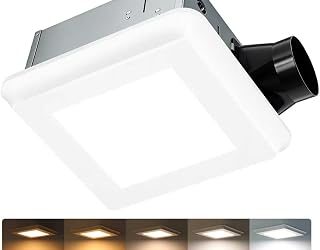
- Color temperature switching: 3CCT fixtures have a small selector switch, usually on the driver housing or the back plate. Flip it before you mount, not after. 3000K reads warm and cozy, 4000K is neutral, 5000K and up feels clinical unless it is a workshop.
- Junction box and dimmer compatibility: Check that the mounting bracket spans your existing box, and confirm the fixture is dimmable if you have a wall dimmer. Non-dimmable LEDs on a dimmer circuit buzz, flicker, and die early.
The Best Light For Low Ceiling (2026)s Reviewed
Diodesy 32-Inch Oval LED Flush Mount
The oval footprint is the smart part here — it spreads light along a rectangular room instead of pooling it in a circle, which is exactly what you want over a bed or a long living room. At 35W and 3000 lumens with brushed nickel trim and full dimming, it is the fixture I would put in a primary bedroom without a second thought.
24-Inch Black Large LED Flush Mount
5480 lumens from a 50W panel is genuinely bright, and the matte black ring keeps it from looking like an office fixture. The housing is only about an inch and a half deep, so it works in basements where the joists are already eating your headroom.
Diodesy Semi Flush Double Ring, 12-Inch
Two concentric rings in oil-rubbed bronze give you actual design presence in a hallway or entry, where a flat disc just reads as utilitarian. At 15W and 1050 lumens it is not a workhorse, so treat it as accent or corridor lighting rather than your only source in a busy room.
15.8-Inch Slim LED Flush Mount, 6-Pack
If you are relighting a whole floor, buying six matched fixtures at once saves money and keeps color temperature consistent from room to room. Each unit puts out 3060 lumens at 34W with the standard three-way CCT switch, and the quick-connect wiring made my install go faster than expected.
3-Light Gold Flush Mount with Ribbed Glass
This is the pick when you want the look of a fixture rather than a light source disappearing into the ceiling. Ribbed clear glass and warm brass hardware suit a dining nook or entryway, and because it takes replaceable bulbs you control the brightness and color yourself.
Frequently Asked Questions
What counts as a low ceiling?
Anything under 8 feet. At 7 feet or less, flush mounts are essentially your only safe option — code and common sense both want at least 7 feet of clearance in walkways.
Can I install one of these myself?
If you are comfortable killing the breaker and verifying with a non-contact tester, yes. Most take under 30 minutes. If your box is not rated for the weight, or you find cloth-insulated wiring, stop and call an electrician.
Do integrated LED panels need bulb replacement?
No, and that is a tradeoff. You get 30,000 to 50,000 hours with no bulb changes, but when the driver eventually fails you replace the whole fixture rather than a $4 bulb.
Which color temperature should I pick?
3000K for bedrooms and living spaces, 4000K for kitchens and baths where you need to see clearly. Keep it consistent within sightlines, since mismatched temperatures in adjoining rooms look off.
Final Thoughts
For most rooms, the Diodesy 32-Inch Oval is the pick — good output, low profile, and a shape that actually matches how bedrooms are laid out. Choose the 24-Inch Black panel if you need serious brightness in a basement or larger space, and grab the 15.8-Inch 6-pack if you are tackling multiple rooms in one weekend.