Key takeaways
- Measure your clearance first: Drop a tape from the ceiling to the floor, subtract seven feet, and that is your entire fixture budget. Most hugger fans occupy 9 to 12 inches from canopy to blade, so an 8-foot ceiling works but a 7-foot-6 basement retrofit usually does not.
- DC motor over AC when you can: DC motors run cooler, draw roughly a third of the wattage, and give you six speeds instead of three. They are also noticeably quieter, which matters more in a hugger since the motor sits closer to your head.
- Check the mounting box, not just the fan: A fan needs a fan-rated box screwed into a joist or an expanding brace bar. A plastic lighting box will not hold 20 pounds of spinning weight. Budget an extra hour if yours needs swapping.
- Decide on controls before you buy: Pull chains need no wall wiring and never lose a signal. Remote and app models are cleaner but require you to tuck a receiver into the canopy, which is tight on flush mounts.
- Match the light to the room: 3CCT switchable LEDs let you dial 3000K warm for bedrooms or 5000K daylight for kitchens without buying bulbs. Look for dimmable output above 1,200 lumens if the fan is your only ceiling fixture.
What's inside
Anyone who has held a boxed ceiling fan overhead while standing on a stepladder in an eight-foot room knows the moment of truth: with a downrod attached, the blades end up somewhere around forehead height. Building code wants at least seven feet of floor-to-blade clearance, and a standard low-profile fan with a 4-inch rod eats that budget fast. Add a light kit hanging below the motor housing and you have a fixture that looks great in the listing photos and feels like a hazard in the room.
Hugger fans, sometimes labeled flush mount, solve that by bolting the motor housing directly to the ceiling canopy with no rod in between. The tradeoff is airflow: less space above the blades means the fan has to work smarter to move air. This guide breaks down what actually matters when you are the one splicing the wires, then walks through six models worth mounting, from wired-up smart fans to simple pull-chain workhorses.
As an Amazon Associate we earn from qualifying purchases.


How to Choose a Hugger Ceiling Fan With Light (2026)
- Measure your clearance first: Drop a tape from the ceiling to the floor, subtract seven feet, and that is your entire fixture budget. Most hugger fans occupy 9 to 12 inches from canopy to blade, so an 8-foot ceiling works but a 7-foot-6 basement retrofit usually does not.
- DC motor over AC when you can: DC motors run cooler, draw roughly a third of the wattage, and give you six speeds instead of three. They are also noticeably quieter, which matters more in a hugger since the motor sits closer to your head.
- Check the mounting box, not just the fan: A fan needs a fan-rated box screwed into a joist or an expanding brace bar. A plastic lighting box will not hold 20 pounds of spinning weight. Budget an extra hour if yours needs swapping.
- Decide on controls before you buy: Pull chains need no wall wiring and never lose a signal. Remote and app models are cleaner but require you to tuck a receiver into the canopy, which is tight on flush mounts.
- Match the light to the room: 3CCT switchable LEDs let you dial 3000K warm for bedrooms or 5000K daylight for kitchens without buying bulbs. Look for dimmable output above 1,200 lumens if the fan is your only ceiling fixture.
The Best Hugger Ceiling Fans With Light Reviewed
42-Inch Flush Mount Fan, 3CCT Dimmable, Black
The sweet spot for most rooms under 200 square feet: a reversible DC motor with six speeds, switchable color temperature, and ETL listing for damp locations so it holds up on a covered patio. Wiring is straightforward, though the receiver module fills the canopy, so dress your wire nuts carefully before tightening the cover.
52″ Black Flush Mount Fan with App and Remote
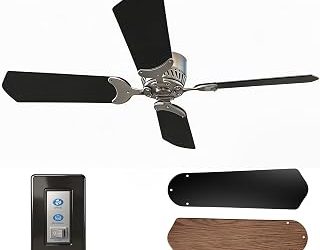
Ten extra inches of blade span makes a real difference in great rooms and open kitchens where a 42-inch hugger just stirs air locally. App control is genuinely useful for scheduling, and the quiet DC motor keeps the larger blades from producing hum at higher speeds.
CF-78049L Hugger Ceiling Fan, 3 Light, Brown
A traditional three-light hugger in warm brown that fits older homes and rental turnovers without looking like a tech upgrade. The three-bulb design means you choose your own LEDs, which is a quiet advantage when a diode array fails in a sealed fixture five years in.
Hunter 42″ Builder Low Profile, New Bronze
If you want the fan you install once and forget, this is it. Hunter’s WhisperWind motor and pull-chain simplicity remove every failure point a remote adds, and the five-blade bronze build is the safest bet for bedrooms where reliability beats features.
42-Inch Hugger with Wood Blades and Power-Off Memory
Real wood-finish blades give this one warmth that painted MDF cannot match, and the power-off memory means the fan returns to your last speed and light setting after an outage instead of blasting on high at 2 a.m. A solid pick for farmhouse or transitional rooms.
Frequently Asked Questions
Do hugger fans move less air than downrod fans?
Slightly, yes. With less space above the blades, a flush mount typically loses 10 to 20 percent of the CFM of the same fan on a rod. Sizing up one blade diameter usually closes the gap.
Can I install one myself?
If you can turn off the breaker, verify with a non-contact tester, and connect wire nuts confidently, yes. The one job worth calling in is replacing a non-fan-rated ceiling box.
Why does my new fan wobble?
Almost always loose blade screws or a canopy bracket that is not seated flat. Retorque every blade bolt, then use a stick-on balance weight kit if a slight wobble remains.
Are outdoor-rated hugger fans necessary for a porch?
Yes. Look for a damp or wet location rating with UL or ETL listing. Indoor motors corrode quickly in humid air, and the warranty will not cover it.
Final Thoughts
For most rooms, the 42-inch 3CCT flush mount hits the best balance of quiet DC performance and install simplicity, while the 52″ app-controlled model is the one to grab for larger open spaces. If you would rather never troubleshoot a remote receiver, the Hunter Builder 51091 is the honest, long-haul choice.