Key takeaways
- Measure the flat footprint, not the folded one: A 59-inch loveseat can open to roughly 71 inches deep. Chalk the full open dimensions on your floor before buying, and account for the walkway you still need around it.
- Boneless vs. framed construction: Boneless models are pure foam and fabric, so they squeeze through doorways and up stairs without a fight. Framed futons hold their shape better long-term but demand more clearance during delivery and assembly.
- Check the assembly method: Most of these ship in one carton with pre-drilled legs and an Allen key. If a listing mentions attaching a metal frame to a wooden base, budget 30 to 45 minutes and a second set of hands.
- Foam density over foam thickness: Memory foam feels plush on day one, but low-density foam bottoms out within months. Look for weight capacity ratings as a proxy — a 700-pound rating signals denser fill than a vague “supportive cushioning” claim.
- Upholstery and maintenance: Linen breathes and hides wear, corduroy resists pilling, faux leather wipes clean but sticks to skin in summer. If your unit runs warm, skip the vinyl-backed options.
What's inside
Anyone who has tried to fit a real sleeping surface into a 400-square-foot studio knows the math rarely works. Standard sofa beds assume you have three feet of clearance in front of them and a doorway wide enough to get the frame through in one piece, which is exactly what small apartments don’t offer. I’ve hauled enough furniture up narrow stairwells to know that the spec that matters most isn’t seat depth, it’s whether the thing arrives flat-packed or wedges itself permanently on a landing.
This guide covers six convertible futons I’d actually recommend for tight rooms, judged on folded footprint, assembly friction, and whether the mattress holds up as a bed rather than just a couch that reclines. I’ve flagged which models use a boneless design (no internal frame, so they compress and maneuver easily), which need tools, and where the real tradeoffs sit between comfort and compactness.
As an Amazon Associate we earn from qualifying purchases.




How to Choose a Futon For Small Spaces (2026)
- Measure the flat footprint, not the folded one: A 59-inch loveseat can open to roughly 71 inches deep. Chalk the full open dimensions on your floor before buying, and account for the walkway you still need around it.
- Boneless vs. framed construction: Boneless models are pure foam and fabric, so they squeeze through doorways and up stairs without a fight. Framed futons hold their shape better long-term but demand more clearance during delivery and assembly.
- Check the assembly method: Most of these ship in one carton with pre-drilled legs and an Allen key. If a listing mentions attaching a metal frame to a wooden base, budget 30 to 45 minutes and a second set of hands.
- Foam density over foam thickness: Memory foam feels plush on day one, but low-density foam bottoms out within months. Look for weight capacity ratings as a proxy — a 700-pound rating signals denser fill than a vague “supportive cushioning” claim.
- Upholstery and maintenance: Linen breathes and hides wear, corduroy resists pilling, faux leather wipes clean but sticks to skin in summer. If your unit runs warm, skip the vinyl-backed options.
The Best Futon For Small Spaces (2026)s Reviewed
COMHOMA 72″ Convertible Futon Sofa Bed
The multi-angle backrest is the standout here — it locks into several positions rather than the usual upright-or-flat binary, which makes it genuinely usable for reading or working from the couch. At 72 inches it’s the widest pick on this list, so measure your wall run first, but the breathable fabric and included pillows make it the most complete out-of-box setup.
Grey Linen Futon Sofa Bed with Memory Foam
Adjustable armrests are an underrated feature in small rooms: drop them and you gain several inches of usable sleeping length without changing the frame’s footprint. The memory foam runs on the softer side, so I’d pair it with a firm mattress topper if you’re using it nightly rather than for occasional guests.
MeMoreCool 59″ Boneless Couch Bed
This is the one I’d pick for an awkward layout. The boneless build means you can fold, tilt, and shove it through tight turns during move-in, and the 700-pound rating points to real foam density rather than filler. Opens to 59 by 71 inches — roughly nine inches shorter than a queen, which is a fair trade for the compact loveseat profile.
Amazon Basics Convertible Futon Sofa Bed
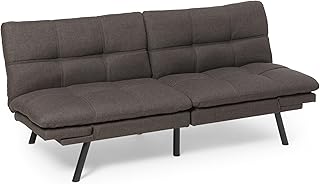
Straightforward memory foam construction with adjustable positions and a dark grey linen cover that hides everyday wear well. Assembly is quick and the price point makes it the sensible choice for a home office or spare room that only occasionally doubles as sleeping quarters.
Flamaker Faux Leather Convertible Loveseat
The removable armrests are the practical hook — pull them off and the sleeping surface extends meaningfully, then reattach them for daytime use. Built-in cup holders feel like a gimmick until you’re actually using it as a media couch, and the faux leather wipes down in seconds.
Frequently Asked Questions
Can a futon work as an everyday bed?
Some can, but foam density is the deciding factor. Higher weight-capacity models like the MeMoreCool hold up better under nightly use, while thinner memory foam units are best kept to guest duty. Rotating the cushion and adding a two-inch topper extends the life of either.
How much clearance do I actually need?
Add the open depth to at least 24 inches of walking space. For a 59-inch boneless model opening to 71 inches deep, plan on roughly eight feet of floor from the wall out. Low-profile options like the COMAX sit around 11.8 inches high, which helps a cramped room feel less blocked.
Is assembly difficult?
For boneless models, essentially none — unbox, unroll, let the foam expand for a day. Framed futons typically involve attaching legs and a backrest mechanism with an included hex key, which is manageable solo but faster with help.
What’s the difference between a futon and a sleeper sofa?
A sleeper sofa hides a separate mattress inside a pull-out frame, adding weight and depth. A futon converts its own seating surface into the bed, which is why it wins on footprint and price for small spaces.
Final Thoughts
For most small-space setups, the MeMoreCool 59″ boneless couch bed is the pick I keep coming back to — it moves easily, sleeps close to queen width, and the foam density justifies the choice. If you want more backrest adjustability and have the wall space, the COMHOMA 72″ delivers the most versatile seating, while the Amazon Basics futon is the practical, no-fuss option for a guest room or office corner.