Key takeaways
- Seat depth over total length: Length gets advertised, depth determines comfort. Under 22 inches and you’ll sit rather than lounge. Deep-seat models in the 28 to 36 inch range let you actually stretch out sideways, which is the entire point. Measure your torso, not just your floor.
- Frame vs. boneless construction: Framed chaises hold a crisp silhouette and sit higher, which matters if standing up from low furniture is a struggle. Boneless designs are all foam and fabric — softer, easier to move solo, and shippable in a compressed box, but they’ll develop body-shaped impressions within months. Neither is wrong; they age differently.
- Foam density and recovery: Ask about high-density or memory foam specifically. Cheap polyfoam bottoms out under repeated use and never bounces back. If you plan to sleep on it, treat it like a mattress purchase, not a chair purchase.
- Fabric versus your household: Velvet reads luxurious and hides seams well but shows watermarks and pet hair. Boucle is forgiving on stains and pilling but snags on claws. Corduroy is the practical middle ground — durable ribbing, easy to spot-clean, warm underfoot. Faux fur is the coziest and the highest maintenance.
- Delivery reality check: Measure your doorway, stairwell turn, and elevator before ordering anything over 60 inches. Compressed boneless models solve this elegantly. Framed pieces often don’t, and no amount of angling fixes a landing that’s too tight.
What's inside
Anyone who’s ever dragged a tape measure around a living room knows the chaise lounge problem: it’s a piece of furniture that looks effortless in photos and turns awkward the moment it lands in a real room. Too shallow and you’re perched instead of reclining. Too firm and it becomes decorative seating nobody actually uses. Too long and it blocks the walkway you forgot to account for. And if the frame arrives in six pieces with a hex key and a diagram drawn by someone who’s never held a screwdriver, the whole weekend disappears.
I’ve assembled, re-stuffed, reupholstered, and occasionally cursed at enough lounge furniture to know what separates a chaise you’ll nap on daily from one you’ll list secondhand by spring. This guide breaks down what actually matters — seat depth, foam density, fabric behavior over time, and whether “no assembly” is a genuine feature or a euphemism for a bag of foam. Below are six indoor chaise lounges worth considering in 2026, spanning slim velvet accent pieces to oversized boneless cloud sofas, plus a straightforward framework for matching one to your space.
As an Amazon Associate we earn from qualifying purchases.



How to Choose a/an Chaise Lounge Indoor (2026)
- Seat depth over total length: Length gets advertised, depth determines comfort. Under 22 inches and you’ll sit rather than lounge. Deep-seat models in the 28 to 36 inch range let you actually stretch out sideways, which is the entire point. Measure your torso, not just your floor.
- Frame vs. boneless construction: Framed chaises hold a crisp silhouette and sit higher, which matters if standing up from low furniture is a struggle. Boneless designs are all foam and fabric — softer, easier to move solo, and shippable in a compressed box, but they’ll develop body-shaped impressions within months. Neither is wrong; they age differently.
- Foam density and recovery: Ask about high-density or memory foam specifically. Cheap polyfoam bottoms out under repeated use and never bounces back. If you plan to sleep on it, treat it like a mattress purchase, not a chair purchase.
- Fabric versus your household: Velvet reads luxurious and hides seams well but shows watermarks and pet hair. Boucle is forgiving on stains and pilling but snags on claws. Corduroy is the practical middle ground — durable ribbing, easy to spot-clean, warm underfoot. Faux fur is the coziest and the highest maintenance.
- Delivery reality check: Measure your doorway, stairwell turn, and elevator before ordering anything over 60 inches. Compressed boneless models solve this elegantly. Framed pieces often don’t, and no amount of angling fixes a landing that’s too tight.
The Best Chaise Lounge Indoor (2026)s Reviewed
Velvet Button-Tufted Armless Chaise Lounge (Black)
This is the classic silhouette done affordably — armless, tufted, with a slim footprint that slides into a bedroom corner or behind a sofa without dominating the room. Assembly is minimal (legs and back), the velvet has decent pile depth for the price, and the included bolster pillow does real lumbar work rather than sitting there for the photo.
ERYE Boucle Right-Facing Chaise Lounge
The right-facing orientation makes this a genuine sectional companion, and boucle is the smartest fabric choice for a piece that gets daily contact — it disguises wear in a way flat weaves can’t. Assembly is honestly straightforward, roughly fifteen minutes with a screwdriver, and the frame feels solid enough that I’d expect it to hold up through a couple of moves.
ivoros 50-Inch Corduroy Boneless Chaise Lounge
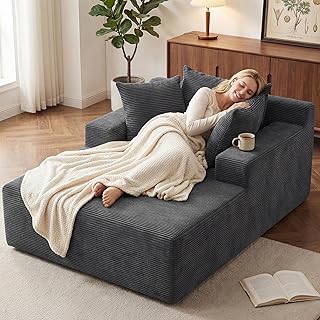
At 50 inches, this is the version that fits apartments, nurseries, and reading nooks where the oversized cloud sofas simply won’t. Corduroy is the underrated hero here — it grips instead of sliding, cleans up with a damp cloth, and the deep seat swallows you without collapsing after a month of use.
67-Inch Corduroy Boneless Sofa Bed
Same well-executed corduroy construction as the 50-inch model, scaled up to full sleeper territory — this genuinely functions as a guest bed rather than pretending to. It arrives compressed, expands over 24 to 48 hours, and requires zero tools, which makes it the easiest large-furniture purchase on this list.
66-Inch Boneless Cloud Chaise with 3 Pillows
The three included pillows aren’t filler — they let you reconfigure between upright reading, side-lounging, and flat napping without buying accessories. It’s the most versatile pick for a media room, though the plush surface means you’ll want a throw over the high-contact zone if you have pets.
Frequently Asked Questions
How long does a compressed boneless chaise take to fully expand?
Plan on 24 to 48 hours for the foam to reach full loft, though most reach roughly 90 percent within the first few hours. A warm room speeds it up considerably. Resist the urge to sit on it early — uneven pressure during expansion can set a permanent dip.
Can I actually sleep on one of these nightly?
The 66-inch and 67-inch models are long enough for most adults, and memory foam versions handle nightly use better than standard polyfoam. That said, treat them as excellent guest beds and occasional-use sleepers rather than a mattress replacement — support geometry isn’t the same.
What’s the difference between right-facing and left-facing?
Sit down on it and note which side the backrest wraps around. A right-facing chaise has the back on your right and works on the right end of a sofa arrangement. Get this wrong and the piece fights your room layout instead of completing it.
How do I keep velvet and faux fur from looking flattened?
Brush against the nap with a soft upholstery brush every few weeks, and rotate any removable cushions. For crushed spots, a light steam pass followed by brushing restores most of the pile. Keep both fabrics out of direct sun, which fades them unevenly.
Final Thoughts
If you want one recommendation that satisfies the most households, the ivoros 50-Inch Corduroy Chaise is the sweet spot — durable fabric, real seat depth, and a footprint that works in rooms where the oversized options don’t. Scale up to the 67-Inch Corduroy Sofa Bed if you need genuine guest-sleeping capacity without a foldout mechanism, or go with the ERYE Boucle Right-Facing Chaise if you’re building around an existing sofa and want a framed piece that holds its shape for the long haul.