Key takeaways
- Measure your gap first: Sit in the recliner, slide your hand behind your lower back, and note how deep the hollow runs. Recliners typically need 4–5 inches of loft, roughly double what a desk chair cushion offers — buy too thin and you’ll feel nothing.
- Foam density over foam thickness: High-density memory foam holds its shape under sustained pressure; cheap shredded fill compresses to a pancake within weeks. Squeeze test: if it collapses easily in your hand, it’ll collapse under your body weight.
- Strap length and anchor points: Recliner backs are wider and rounder than office chairs. Look for adjustable straps long enough to reach around a generous seat back, ideally with two anchor points so the cushion can’t rotate.
- Width matters more than you’d think: A narrow cushion creates pressure points at its edges. Something in the 18–20 inch range spreads the load across your whole lower back rather than jabbing into a single spot.
- Removable, washable cover: This gets skin contact for hours a day. A zippered cover you can throw in the machine is non-negotiable for longevity — sealed cushions start smelling within a year.
What's inside
Recliners are built for lounging, not for holding your spine in a neutral curve. Most have a soft, hollowed-out backrest that swallows your lower back the moment you sit down, which is why you can nap in one for an hour and stand up feeling like you’ve been shoveling gravel. The gap between your lumbar curve and the chair’s padding is the whole problem — nothing supports the arch, so your pelvis rolls back and your discs take the load.
I’ve stuffed rolled towels, folded quilts, and one ill-advised throw pillow into that gap over the years, and the DIY fixes all migrate or flatten within twenty minutes. A purpose-built lumbar cushion solves it properly: correct depth, foam that pushes back, and a strap system that keeps it where you put it. Below I’ve broken down what actually matters when you’re buying, then reviewed the cushions worth your money in 2026.
As an Amazon Associate we earn from qualifying purchases.


How to Choose a Lumbar Support Cushion For Recliner Chair (2026)
- Measure your gap first: Sit in the recliner, slide your hand behind your lower back, and note how deep the hollow runs. Recliners typically need 4–5 inches of loft, roughly double what a desk chair cushion offers — buy too thin and you’ll feel nothing.
- Foam density over foam thickness: High-density memory foam holds its shape under sustained pressure; cheap shredded fill compresses to a pancake within weeks. Squeeze test: if it collapses easily in your hand, it’ll collapse under your body weight.
- Strap length and anchor points: Recliner backs are wider and rounder than office chairs. Look for adjustable straps long enough to reach around a generous seat back, ideally with two anchor points so the cushion can’t rotate.
- Width matters more than you’d think: A narrow cushion creates pressure points at its edges. Something in the 18–20 inch range spreads the load across your whole lower back rather than jabbing into a single spot.
- Removable, washable cover: This gets skin contact for hours a day. A zippered cover you can throw in the machine is non-negotiable for longevity — sealed cushions start smelling within a year.
The Best Lumbar Support Cushion For Recliner Chair (2026)s Reviewed
HOMBYS Extra Large Lumbar Support Pillow
At 20 by 13.5 by 5 inches, this is the one that actually fills a recliner’s hollow instead of hovering in it — the extra depth is exactly what most cushions get wrong. The memory foam is firm enough to hold its contour through a long evening, and the generous width means no edge-digging at the sides of your spine.
Large Memory Foam Back Support Cushion for Sofa & Recliner
A well-judged balance of surface area and give, with a machine-washable cover that makes it practical for daily use rather than occasional. The ergonomic contour is gentler than a hard orthopedic wedge, which suits people who want relief without feeling like they’re sitting against a brick.
HIGOGOGO Tufted Corduroy Back Support Cushion
The tufting isn’t just decorative — it stops the fill from shifting into clumps, which is the usual failure mode for softer cushions. Worth choosing if you care about the recliner still looking like furniture; corduroy in brown reads as an intentional accent rather than a medical device parked in your living room.
Everlasting Comfort Original Lumbar Support Pillow
The benchmark cushion for good reason: dense foam, a well-shaped curve, and straps that genuinely stay put. It’s built for office chairs, so on a deep recliner you may want to pair it with a thin throw behind it, but the foam quality is a clear step above most competitors.
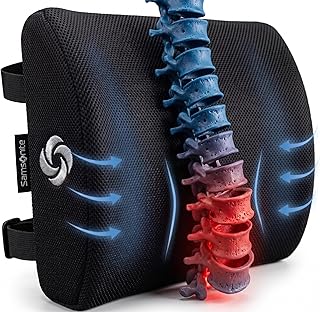
Samsonite Memory Foam Lumbar Support Pillow
Compact and travel-friendly with reliably firm memory foam, making it the pick if you want one cushion that moves between recliner, car seat, and desk chair. The slimmer profile suits shallower recliners and smaller frames better than the extra-large options above.
Frequently Asked Questions
How thick should a lumbar cushion be for a recliner?
Aim for 4–5 inches. Recliner backrests are softer and deeper than task chairs, so a 2-inch office cushion simply sinks into the upholstery and does nothing. Measure the gap behind your lower back while seated and match it.
Will a lumbar cushion work in a reclined position?
Yes, but the support point shifts as you lean back. Cushions with adjustable straps let you slide the position up or down after reclining, which is why strap systems matter more here than on a fixed office chair.
Memory foam or shredded fill?
Memory foam for support, shredded fill for comfort. If pain relief is the goal, choose high-density memory foam — it resists compression and maintains the lumbar curve. Shredded fill is more of a soft cushion than a corrective one.
How long do these cushions last?
A quality high-density foam cushion holds its shape for two to four years with daily use. Rotating it occasionally and washing the cover rather than the foam core will extend that considerably.
Final Thoughts
For most recliners, the HOMBYS Extra Large is the correct answer — it’s the only one with the depth and width to properly fill a deep backrest hollow. If aesthetics matter in a shared living space, the HIGOGOGO tufted corduroy delivers real support without looking clinical, and the Everlasting Comfort Original remains the smartest buy if you want one dependable cushion that works across a recliner, desk chair, and car seat alike.