Key takeaways
- Lumens you can dial down: Peak output gets quoted on the box, but the low setting matters more. A 2,200–3,000 lumen tower at full blast will wash out surface detail on a raw panel; drop it to 500–700 lumens and rake it across the grain at a low angle and every flaw jumps out. Look for at least three brightness steps.
- Color temperature switching: Cool 6,500K light is best for finding dust nibs and sanding scratches. Warmer 4,000K (or 3,000K on three-mode units) shows you closer to how a stain or oil finish will actually read under living-room lamps. Having both saves you from nasty color surprises after the topcoat cures.
- Battery format — built-in vs. tool platform: Self-contained 8AH and 12,000mAh units charge by USB-C and work anywhere, ideal if you don’t own a cordless drill system. If you already have DEWALT 20V MAX packs on the shelf, a bare-tool light is cheaper and shares batteries with your drill and sander.
- Stand height and stability: Anything under 60 inches keeps light below your eye line and back in shadow territory. Look for 67–75 inch aluminum poles with a wide tripod base, and detachable heads so you can pull the lamp off and set it on the bench for detail work.
- Mounting tricks: Magnetic bases stick to cast-iron table saw tops and metal shelving. Pivoting heads let you bounce light off a ceiling for soft, shadowless fill. Hooks and 1/4-20 threads mean you can hang or clamp instead of hunting for floor space in a crowded garage.
What's inside
Anyone who has tried to sand a tabletop, stain a set of chair legs, or fit drawer slides in a dim garage knows the real enemy isn’t your skill level — it’s shadow. Overhead shop bulbs throw light straight down, which means the moment you lean over your work, your own shoulders black out the exact spot you’re trying to see. Clamp lamps help until the cord snags your extension leads, and phone flashlights die halfway through a glue-up. What you actually need is a bright, movable, cord-free light you can aim sideways across a surface to reveal every scratch, swirl mark, and glue squeeze-out before the finish goes on.
This guide covers the cordless work lights I’d genuinely trust for furniture builds, refinishing jobs, and home repair projects — the tall tripod towers that flood a whole room, and the compact battery-platform lights that live in your tool bag. I’ve focused on the specs that change how a project turns out: usable lumen range, color temperature control, runtime on a real battery, and how quickly the thing collapses back into a bag when you’re done for the night.
As an Amazon Associate we earn from qualifying purchases.


How to Choose a Cordless Work Light (2026)
- Lumens you can dial down: Peak output gets quoted on the box, but the low setting matters more. A 2,200–3,000 lumen tower at full blast will wash out surface detail on a raw panel; drop it to 500–700 lumens and rake it across the grain at a low angle and every flaw jumps out. Look for at least three brightness steps.
- Color temperature switching: Cool 6,500K light is best for finding dust nibs and sanding scratches. Warmer 4,000K (or 3,000K on three-mode units) shows you closer to how a stain or oil finish will actually read under living-room lamps. Having both saves you from nasty color surprises after the topcoat cures.
- Battery format — built-in vs. tool platform: Self-contained 8AH and 12,000mAh units charge by USB-C and work anywhere, ideal if you don’t own a cordless drill system. If you already have DEWALT 20V MAX packs on the shelf, a bare-tool light is cheaper and shares batteries with your drill and sander.
- Stand height and stability: Anything under 60 inches keeps light below your eye line and back in shadow territory. Look for 67–75 inch aluminum poles with a wide tripod base, and detachable heads so you can pull the lamp off and set it on the bench for detail work.
- Mounting tricks: Magnetic bases stick to cast-iron table saw tops and metal shelving. Pivoting heads let you bounce light off a ceiling for soft, shadowless fill. Hooks and 1/4-20 threads mean you can hang or clamp instead of hunting for floor space in a crowded garage.
The Best Cordless Work Lights (2026) Reviewed
Aluminum 67″ Rechargeable LED Work Light with Tripod
The 500/1500/2500 lumen ladder is the sweet spot for furniture work — low for inspecting finish, high for framing and assembly — and the 4000K/6500K toggle covers both sanding and staining passes. The aluminum pole feels solid rather than flexy, and the included carry bag means the tripod actually gets put away instead of becoming a tripping hazard.
GoGonova Cordless Work Light with Triple LED Lamps
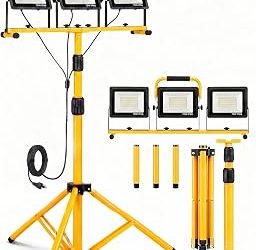
Three independently usable lamp heads let you light a workbench from two angles while aiming the third at whatever you’re holding, which effectively eliminates hand shadow during joinery. The 8AH pack stretches a long way on the 700 lumen setting, making this the one I’d grab for an all-evening refinishing session.
DEWALT 20V MAX LED Work Light (DCL050)
A genuinely tough area light that clips onto batteries you probably already own, with a pivoting head that bounces light off a ceiling for soft, even fill. It’s not a room-flooder, but for crawling behind a cabinet or lighting a drawer cavity it’s the most durable option here.
DEWALT 20V MAX Handheld Spotlight (DCL043)
At 1,500 lumens with a 508-yard throw, this is a spotlight rather than a work lamp — brilliant for inspecting a barn find dresser in a dark storage unit or checking rafters and crawl spaces. Keep it as a companion to a tripod light, not a replacement.
12000mAh Work Light with 74.8″ Stand
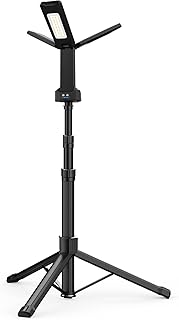
The tallest tower on this list, and the three-way color temperature switch (3000K/4500K/6000K) makes it the most useful for finish evaluation — that 3000K setting previews warm indoor lighting surprisingly well. The 12,000mAh cell also doubles as a power bank when your phone dies mid-project.
Frequently Asked Questions
How many lumens do I need for woodworking and furniture projects?
For general assembly in a one- or two-car garage, 2,000–2,500 lumens from a tall stand is plenty. For finish inspection you want the option to go much lower — around 500–700 lumens held at a shallow angle to the surface reveals defects that bright, flat light hides completely.
Are built-in batteries better than tool-platform batteries?
Built-in USB-C rechargeable units are more convenient and cheaper overall if you’re starting fresh. If you already run DEWALT 20V MAX tools, bare-tool lights cost less up front and let you hot-swap packs from your drill, which effectively gives you unlimited runtime.
Can I use these lights for camping or power outages too?
Yes — that dual purpose is why most of these are marketed as camping lights. The detachable heads, hooks, and high-capacity cells with USB output make them practical emergency lighting, and the warmer color modes are far easier on the eyes indoors than pure 6500K.
What color temperature should I use when staining wood?
Check your work under both. Evaluate coverage and sanding scratches at 6,500K, then switch to 3,000–4,000K to judge tone and undertone, since that’s much closer to typical household lighting where the finished piece will live.
Final Thoughts
For most furniture makers, the Aluminum 67″ Rechargeable Work Light hits the best balance of height, dimming range, and portability, while the 74.8″ 12000mAh tower earns the nod if three-way color temperature control and power-bank capability matter to you. If you’re already invested in DEWALT 20V MAX batteries, add the DCL050 to your kit as a rugged, shares-your-packs light for tight spaces and detail work.