Key takeaways
- Fence quality: This is the single biggest divider between a saw you trust and one you fight. A rack-and-pinion fence that locks square every time saves more frustration than any horsepower bump. Check for micro-adjustment and whether the fence stays put when you lean on it.
- Rip capacity vs. footprint: A 32-inch rip lets you break down a full sheet of ply with the fence to the right of the blade. If you’re building cabinets or casework, that matters. If you mostly cut 1x stock and trim, a compact 24-inch model saves floor space you don’t have.
- Stand mechanics: Rolling stands with pneumatic-assist or scissor action are worth the premium if you set up and tear down often. Folding legs are lighter and cheaper, but you’ll be lifting the whole saw into position. Test the deployment motion before committing.
- Dust management: Look for a shrouded blade with a dedicated port sized to your shop vac hose. Under-table collection alone leaves a mess; the good systems capture at the blade and below. Retrofitting decent dust control after the fact is rarely satisfying.
- Blade and arbor standards: Stick with brands using standard 5/8-inch arbors so you can drop in a quality thin-kerf or crosscut blade. Proprietary sizing locks you into whatever the manufacturer stocks, and the factory blade is almost always the first thing you’ll want to replace.
What's inside
Walk into any tool aisle and the table saws all start to blur together. Same 15-amp motors, same 10-inch blades, same promises about rip capacity. What the spec stickers won’t tell you is which fence stays parallel after six months of being knocked around, which stand you can actually deploy alone with a sheet of plywood under your arm, or which dust port does more than spray sawdust at your shins. Those are the details you only learn after building a few projects — or after buying the wrong saw once.
This guide sorts the field by brand behavior rather than marketing copy. I’ve grouped the picks by who they’re actually for: the weekend furniture builder squaring up hardwood for a dining table, the trim carpenter hauling a saw up three flights of stairs, and the shop owner who wants one machine to handle everything. Below you’ll find the standouts, the buying criteria that matter, and honest notes on where each saw earns its keep.
As an Amazon Associate we earn from qualifying purchases.


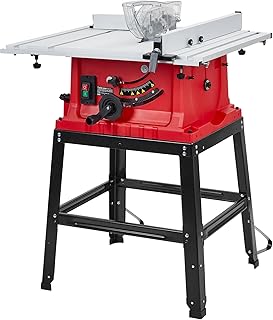

🛒 Best Price Today on Amazon
Prime members get fast, free shipping on everything above, plus member-only deals. New members get a 30-day free trial — cancel anytime.
How to Choose a Table Saw Brands (2026)
- Fence quality: This is the single biggest divider between a saw you trust and one you fight. A rack-and-pinion fence that locks square every time saves more frustration than any horsepower bump. Check for micro-adjustment and whether the fence stays put when you lean on it.
- Rip capacity vs. footprint: A 32-inch rip lets you break down a full sheet of ply with the fence to the right of the blade. If you’re building cabinets or casework, that matters. If you mostly cut 1x stock and trim, a compact 24-inch model saves floor space you don’t have.
- Stand mechanics: Rolling stands with pneumatic-assist or scissor action are worth the premium if you set up and tear down often. Folding legs are lighter and cheaper, but you’ll be lifting the whole saw into position. Test the deployment motion before committing.
- Dust management: Look for a shrouded blade with a dedicated port sized to your shop vac hose. Under-table collection alone leaves a mess; the good systems capture at the blade and below. Retrofitting decent dust control after the fact is rarely satisfying.
- Blade and arbor standards: Stick with brands using standard 5/8-inch arbors so you can drop in a quality thin-kerf or crosscut blade. Proprietary sizing locks you into whatever the manufacturer stocks, and the factory blade is almost always the first thing you’ll want to replace.
The Best Table Saw Brands (2026)s Reviewed
DEWALT DWE7491RS 10-Inch with Rolling Stand
The rack-and-pinion fence on this one glides and locks with a precision you normally pay twice as much for, and the 32-1/2-inch rip handles full sheet goods without drama. The rolling stand deploys in one motion, which makes it the go-to for anyone splitting time between a garage bay and a job site.
DEWALT DWE7485 8-1/4-Inch Compact Jobsite Saw
At around 54 pounds it’s genuinely one-hand portable, and the 24-1/2-inch rip covers most trim and cabinet-part work. The smaller blade means less depth of cut, so it’s a poor choice for thick hardwood, but for finish carpentry it’s hard to beat.
SKIL SPT99-11 Worm Drive with Stand
The worm-drive gearing delivers noticeably more torque under load, so it powers through wet lumber and dense hardwood where direct-drive saws bog down. The heavy-gauge rack-and-pinion fence and generous 30-1/2-inch rip make this a serious contender for shop use.
DEWALT DWE7491X with Scissor Stand
Mechanically the same excellent saw as the RS, but the scissor stand sits lower and stows flatter — better if you’re loading into a van or working from a tight storage corner. Same fence, same 4800 RPM motor, different transport philosophy.
SKIL TS6307-00 10-Inch with Folding Stand
SKIL’s value play, with a smart integrated foot-activated dust port and a folding stand that keeps the total weight manageable. The fence isn’t quite as refined as the DEWALT units, but for the money the cut quality is legitimately good.
Frequently Asked Questions
Do I need a 10-inch blade or is 8-1/4 enough?
A 10-inch blade gives roughly 3-1/8 inches of cut depth at 90 degrees, enough for 4x material in one pass. An 8-1/4-inch tops out near 2-1/2 inches, which handles 2x lumber fine but limits thick hardwood and tenon work.
Is a worm drive saw worth the extra weight?
If you regularly cut dense or damp stock, yes — the torque advantage is real and the motor runs cooler under sustained load. For occasional pine and plywood, a standard direct-drive motor is plenty.
Can I use a dado stack on a portable jobsite saw?
Most compact jobsite saws have short arbors that won’t accept a full dado stack. Check your manual before buying one; on many portables you’re limited to a single blade or a thin stacked set.
How much of a difference does an aftermarket blade make?
More than most people expect. Swapping the 24-tooth factory blade for a 40- or 60-tooth crosscut blade transforms edge quality on plywood and hardwood, often eliminating the need for cleanup passes.
Final Thoughts
If you want one saw to grow with, the DEWALT DWE7491RS remains the benchmark — that fence alone justifies the price, and the rolling stand makes it practical in a shared garage. Builders working with dense hardwood should look hard at the SKIL SPT99-11 for its worm-drive torque, while anyone hauling a saw daily will appreciate how little the DEWALT DWE7485 asks of their back and their truck bed.