The stock table that came with your drill press is almost certainly the weakest part of the machine. It’s a small cast-iron plate with a hole in the middle, no way to clamp a fence, and nothing to stop the workpiece from spinning when the bit breaks through. Anyone who has tried to drill a row of evenly spaced shelf-pin holes on one knows the feeling: you mark, you clamp, you eyeball, you drill, and the fifth hole still drifts a sixteenth off the line. Tear-out on the underside of the board is the other constant annoyance, because there’s simply nothing supporting the wood fibers where the bit exits.
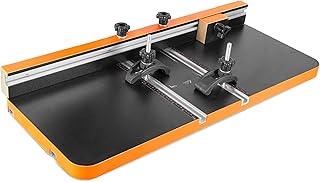
A dedicated drill press table fixes all of that at once. You get a broad, flat MDF or laminate surface, an aluminum fence with a flip-away stop for repeat cuts, T-tracks for hold-downs, and a replaceable insert that backs up the exit hole so your veneer stays intact. This guide covers the tables worth bolting on in 2026, plus a couple of benchtop presses and a workbench that pair well with them if you’re building the station from scratch. Everything below is judged on flatness, fence squareness, mounting flexibility, and whether the stop actually returns to the same spot twice.
Our top picks



As an Amazon Associate we earn from qualifying purchases at no extra cost to you.
🛒 Best Price Today on Amazon
Prime members get fast, free shipping on everything above, plus member-only deals. New members get a 30-day free trial — cancel anytime.
How to Choose a Drill Press Tables (2026)
- Surface size and clearance: A 24-inch-wide top supports long stock without a helper, but measure your column-to-wall distance first. Deep tables can foul on the column or hit your quill handles when you crank the table up.
- Fence and stop quality: Extruded aluminum stays straighter than folded steel. Look for a flip stop that pivots out of the way rather than one you have to unbolt and re-measure every time the layout changes.
- Replaceable insert: This is the single biggest upgrade for clean holes. A sacrificial plug you can rotate or swap for pennies beats drilling into your good tabletop and living with a crater.
- T-track layout: Tracks in both the fence and the deck let you run hold-down clamps, stop blocks, and shop-made jigs. Check the slot profile matches standard 3/8-inch T-bolts before you buy accessories.
- Mounting hardware: Most tables bolt through the existing cast-iron table slots. Slotted mounting holes are better than fixed ones, since drill press slot spacing varies wildly between brands and vintages.
The Best Drill Press Tables (2026)s Reviewed
O’SKOOL DAB022 Drill Press Table
The most complete package here: a 23-5/8″ x 15″ one-inch MDF deck, real T-tracks, an aluminum fence with a flip stop, and a replaceable insert, all sized for 12-inch and larger presses. The thick core resists sagging under clamp pressure better than the half-inch panels on cheaper tables, and the fence sits square out of the box with only minor shimming.
WEN DPA2513 24-by-12-Inch Drill Press Table
A wide, no-nonsense option that trades depth for reach, which is exactly right if you drill a lot of long rails and stiles. The adjustable fence and stop block handle repeatable work well, though the shallower 12-inch depth means wide panels will need outboard support.
JET JWDP-12 12-Inch Benchtop Drill Press
If the press itself is the bottleneck, this is the one to build your station around. The variable-speed drive changes RPM without swapping belts, runout is genuinely low for a benchtop machine, and the cast-iron table has clean slots that accept aftermarket tops without drilling.
WORKPRO 48″ Adjustable Workbench
A rubber wood top rated to 2,000 pounds with five height settings and built-in outlets, which solves the “my press vibrates the folding table across the floor” problem. Set it low so the chuck lands at comfortable working height once the press is bolted down.
VEVOR 12-Inch Benchtop Drill Press (1 HP, 530–3140 RPM)
The strongest value pick for mixed wood and metal work, with a wide variable-speed range and a 0–45° tilting table for angled holes. The laser and LED are conveniences rather than precision aids, so keep marking your centers the old-fashioned way.
What to Look For in a Drill Press Table
Size Versus Your Press’s Throat Distance
A drill press is rated by swing, the full diameter it can reach around the column. Half of that figure is the farthest a bit can sit from the column, so a 12-inch swing machine can drill no deeper than about 6 inches into a panel. A table far larger than that distance still helps, because the extra length supports long boards on either side of the bit, but depth beyond the throat is wasted. Compare the footprint listed for any table, such as the 24-by-12-inch size on the WEN DPA2513, against the column position of your own machine before ordering.
Surface Flatness and Fence Design
The table should lie flat when bolted down, because a bowed surface tilts the workpiece and angles every hole. Lay a straightedge across the surface after assembly and look for light under it. A good fence is tall enough to support the stock, long enough to reach past the table edge, and clamps without racking. Many shops add a sacrificial insert around the bit so the underside of the board is supported at the exit point.
Mounting Method
Most add-on tables bolt through the slots in the stock cast-iron table, which keeps the new surface from shifting during a cut. Check the slot spacing and bolt length against your machine, and look for slots that allow some adjustment so the fence can be squared to the bit.
Step-by-Step: Installing and Squaring a New Table
- Unplug the machine and raise the stock table to a comfortable height, then lock it.
- Clean the stock table so no chips or oil sit between the two surfaces.
- Position the new table so the bit’s centerline falls along the fence slot, then loosely start the mounting bolts.
- Insert a straight rod or drill blank in the chuck and lower it to the table surface.
- Hold a combination square against the rod and the table, then check both front-to-back and side-to-side.
- Tighten the bolts gradually, rechecking after each, and shim if the square shows a gap.
- Clamp the fence, measure from the chuck rod to the fence at both ends, and adjust until both readings match.
- Drill a scrap board and check that holes are square to the face before using real stock.
Matching Speed to Bit Size
Larger bits need slower spindle speeds because the cutting edge travels faster at the rim. The standard formula is RPM equal to surface speed in feet per minute times 3.82, divided by bit diameter in inches. Assume 100 feet per minute for a high-speed steel bit in mild steel, a figure commonly published in machining references, and the arithmetic gives these targets.
| Bit diameter | Approximate RPM |
|---|---|
| 1/4 inch | 1,530 |
| 3/8 inch | 1,020 |
| 1/2 inch | 760 |
| 3/4 inch | 510 |
| 1 inch | 380 |
A machine like the VEVOR 12-Inch Benchtop Drill Press, listed at 530 to 3,140 RPM, covers the first four rows but bottoms out above the last one. That gap matters if you plan to use large bits in metal. Wood tolerates higher surface speeds, though large Forstner bits still run best slowly.
Which One Should You Buy?
| If you… | Choose… |
|---|---|
| Want a large auxiliary table with a fence for long boards | WEN DPA2513 24-by-12-Inch Drill Press Table |
| Want a smaller add-on table for occasional work | O’SKOOL DAB022 Drill Press Table |
| Do not own a drill press yet and want a compact benchtop machine | JET JWDP-12 12-Inch Benchtop Drill Press |
| Need a wide speed range for both wood and metal bits | VEVOR 12-Inch Benchtop Drill Press |
| Need a bench to mount a machine and clamp work | WORKPRO 48″ Adjustable Workbench |
Note that the JET and VEVOR listings are complete benchtop drill presses and the WORKPRO is a workbench, so they solve a different problem than a table upgrade.
Common Mistakes
- Ordering by table size alone. Throat distance and bolt-hole spacing decide whether a table fits.
- Skipping the squaring step. A fence set by eye can drift even when the table is flat.
- Drilling without clamping. A bit that grabs can spin the workpiece and injure a hand.
- Using the same speed for every bit. Big bits at high speed burn the edge and overheat the material.
- Drilling straight onto the table. Without a backer board, the exit side tears out and the bit scars the surface.
Troubleshooting
- Holes wander off the line. Recheck fence alignment, then confirm the bit is sharp and the chuck is seated, since a dull bit pushes sideways.
- Tear-out on the underside. Clamp a sacrificial board beneath the workpiece and drill through both.
- The workpiece lifts or spins. Add a hold-down clamp and reduce feed pressure at breakthrough.
- Holes are not square to the face. Resquare the table with a combination square and tighten the mounting bolts evenly.
- The bit wobbles. Spin the chuck by hand and watch the tip, because a bent bit or loose chuck produces oversized holes.
Frequently Asked Questions
Will these tables fit any drill press?
Most use slotted mounting holes designed for 12-inch and larger presses. Measure the slot spacing on your cast-iron table before ordering, and expect to supply longer bolts on some older machines.
Do I still need the original cast-iron table?
Yes. The auxiliary table bolts on top of it and relies on it for support and height adjustment. Nothing gets removed.
How do I keep the fence square to the bit?
Chuck a straight rod, bring it down beside the fence face, and check with a machinist square. Adjust once, then mark the fence position with a pencil line so you can reset it after moving it.
Can I build one instead?
Absolutely, and plenty of makers do. The bought units win on the extruded aluminum fence and precision T-track, which are the parts that are fiddly to fabricate accurately at home.
Final Thoughts
For most shops, the O’SKOOL DAB022 is the table to get: thick deck, proper T-tracks, replaceable insert, and a fence that holds a setting. The WEN DPA2513 is the smarter buy if your work runs long and narrow. And if you’re starting the bench from nothing, pair either one with the JET JWDP-12 and you’ll have a drilling station that stays accurate for years.